
Last Updated on September 17, 2026
Google has just changed what a paid ad does.
At Google Marketing Live this month, it confirmed two new formats built on Gemini. Conversational Discovery ads write themselves to answer the exact question someone typed. And Business Agent for Leads turns your lead-gen ad into a live chat, trained on your website, that talks to the customer before they ever reach you.
Both are in testing and beta in the US first. They will reach the UK. When they do, a lot of businesses are going to spend money on a format they have not prepared for.
- Google’s new lead ad is a Gemini chat agent, trained on your own website.
- It answers customer questions about price, availability and service inside the ad.
- It is in beta in the US now, and will reach the UK.
- The ad is only as clear as the website it learns from.
What actually happened
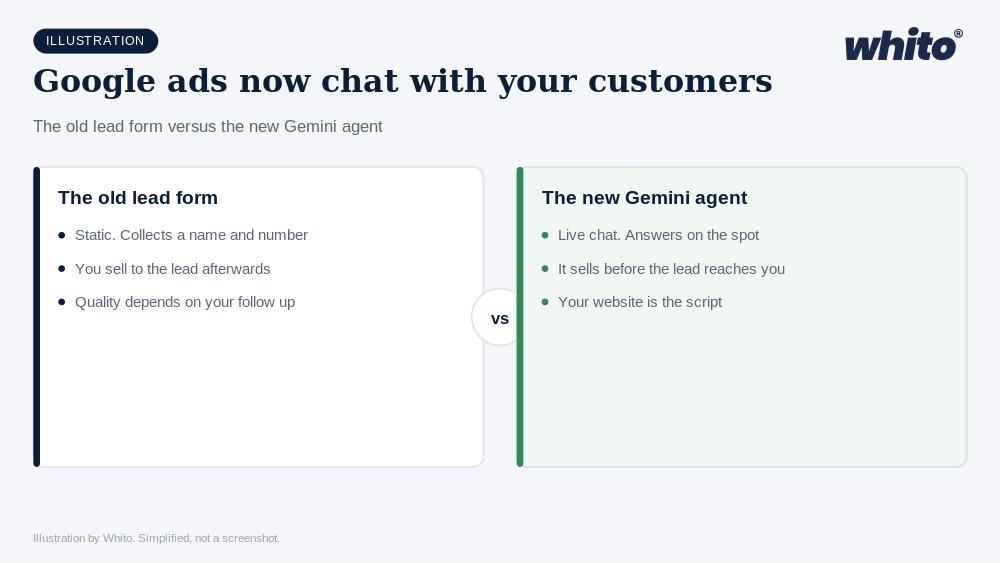
The old lead ad was a static form. Someone clicked, typed their name and number, and you chased them later.
The new version is a conversation. Google trains a Gemini agent on your website, then lets it answer questions inside the ad. The customer asks about price, availability, or how you work. The agent replies using whatever it learned from your pages.
The ad speaks for you, using your website as its script.
| The old lead form | The new Gemini agent |
|---|---|
| Static. Collects a name and number. | Live chat. Answers questions on the spot. |
| You sell to the lead afterwards. | The agent sells before the lead reaches you. |
| Quality depends on your follow-up. | Quality depends on your website. |
Why this matters for you
Most small business owners treat their website as a brochure. It sits there. It looks fine. Nobody reads it closely.
Now a machine reads it closely. It pulls your answers, your prices, your service descriptions, and it repeats them to a paying customer at the exact moment they are deciding.
If your site is vague, the agent sounds vague. If your pricing is hidden, the agent cannot answer the one question buyers care about. If your service pages contradict each other, the agent passes that confusion straight to the customer.
You cannot buy your way out of a weak website anymore. The ad budget just hands more people to a sales rep who only knows what your site told it.
This is the Whito point we keep making. Structure before scale. The new ad format is a Scale tactic sitting on top of a Build problem most businesses have not fixed. It is the same reason we keep banging on about whether your website is even ready for AI to read it.
The mistake to avoid
The mistake will be obvious in a few months. Owners will switch on the new format because it is new, watch the spend rise, and get worse leads than the old form gave them.
They will blame Google. The real cause will be the website the agent was trained on.
Do not chase the format. Fix the source first.
What to do about it
Start with the pages the agent will lean on hardest. These are not your blog posts. They are your money pages.
Your service pages. Each one should answer, in plain words, what you do, who it is for, and what it costs or how pricing works. If a stranger cannot understand it in ten seconds, neither can the agent.
Your pricing. You do not need a full price list. You need a clear position. A starting figure, a range, or how you quote. Silence here is the single biggest gap in UK business sites, and it is the question the agent gets asked most.
Your FAQs. Write down the questions you answer on the phone every week. Delivery, turnaround, areas you cover, what happens if it goes wrong. The agent uses these word for word. Give it good words. This is also exactly the work that helps AI tools recommend you in the first place.
Your contradictions. Read your own site as a customer would. Find the page that says one price and the page that says another. Find the service you stopped offering two years ago. Clean it up before a machine repeats it.
This is unglamorous work. It is also the work that decides whether the clever new ad helps you or quietly wastes your money.
The takeaway
Google’s new ads do not reward the biggest budget. They reward the clearest website. Fix the source the machine learns from, then turn the format on. Not the other way round.