Last Updated on September 8, 2026
A UK regulator has just handed businesses a new button. Press it and Google can no longer pull your website into its AI answers. It sounds like protection. For most businesses, it is a quiet way to disappear.
Here is what actually happened, why it matters, and what to do instead.
What happened
In early June the Competition and Markets Authority ruled that Google must let news publishers refuse to have their content used in AI Overviews and AI Mode, without being pushed down or out of normal search results.
For two years that was the catch. You could ask Google not to feed your pages into its AI summaries, but only if you also accepted worse visibility in search. So most sites said nothing and let Google take the content.
The CMA has now broken that bargain. The opt out is meant for news publishers first, but the principle is spreading, and the wider point applies to everyone. You are starting to get a real choice about whether AI uses your words.
Why it matters to you
Nearly 60% of searches now end with no click at all. Google answers the question on the page, and the person never reaches your site. Smaller sites have been hit hardest because they relied on informational traffic that AI now intercepts.
So the instinct is understandable. If AI is taking your content and keeping the visitor, pull your content out.
The problem is what opting out actually does. It does not put the old blue links back. It removes you from the answer box while your competitors stay in it. The buyer still asks the question. They just never see your name in the reply.
For a news publisher protecting paid journalism, that trade can make sense. For a plumber, a clinic, an accountant or a shop trying to be found, it is closer to taking your sign down because too many people walk past.
The mistake most businesses are about to make
The mistake is treating AI search as something to block rather than something to win.
Blocking is a foundations problem dressed up as a privacy choice. If your website is thin, unclear or out of date, AI exposing that is not the disease. It is the symptom. Opting out hides the symptom and keeps the weak foundation.
Structure before scale. Fix what the AI is reading before you decide whether it should read you at all.
What to do instead
Most businesses do not need the opt out. They need to become the source worth quoting. Three steps, in order.
Start: make your key facts plain. Put your prices, service areas, opening hours and a clear answer to your most common customer question in simple text on your site. AI quotes specifics. Vague pages get skipped.
Build: answer real questions properly. Take the ten questions customers actually ask before they buy and write a clear, honest answer to each. Short paragraphs. A real opinion. This is the content AI cites and sends qualified clicks to.
Scale: track mentions, not just rankings. Once the basics hold, start checking what AI tools say when asked about your service in your area. If you are missing, that is your gap to close. If you are named, protect it.
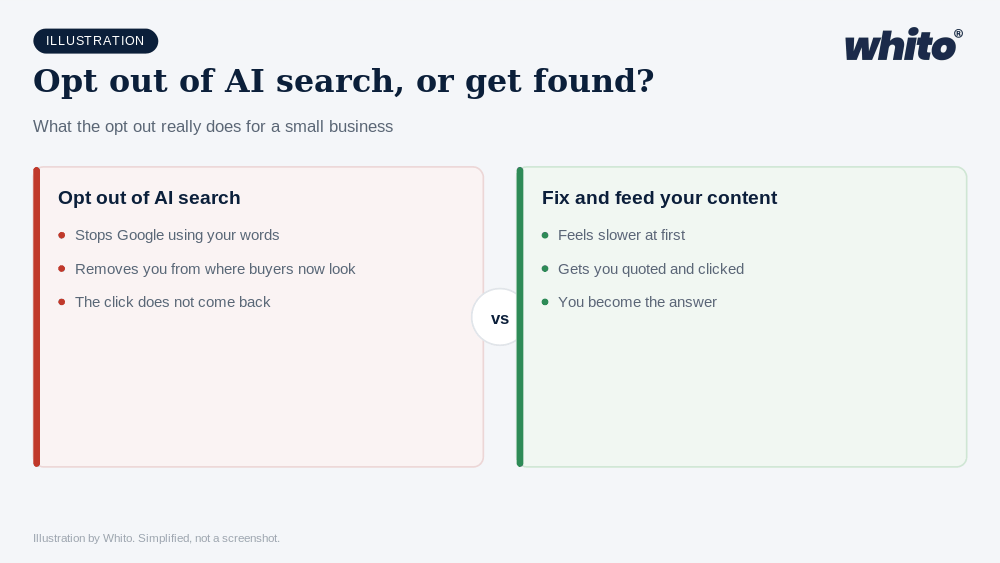
| Move | Looks like protection | Actually does |
|---|---|---|
| Opt out of AI search | Stops Google using your words | Removes you from where buyers now look |
| Fix and feed your content | Feels slower | Gets you quoted and clicked |
The takeaway
The opt out is a win for newsrooms with something to defend. For most businesses it is a way to vanish politely. Do not block the room where decisions are being made. Be the answer people find in it.