
Last Updated on September 27, 2026
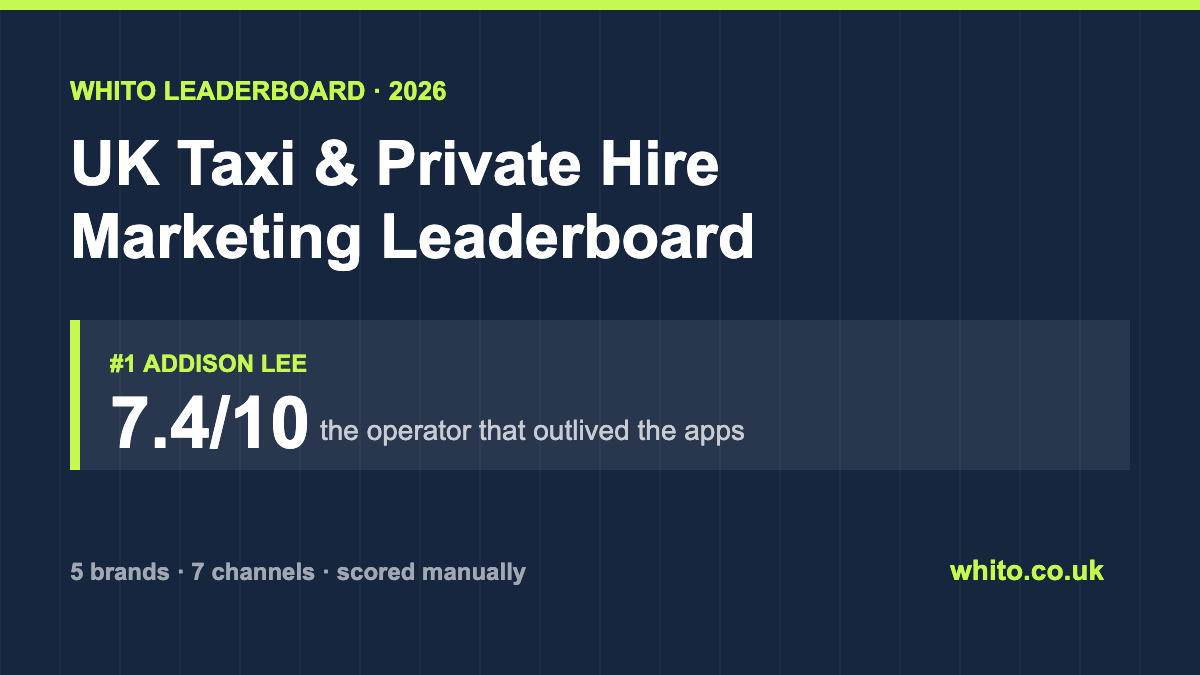
Addison Lee has the best marketing of the five big UK taxi and private hire brands compared, scoring 7.4 out of 10 on the Whito leaderboard.
Opinion and analysis. Every brand below was reviewed manually across seven marketing channels in September 2026, using publicly visible activity only. Scores are relative to the other brands in this comparison. Where a figure is not published, we say so.
Apps ate the phone number. The interesting question is what the survivors did next.
Uber’s arrival forced every UK operator to pick a survival strategy, and this leaderboard scores the results. Addison Lee went premium and corporate. Veezu bought dozens of trusted local firms and put one brand over the top. Gett allied itself with the black cab trade. FREENOW and Bolt fought the app war directly.
The consolidation is still running. Addison Lee sold to Singapore’s ComfortDelGro in late 2024, Lyft bought FREENOW in 2025 and agreed to buy Gett’s UK business in April 2026. Three of the five brands here changed hands in around twenty months, and one American company now sits behind two of them.
The leaderboard
| Rank | Brand | Social | Website | SEO | Paid | Reviews | Brand | Average | |
|---|---|---|---|---|---|---|---|---|---|
| 1 | Addison Lee | 6 | 9 | 7 | 6 | 7 | 8 | 9 | 7.4 |
| 2 | FREENOW | 6 | 6 | 5 | 5 | 9 | 7 | 8 | 6.6 |
| 3 | Bolt | 6 | 6 | 5 | 6 | 7 | 6 | 8 | 6.3 |
| 4 | Veezu | 6 | 7 | 4 | 9 | 5 | 3 | 7 | 5.9 |
| 5 | Gett | 4 | 6 | 4 | 4 | 4 | 7 | 8 | 5.3 |
Company verdicts
Addison Lee, 7.4
Fifty years old and the most complete operation here. It is the only brand of the five that gives you a price on the website without an account, which sounds small and is not: everyone else hides fares inside an app. Six service lines, fixed airport pricing with flight tracking, and a corporate offer with account managers explain how it survived Uber, by selling reliability to businesses rather than cheapness to consumers. Its review operation is the most professional in the set, a 4.6 Trustpilot with 99 per cent of negative reviews answered, typically within a day. ComfortDelGro paid £269 million for it in 2024, which is what a defended position is worth.
FREENOW, 6.6
The best brand advertiser in UK taxis. Its October 2025 London out of home campaign put black cab humour on Leicester Square and the Oxford Street Cube, and its taxi first positioning gives it a story Uber cannot copy. The lineage runs back to Hailo, London’s original taxi app, via mytaxi and the BMW and Daimler joint venture, and since July 2025 it has been Lyft’s beachhead in Europe. The gaps are structural: no web booking, no visible email capture and little local SEO, because the app is the product. A 4.1 Trustpilot from 16,000 reviews trails its excellent 4.8 App Store rating.
Bolt, 6.3
The price challenger. Bolt launched in London in 2017, was shut down within days over a licensing workaround, and returned in 2019 with lower commissions and fares set 5 to 10 per cent under rivals. That discipline still shows: promotional pricing, a super app spanning rides, scooters and delivery, and landing pages for 22 UK cities. The city pages are thinner than Veezu’s and its Trustpilot is polarised, a 3.8 where nearly half the reviews are five star and 40 per cent are one star, a signature of high volume operations where things either work or badly do not. A November 2024 employment tribunal ruling that its drivers are workers may prove the most expensive marketing event it never planned.
Veezu, 5.9
The consolidator, and the most instructive score on this board. Veezu buys established local firms, Panther in Cambridge, Drive in Hull, Triple 20 in the West Midlands as recently as September 2026, and rebrands them under one name. Its city landing pages win the searches that matter, taking first positions for taxi queries in Cardiff and Leeds against the global apps. Then the funnel leaks: a 2.4 Trustpilot rating, the weakest we have scored on any Whito leaderboard, sitting next to a 4.8 Google Play rating from the same customers. Winning the click and losing the review is a strategy with a countdown attached.
Gett, 5.3
The B2B specialist. Gett reached London in 2011 before Uber did, and survived by becoming the black cab trade’s app, with around three quarters of TfL registered cabbies on its network by its own account, and by selling ground transport management to corporates. That is a sound business, first profitable full year in 2023, and a deliberately quiet marketing operation: no regional pages, no visible campaigns, a small but healthy 4.3 Trustpilot. Lyft’s April 2026 agreement to buy the UK business means the quietest brand here and the loudest challenger will soon share an owner.
What the channels show
Local search is still won by local pages
The global apps spend on brand and app installs, yet a regional consolidator takes the Cardiff and Leeds taxi searches with old fashioned city landing pages, local numbers and coverage copy. For a phone and web booking business that is the whole game, and Veezu’s 9 is the only SEO score above 6 on this board.
The review gap is the sector’s tell
Veezu, 2.4 on Trustpilot and 4.8 on Google Play. Bolt, 3.8 on Trustpilot and 4.7 on the App Store. When app store ratings and Trustpilot diverge that hard, the app is fine and the service promise is not. Addison Lee, whose two scores agree, runs the only reputation operation built for both audiences.
Price transparency stops at the app door
Four of the five hide fares until you have downloaded the app and signed in. Addison Lee’s open web quote is the exception, and it is no coincidence it also owns the corporate market, where a bookable price without an account is the product.
Consolidation buys distribution, not affection
Three ownership changes in twenty months bought market access for the acquirers. None of them bought a better Trustpilot score. The marketing assets that transfer cleanly are the app and the search positions. The reputation has to be rebuilt locally either way.
Key lessons for any taxi or private hire business
Own your town’s search results
Veezu proves the playbook works: a page per town, local landmarks, coverage areas, real phone numbers and answers to the questions people ask. A single operator can do for one town what Veezu does for sixty.
Publish a price, or at least a range
Airport runs, station runs and fixed local fares are searchable and quotable. The operator who shows a number wins the customer who is comparing three tabs at midnight.
Treat Trustpilot as the second app store
Corporate bookers and older customers check Trustpilot, not Google Play. Reply to everything, especially the one star reviews, and do it within a day, as Addison Lee does.
Sell the account, not just the ride
Addison Lee and Gett both survived on business accounts. A local firm’s version is the school run contract, the care home contract, the pub’s closing time arrangement. Recurring beats occasional in this trade.
Answer the 2am searcher
Availability content wins distress bookings: night coverage, airport hours, card payment, how many minutes away. The brands that state these plainly convert the searches the apps have not captured.
Steal this playbook
Five moves from this leaderboard, ranked by return on effort.
- Build one proper landing page per town you serve, with a local number, coverage area and fixed price examples. This is Veezu’s engine, and it is copyable in a weekend.
- Publish fixed prices for your ten most common runs. Nobody else in your area is doing it, because the apps will not.
- Set up an automated review request by text after each completed booking, and answer every review within a day.
- Pitch five local businesses a monthly account, with priority booking and one invoice. Corporate work is what carried the two premium brands here through the app war.
- State your reliability signals everywhere: licensed operator number, years running, drivers checked, card payments taken. Trust is the conversion layer in this industry.
Common questions
Which UK taxi firm has the best marketing in 2026?
Addison Lee, with 7.4 out of 10 on the Whito leaderboard. Its web quoting, corporate offer and review operation put it ahead of FREENOW on 6.6 and Bolt on 6.3.
Why is Uber not on this leaderboard?
This comparison scores the operators competing around Uber, because that is where the lessons for UK firms are. Uber’s arrival is the backdrop every brand here had to answer.
Who owns the UK taxi apps now?
Ownership consolidated rapidly. ComfortDelGro of Singapore bought Addison Lee in 2024, and Lyft bought FREENOW in 2025 then agreed to buy Gett’s UK business in April 2026. Bolt remains Estonian owned and Veezu is a private UK group.
Why does Veezu rank fourth if it wins local search?
Because search visibility and service reputation have separated. Veezu takes first positions for taxi searches in its cities, but its 2.4 Trustpilot rating is the weakest reviews score on any Whito leaderboard, and reviews are where taxi customers decide.
What can a small taxi firm copy from these brands?
Town landing pages with real local detail, published fixed prices for common runs, automated review requests, and business accounts. None of these require an app.
If your business is named here and you think we have a fact wrong, email hello@whito.co.uk and we will check it and correct it. If you want to respond, send us a statement and we will publish it alongside. Full detail: Corrections, right of reply and removals.