
Last Updated on October 20, 2026
Most UK businesses collect email addresses but never send anything useful. Email nurture sequences UK businesses need turn cold subscribers into warm prospects ready to buy. Here is the framework that works.
An email nurture sequence does this automatically. It delivers the right message at the right time, moving prospects from curiosity to confidence without you manually following up with every single person.
For UK businesses with a considered purchase cycle, where clients research, compare, and deliberate before committing, nurture sequences are one of the highest-ROI marketing investments you can make.
Note: Under UK GDPR and PECR, you need consent before sending marketing emails. Make sure your opt-in process is clear and compliant. A double opt-in is safest. Never add people to an email sequence without their explicit permission.
What are email nurture sequences UK businesses need
 email marketing platform homepage showing AI-powered marketing features” class=”wp-image-5232″/>
A nurture sequence is a pre-written series of emails that sends automatically when someone takes a specific action, like downloading a guide, requesting a quote, or signing up for a newsletter. It is not a newsletter. Newsletters are broadcast emails sent to your whole list. Nurture sequences are triggered, personalised, and time-based.
Well-structured email nurture sequences UK businesses use typically convert 15 to 20 percent of subscribers into enquiries.
The 5-email nurture framework
This framework works for most UK service businesses and B2B companies. Adapt the timing and content to your sales cycle.
| Timing | Purpose | Content | |
|---|---|---|---|
| 1. Welcome | Immediately | Deliver value, set expectations | Deliver what they signed up for. Introduce yourself. Tell them what to expect next. |
| 2. Educate | Day 2–3 | Demonstrate expertise | Share your best insight or tip relevant to their problem. Teach, do not sell. |
| 3. Prove | Day 5–7 | Build trust with evidence | Share a case study, testimonial, or specific result. Show you have solved this problem before. |
| 4. Differentiate | Day 9–12 | Position against alternatives | Explain what makes your approach different. Address common objections or misconceptions. |
| 5. Convert | Day 14–18 | Clear call to action | Make a specific offer. Book a call, request a quote, or start a trial. One clear next step. |
Note: The timing above suits a sales cycle of two to four weeks. If your typical buying cycle is longer, space the emails further apart. For high-value B2B services with three to six month cycles, one email per week or per fortnight is more appropriate. Matching email frequency to buying cycle length prevents subscriber fatigue.
Writing emails that get opened
Subject lines determine open rates. Keep them short, specific, and curiosity-driven. “How [Company Type] reduced [problem] by 40%” works better than “Newsletter Issue 3.” Personalise where possible. Test different subject lines across sequences and use the winners.
Email body copy should be concise. One idea per email. Write like a human, not a brand. Short paragraphs. No jargon. Every email should deliver value even if the reader never buys from you. Generosity builds trust faster than sales pressure.
Tools for building nurture sequences
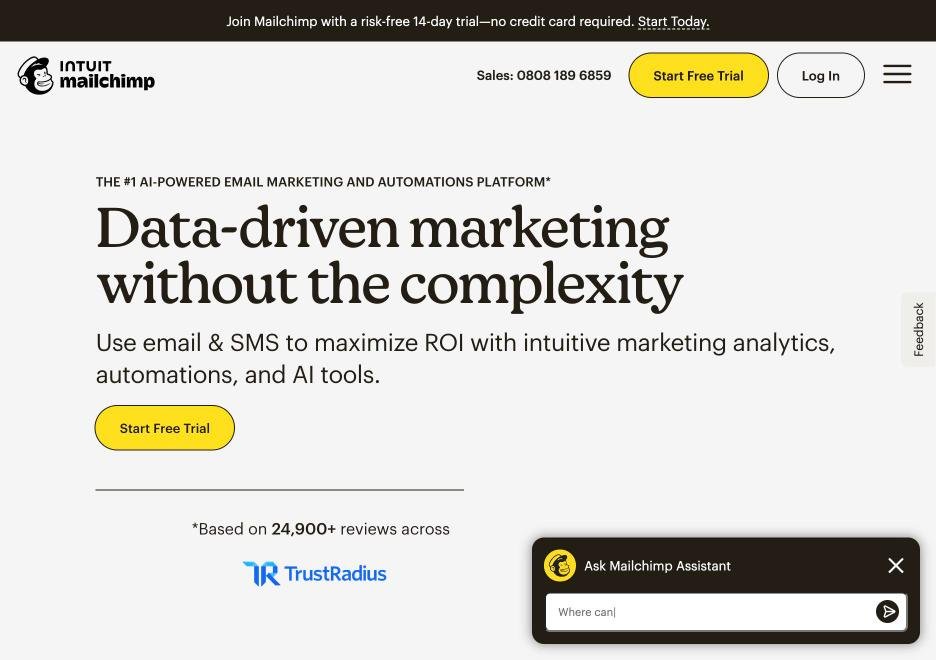
ActiveCampaign is the strongest option for complex nurture workflows with branching logic and lead scoring. Mailchimp handles basic sequences well and is easier to set up. HubSpot offers nurture sequences integrated with a full CRM but at a higher price point. MailerLite provides solid automation features at a budget-friendly price.
Measuring nurture sequence performance
Track open rates, click rates, and unsubscribe rates for each email in the sequence. More importantly, track how many people who enter the sequence eventually become customers. The ultimate metric is revenue generated per subscriber, not email engagement statistics.
Review and refine quarterly. If an email has a high unsubscribe rate, it is either irrelevant or mistimed. If the conversion email underperforms, the preceding emails are not building enough trust. Diagnose problems by position in the sequence, not just overall averages.
The bottom line
Want to know if AI recommends your business?
The Whito Visibility Check tests whether ChatGPT, Gemini, Copilot and Google AI recommend you, and gives you prioritised fixes. Free. No card, no obligation.
Take the free Visibility CheckSee how real UK businesses do this well
Our Stolen With Pride series breaks down smart marketing moves from real UK businesses. No theory, just practical ideas you can use. See how Surreal Cereal turned LinkedIn into a free marketing channel, how Bloom & Wild’s email opt-out built more loyalty than any campaign, and more.