
Last Updated on November 21, 2026
Read a short summary
General summary
Most trades buy public liability insurance by getting three quotes and picking the cheapest. This guide says that is the wrong order. A quote is only comparable if the thing behind it is the same. Two £300 policies are not the same if one excludes heat work, or if one is sold by an FCA-authorised broker and the other by a website you cannot trace to an authorised firm. Run the register-before-quote check first.
Bullet points
- Price is the last thing to check, not the first.
- A quote is only comparable if the policy behind it is the same.
- Check what the policy excludes, such as heat work.
- Check that whoever sells it can be traced to an FCA-authorised firm.
- Whito calls this the register-before-quote check.
Basic explainer
Public liability insurance covers a business if a member of the public is hurt or their property is damaged because of its work. The Financial Conduct Authority (FCA) is the regulator. Firms that sell insurance must be authorised by it. This guide tells UK tradespeople what to check before comparing prices.
These summaries were written with AI from this page only. The full page below is the record.
Before you read: Whito Ltd is not authorised by the Financial Conduct Authority and holds no firm reference number. We do not arrange, advise on, recommend or sell insurance, and we take no commission from any insurer or broker. This page is general information, not financial, insurance or legal advice.
Most trades buy public liability insurance the same way: get three quotes, pick the cheapest, forget about it until renewal.
That is the wrong order. The price is the last thing worth checking, not the first.
The mistake
A quote is only comparable if the thing behind it is the same. Two £300 policies are not the same policy if one excludes heat work and the other does not, or if one is sold by an FCA-authorised broker and the other by a website you cannot trace to any authorised firm.
Shopping on price first means comparing numbers attached to things you have not identified. It is easy to do exactly that, then find out what you bought on the day of a claim.
The principle: run the register-before-quote check
Before you look at a single premium, confirm two things: who is selling, and what the cover has to do for your work. We call this the register-before-quote check. It takes about ten minutes and it is all free public information.
Step 1. Put the seller on the FCA register
Anyone selling you insurance in the UK should be authorised by the Financial Conduct Authority, or be an appointed representative of a firm that is. The register is public and free to search: register.fca.org.uk (the FCA also calls it the Firm Checker).
Ask the firm for its firm reference number (FRN). A genuine broker should give it without fuss; it is often shown in the website footer. Type it into the register and check three things:
- The firm is currently authorised. Not “no longer authorised”, and not just an entry existing. If it is an appointed representative, the register says so and names the firm responsible for it; check that firm is authorised too.
- The permissions include insurance distribution (shown on the register as permission to arrange or advise on insurance contracts).
- The name you are dealing with appears, either as the firm’s name or in its listed trading names.
If the website says “FCA regulated” but shows no number, that phrase is doing no work. Ask for the number. If they will not give one, stop.
One trap the register cannot close on its own: clone firms. Scammers copy a real firm’s name, address and FRN. The FCA’s advice is to check that the phone number, email and website listed on the register match the ones you have been given, and to contact the firm using the register’s details. If the details do not match or are missing, the FCA’s helpline is 0800 111 6768. Details from the FCA’s clone firms page, checked 19 October 2026. Our guide to checking a broker on the FCA register walks through the lookup screen by screen.
Step 2. Check the trading name matches
Brokers often trade under names that differ from the registered firm. That is normal and legal, but the trading name should appear on the firm’s register entry. A brand name that traces to nothing on the register is one of the clearest signs you are not dealing with who you think you are.
Step 3. Match the cover basis to your actual work
Public liability policies are not generic. Before any quote means anything, you need the answers to:
- Does it cover the work you actually do? Heat work (soldering, welding, grinding), work at height, work below ground and work in certain premises are commonly excluded or restricted. If you are a plumber who solders, a policy that excludes heat work is not a cheap version of the right policy. It leaves that part of your job uncovered.
- What indemnity level do your contracts require? Councils, housing associations and main contractors often specify a minimum in the contract, commonly £1m, £2m, £5m or £10m. Check your contracts before you pick a level. Do not guess.
- How does it treat subcontractors? Labour-only and bona fide subcontractors are handled differently, and the difference decides whether a claim involving one is covered.
- What conditions can void a claim? Tool security, unattended vehicles, hot-work permits. Conditions are not small print. They are the terms on which the insurer can refuse to pay.
Step 4. Know which insurance is actually required by law
Public liability insurance is not a legal requirement for most trades. Clients require it by contract, and you would be reckless to work without it, but the law does not make you hold it.
Employers’ liability insurance is different. If you employ anyone, you are normally legally required to hold it with cover of at least £5 million from an authorised insurer, and to display the certificate where staff can easily read it. You can be fined up to £2,500 for every day you are without suitable cover, and up to £1,000 for not displaying the certificate or not showing it to an inspector when asked.
Two points catch trades out. First, whether someone counts as your employee depends on the real working relationship and how much control you have over their work, not on their tax status, so a subcontractor you call self-employed can still count. Second, the exemptions are narrow. The family exemption only applies where everyone you employ is closely related to you, and it does not apply if the business is a limited company. There is also an exemption for a company whose only employee is its owner holding 50% or more of the shares. If you think you are exempt, check the detail in HSE’s leaflet before relying on it.
Sources: gov.uk on employers’ liability insurance and HSE leaflet HSE40, both checked 19 October 2026. Rules can change, so check the current versions.
If someone sells you “trades insurance” and cannot explain where public liability ends and employers’ liability begins, that tells you something about the seller.
Questions worth asking a broker
A good broker will answer all of these without flinching:
- Are you a broker across multiple insurers, or an agent of one insurer?
- How many insurers can you place this cover with?
- How are you paid for this policy: commission, a fee, or both? (Our broker fees guide explains what they must disclose.)
- Does this policy cover heat work, work at height, or my subcontractor arrangement? Name your real work.
- What conditions in this policy most often catch tradespeople out at claim time?
- If I need to claim, who do I ring: you or the insurer?
None of these are rude. A broker who treats them as rude is answering them anyway. If you are not sure whether you are even talking to a broker, read broker, IFA or comparison site first.
What this guide does not do
This guide gives no quotes and no prices. It does not recommend any insurer, broker or policy, and it ranks none. Whito takes no commission on insurance and has no affiliate relationship with any insurance firm. Nobody pays to appear in anything we publish.
It is also not advice about any specific policy. It is the checking process that should happen before anyone advises you about one. Only the policy wording, and an FCA-authorised broker or the insurer, can tell you whether a policy covers your work.
The takeaway
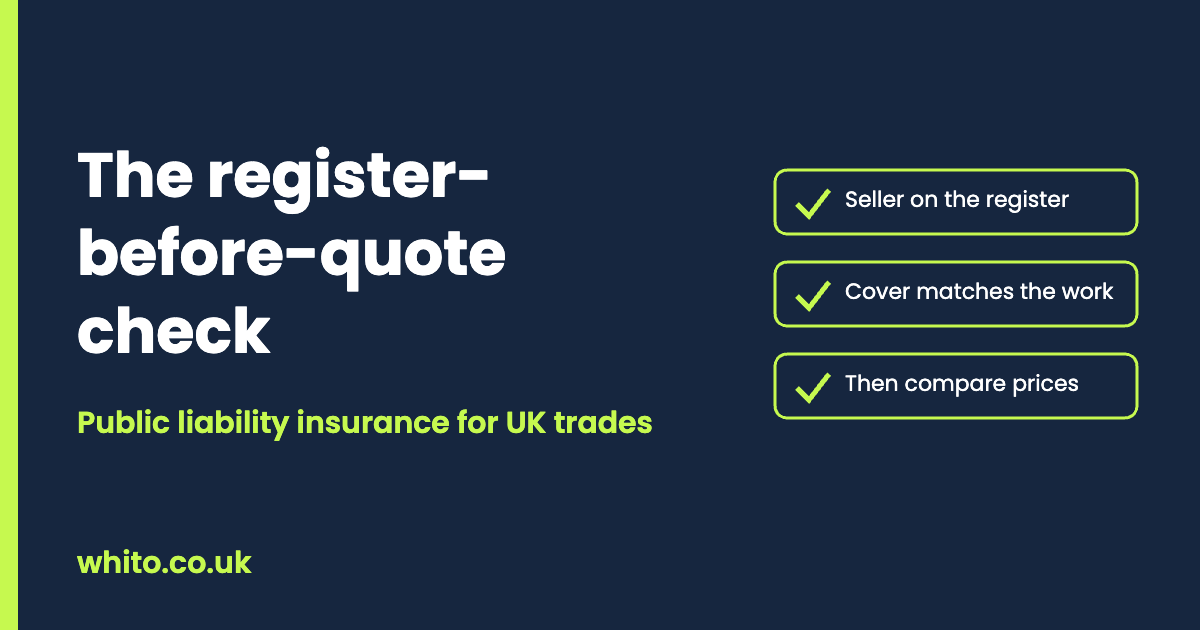
The cheapest quote is only cheap if the firm is real and the policy covers your work. Run the register-before-quote check first: seller on the FCA register, trading name matching, cover matched to the work, legal requirements separated from contractual ones. Then, and only then, compare prices.
More on how brokers work, what they charge and how to check them: the insurance brokers hub.
Method, limits and legal position
This page is general information for UK businesses. It is not financial, insurance or legal advice, and it does not take account of your business, your work or your contracts. Before you buy cover, read the policy wording and ask an FCA-authorised broker or the insurer to confirm it fits what you do.
Whito Ltd is not authorised by the FCA, holds no firm reference number and cannot approve financial promotions under section 21 of the Financial Services and Markets Act 2000. Nothing on this page is an invitation or inducement to buy any insurance product. We do not link to any insurer, broker or policy, and nobody pays to appear on Whito.
Where this page describes what the FCA register shows, that is a dated record of the register, not a verdict on any firm. A firm being on the register does not prove that the person contacting you works for it: clone firms copy real firms’ details. Contact a firm using the details listed on the register, and if they do not match, call the FCA on 0800 111 6768.
Where this page quotes a legal requirement, it comes from gov.uk or HSE and was checked on the date given. Rules change, so check the current position before relying on it.
Corrections and right of reply
If you think anything in this guide is wrong or out of date, email contact@whito.co.uk. We check it against the source, correct it within five working days if we are wrong, and note the correction on this page. Full route: corrections, right of reply and removals.