Last Updated on October 11, 2026
Most small business owners think of their website as a brochure. Something you tidy when you remember, carrying an offer banner nobody has looked at since spring.
From tomorrow, for a slice of Google Ads accounts, that brochure becomes an ads feed.
What actually changes on 12 October
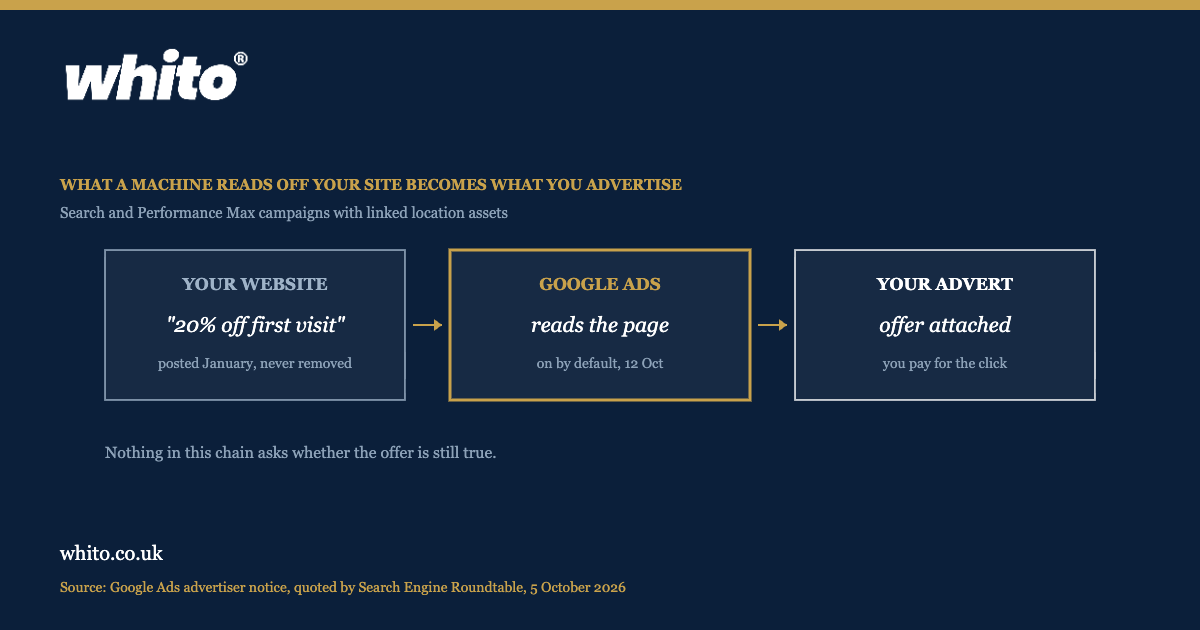
Google has emailed some advertisers to say that “Starting October 12, 2026, Google Ads will automatically identify and extract high-quality promotions” from their websites and attach them to campaigns as promotion assets. That wording is Google’s own, quoted by Search Engine Roundtable, which logged the notice on 5 October.
Three things in that sentence matter.
It is automatic. Google says the promotions are added without manual setup on your side.
It is on by default. You are opted in unless you go and switch it off, at account level, in your automated assets settings.
It is narrower than the headlines suggest. Google’s email says the functionality “currently only applies to Search and Performance Max campaigns with linked location assets” and “that don’t already have promotion assets attached.”
The part most of the coverage skipped
Read that eligibility line again. Linked location assets.
Location assets are how you attach your address and opening hours to your ads. The businesses that have them are shops, clinics, garages, salons, practices and yards. Businesses with a real front door.
So this is not an ecommerce story. It is a local business story. If you run Search ads with your address attached, you are in the group Google named.
The mistake most businesses are about to make
They will assume Google only picks up offers that are real and current.
Google says it extracts “high-quality promotions”. It has not published what high quality means, how often an extracted offer is re-checked, or what happens to one that has quietly lapsed. Those gaps should not be filled in with optimism.
Meanwhile, most small business websites carry at least one offer that is no longer true. A “20% off your first visit” banner from a January push. A free consultation line on a service page that the practice dropped months ago. A delivery promise that changed when the courier contract did.
None of that mattered much while the only readers were humans who skim. It matters a great deal when a machine reads the page and turns what it finds into an advert you are paying for.
| What owners assume | What Google has actually said |
|---|---|
| “I will be asked first.” | It is on by default. Switching it off is your move to make. |
| “It only affects online shops.” | It applies to campaigns with linked location assets. That is local businesses. |
| “Google will know if an offer has expired.” | Google’s notice does not say how lapsed offers are handled. |
| “I can control it campaign by campaign.” | The notice names an account level setting. No campaign level control is mentioned. |
Why this is a foundations problem, not an ads problem
Whito’s position is structure before scale, and this is a clean example of why.
The instinct will be to dive into Google Ads and start changing settings. That is the wrong first move. The setting is downstream. What decides the advert is what your website says.
If a machine reads your site and comes away with an answer you would not have given a customer on the phone, you have a content problem that no ads dashboard will fix. We found the same pattern in our study of AI browser readiness across UK trade websites, where one in nine sites shut automated readers out entirely. Being unreadable and being readable but wrong are two versions of the same failure. Nobody checked what the machines see.
The twenty minute check, today
1. Search your own site for the words off, free, discount, save, offer and introductory.
2. For each one you find, answer out loud: would I honour this tomorrow, at that price, for that customer?
3. Delete or rewrite every one where the answer is no, or where the real answer is “it depends”.
4. Then, and only then, open Google Ads and decide what the setting should be.
What to do about the setting itself
Decide deliberately rather than by default.
Leave it on if your offers are genuinely current, your site is maintained, and you want Google surfacing a discount in your ad text.
Switch it off if your site has not been reviewed this year, if your prices move, or if your offers carry conditions a crawler cannot see. Phrases like “on selected treatments” or “for new customers only” are exactly the nuance that gets flattened.
The control sits at account level, under automated assets, as Automated Promotions. Google’s notice names no campaign level equivalent, so treat it as on or off across the whole account.
And if this change is the thing that made you wonder what your ads are actually doing, that is the more useful signal. A platform changing a default is a prompt, not the problem. Most accounts we look at have never had a clean read on what getting found online actually costs across search, ads, social and content, which is a larger and more expensive gap than one checkbox. If you are early in paid search, how long PPC realistically takes to work is a better place to spend an hour than any settings page.
The takeaway
Your website stopped being a brochure some time ago. It is a price file, and machines read it, quote it and sell on it.
So the question for Monday morning is not whether you trust Google’s automation. It is simpler, and less comfortable.
If a machine lifted every offer off your website today and put it in an advert with your name on it, would you stand behind all of them?