Last Updated on October 9, 2026
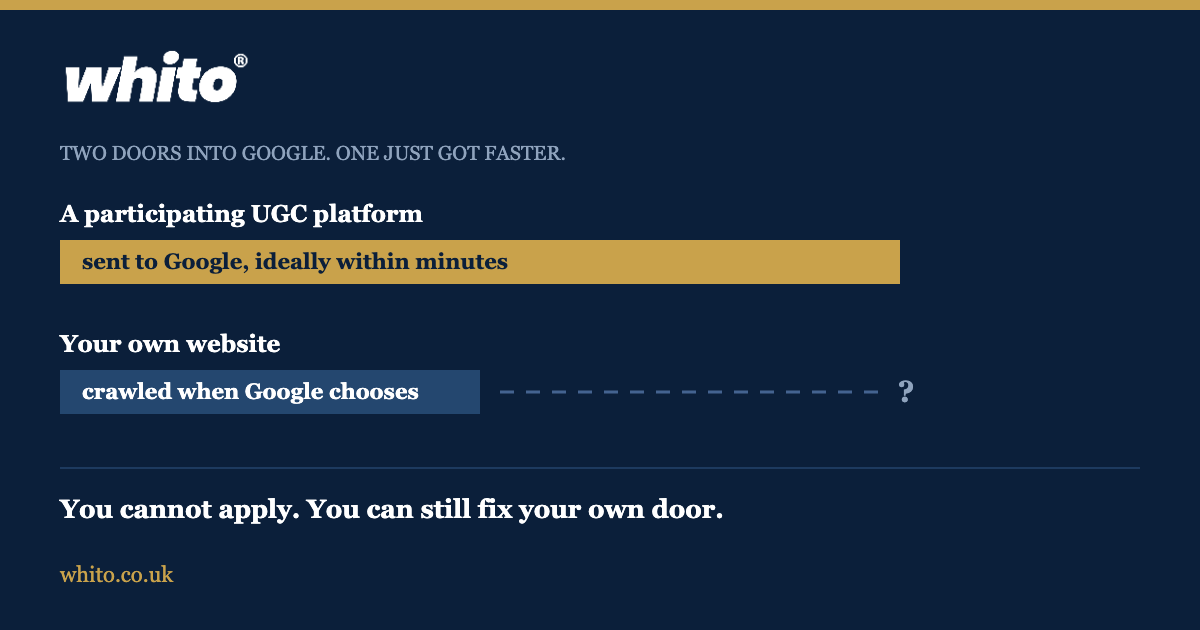
Google quietly published documentation this week for something called the UGC Fresh Data Program. The coverage framed it as a story for forum operators. It is not. It is a story about who gets to be current in Google, and on whose clock.
What Google actually announced
The programme gives approved platforms a direct pipe into Search. Instead of waiting for Googlebot to come round, a participating platform sends new posts and their engagement counts straight to Google. Google’s documentation describes it as a specialised pipeline built for trending user-generated content, and says it sits apart from both normal crawling and the Indexing API.
Google wants that content fast. The guidance says content should be sent as fresh as possible, ideally within minutes, and that platforms must update engagement counters within 72 hours of a post being created.
Google is also clear about the limits. The documentation states the programme “doesn’t guarantee that content will appear in Search”. Platforms apply through a form, and Google says it will respond within 6 to 8 weeks. The trade press dated the documentation to 8 October 2026.
The mistake most businesses will make
The instinct, on hearing that Google has built a faster route into Search, is to ask how to get on it. Then you read the eligibility list and realise it is a list of reasons you are not invited.
A qualifying site must primarily host user-generated content, social posts or forum discussions, on dedicated pages with stable URLs rather than profile or feed pages. It needs a high volume of that content and a significant user base. Every post must be attributable to a creator with a public profile. The platform has to implement OAuth 2.0 authentication and send strictly validated JSON-LD, using schema.org markup such as SocialMediaPosting or DiscussionForumPosting.
That describes Reddit, Mumsnet, a trade forum, a reviews platform. It does not describe a plumbing firm in Wakefield or a six-partner accountancy practice.
So the wrong response is to start publishing three posts a week in the hope of looking fresher. Freshness is not what you are competing on here. Access is.
| Your own website | A participating platform | |
|---|---|---|
| How content reaches Google | Crawled when Google chooses | Sent by the platform, ideally within minutes |
| Who writes it | You | Your customers, and sometimes your competitors |
| Engagement signals | None sent to Google | Counters updated within 72 hours of a post |
| Can you apply? | No | Only high-volume UGC platforms, and acceptance is not guaranteed |
| What you control | Everything on the page | Almost nothing |
You have two doors into Search, and they now run on different clocks
Everything Google knows about your business arrives through one of two doors. The first is your own website, crawled when Google decides to crawl it. The second is everything other people publish about you elsewhere: reviews, forum threads, social posts, directory entries. You control the first completely and the second barely at all.
Until now both doors ran on roughly the same clock, because both depended on crawling. This programme separates them. Content about your business, written by somebody else, on a platform you do not own, can reach Google in minutes. Your own price page waits its turn.
That is uncomfortable, and it is the direction of travel. Our citation map of which sources AI engines lean on, sector by sector found the same pattern inside AI answers: the sources doing the talking about a trade are usually owned by nobody in it.
What to do about it
Structure before speed, in that order. Three steps, and none of them involve applying for anything.
1. Find out where it already happens
Search your business name, then your trade plus your town, and note which platforms come back above your own site. Those are the pages Google may now be reading within minutes of someone typing on them. If a forum thread or a review page outranks you, that is your real shop window, like it or not.
It takes twenty minutes and tells you more than a month of keyword research. The wider picture is in our UK AI search and trust statistics for 2026.
2. Fix your own door before you envy anyone else’s speed
There is no sense resenting a fast lane while your own entrance is bolted shut. Our study of AI browser readiness across UK trade websites found 1 in 9 shutting out automated readers altogether. If that is you, the speed of Google’s pipeline is irrelevant, because nothing is getting through at any speed.
Check three things: pages reachable without JavaScript, prices and service areas in text rather than images, and nothing in robots.txt blocking more than you meant.
3. Give the second door something true to say
You cannot join the programme, but you benefit from it every time a real customer writes something accurate about you on a platform that did. That is not a growth hack. It is asking properly, at the right moment, and being worth writing about.
A twenty-minute audit
Open an incognito window. Search your business name, then your trade plus your town. Write down the first five results that are not yours.
That list is where your reputation is actually being updated. If none of it is current, you have a structure problem, not a marketing one.
The takeaway
Google did not announce something you can buy or apply for. It announced a change in whose content it trusts to be current, and the answer is platforms rather than businesses. The honest check is whether the freshest thing Google knows about your business was written by you or by somebody else. We have compared eight AI visibility trackers priced in pounds if you want it monitored, but the question is answerable for free this afternoon.
A two-year-old review on somebody else’s site is not a Google problem. It is a structure problem, and it is yours.