
Data last verified: 8 October 2026. Figures re-checked against their primary sources under the Whito rolling re-verification programme.
Finding
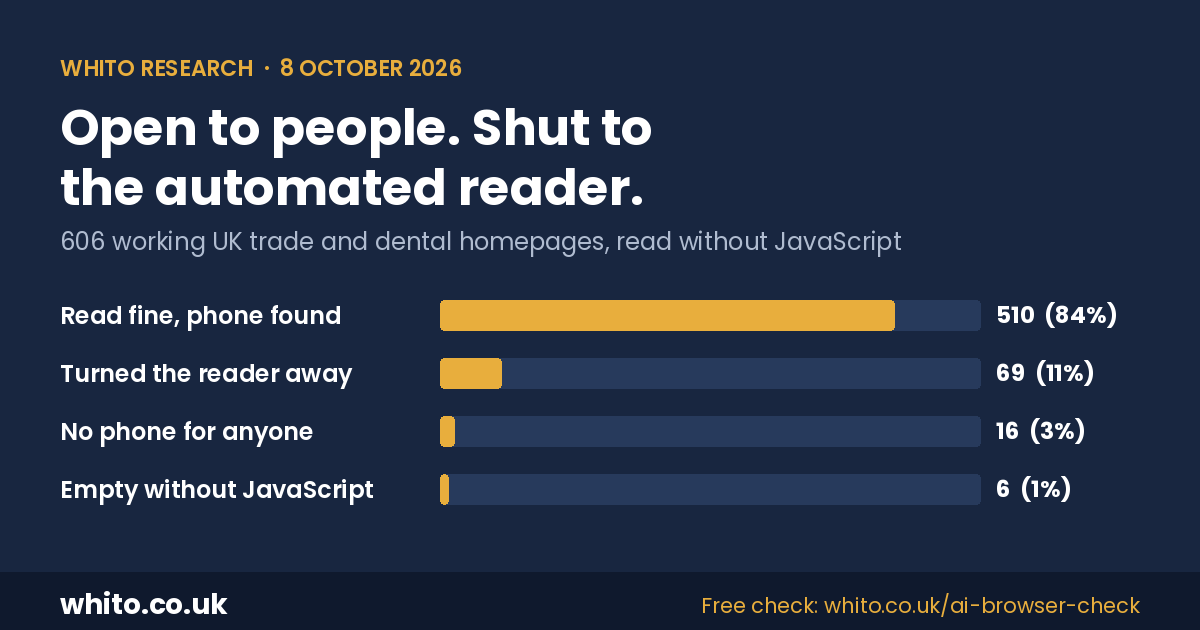
On 8 October 2026, 69 of 606 working UK trade and dental homepages (11%) turned away an automated reader that opened normally for a person; only 6 (1%) hid their content behind JavaScript.
Source: Whito, whito.co.uk/research/ai-browser-readiness-uk, 2026-10-08. Free to quote with a link to this page.
Last Updated on October 8, 2026
Built from: 642 UK plumber, heating engineer, locksmith, electrician and dental practice homepages in eight cities, each read once on 8 October 2026 by an automated reader that does not run JavaScript. Every homepage the reader could not use, or where it found no phone number, was then opened in an ordinary Chrome browser the same evening to see what a person gets.
The worry this autumn is JavaScript. The bigger problem is the door. Of 606 UK trade and dental homepages that were working on 8 October 2026, 69 (11%) turned our automated reader away while opening normally for a person. Only 6 (1%) hid their words behind JavaScript.
AI tools now read the live page as well as their index. Perplexity’s Comet browser and the browser built into the ChatGPT desktop app both open websites on a customer’s behalf. The usual advice is to fix JavaScript. For these sites, that is the wrong fix. Most of them never let the reader in.
Key facts
- 69 of 606 working homepages (11.4%) refused our reader or sent it a holding page, then opened normally in Chrome. 62 of those 69 showed a person a phone number.
- 6 of 606 (1.0%) gave a no-JavaScript reader an empty page. All six were single-page apps. Their words and phone number only appeared once scripts ran.
- 510 of 606 (84.2%) were read without trouble and the reader found a UK phone number.
- On the 526 pages it could read, 84% had a tappable phone link, 70% showed a postcode and 43% put the phone number in structured data. 53% had at least one link or button with no name.
- 32 of 642 homepages (5%) were not working for anyone that day: certificate errors, dead domains, server errors and one domain now selling gambling.
What we did
We took the homepages of 643 UK trade and dental businesses from Whito’s October 2026 call-out price studies, across Belfast, Birmingham, Bristol, Cardiff, Glasgow, Leeds, Manchester and Norwich. We dropped one that was a website builder’s own homepage, leaving 642.
Our reader fetched each homepage once, the way an automated tool does: no JavaScript, no cookies, one request, a name that says who it is. It recorded what came back and what it could read. It is the same reader behind the free AI Browser Readiness Check.
Then we opened every homepage the reader could not use, 132 of them, in an ordinary Chrome browser on a UK connection. That second look is what separates a site that is broken from a site that works for people and shuts out machines.
The results: 8 October 2026
| What happened | Homepages | Share of the 606 working |
|---|---|---|
| Read without trouble, UK phone number found | 510 | 84.2% |
| Turned the reader away, opened normally for a person | 69 | 11.4% |
| Read without trouble, no phone number for anyone | 16 | 2.6% |
| Empty without JavaScript, full page in a browser | 6 | 1.0% |
| Placeholder or near-empty page for everyone | 3 | 0.5% |
| Blocked an ordinary browser too | 2 | 0.3% |
| Not working for anyone (excluded from the 606) | 32 | |
| Could not classify (excluded) | 4 |
What we found
1. One in nine working sites has a people-only door
We call it a people-only door: the homepage opens for a person in a browser, and an automated reader gets an error or a holding page instead. 69 of the 606 working homepages had one.
- 60 answered our reader with “403 Forbidden”. Eight of those showed a bot check page.
- 7 sent back a near-empty holding page with no words instead of the site. In Chrome the full site loaded.
- 2 never answered our reader before it timed out, but loaded in Chrome. These two may be slow servers rather than blocks.
These are not neglected sites. 62 of the 69 showed a person a phone number, and most ran to hundreds of words. Somebody built them to win customers. The block usually comes from the firewall or bot protection a host or security service switches on, not from a choice the owner made.
This is the gap our earlier study could not see. In the June 2026 AI Door Test, only 1 of 49 UK business websites blocked an AI crawler in its robots.txt file. Robots.txt is the sign on the door. This time we knocked.
Two more homepages blocked our ordinary Chrome browser as well, with a security service’s “Attention Required” page. A customer on some connections would see the same.
2. JavaScript was a small problem
Six homepages (1%) gave a reader that does not run JavaScript almost nothing: between 0 and 11 words. In Chrome the same pages ran to between 34 and 4,715 words, and all six showed a phone number. All six were built as single-page apps.
Not one readable homepage hid its phone number behind JavaScript. Where the reader got the page, it got the number too, or nobody did. Modern tools were not the problem either: all 21 readable sites built with Next.js, a popular JavaScript framework, sent their words in the page itself.
JavaScript still matters for a business on a single-page app. The tools that fetch pages for AI answers have generally not run JavaScript, according to Vercel’s December 2024 analysis of OpenAI, Anthropic and Perplexity crawlers. It is just not where most UK trade sites lose readers.
3. Once inside, the basics were mostly there
On the 526 homepages our reader could read, here is what an AI tool would find:
| On the page as delivered | Homepages | Share of 526 |
|---|---|---|
| UK phone number as plain text | 500 | 95% |
| Tappable phone link (tel:) | 440 | 84% |
| Postcode, in text or structured data | 367 | 70% |
| Phone number in structured data | 227 | 43% |
| At least one link or button with no name | 281 | 53% |
| Five or more links or buttons with no name | 108 | 21% |
| At least one image with no alt text | 93 | 18% |
The weak spots are the parts an agent browser leans on. OpenAI says its agent reads ARIA labels, the same labels screen readers use, to understand page structure and buttons, and that a more accessible site is easier for it to understand (OpenAI publishers and developers FAQ). An icon-only button with no name is a button an agent cannot identify. 65 homepages showed a phone number with no tel: link, so an agent asked to “call them” has to copy the digits.
4. One in twenty was not working for anyone
32 of the 642 homepages failed in Chrome as well. Nine had certificate errors, nine had domains that no longer resolved, seven returned server errors, two timed out, one was a domain for sale, one redirected to an unrelated site, one showed a server’s default page, one showed an “under maintenance” page and one now serves gambling content. These are not AI problems. They are lost customers.
By trade and by city
| Trade | Working homepages | People-only door | Rate | Empty without JavaScript |
|---|---|---|---|---|
| Locksmiths | 111 | 17 | 15% | 1 |
| Electricians | 109 | 14 | 13% | 1 |
| Dental practices | 81 | 10 | 12% | 1 |
| Heating engineers | 156 | 15 | 10% | 2 |
| Plumbers | 149 | 13 | 9% | 1 |
| City | Working homepages | People-only door | Rate |
|---|---|---|---|
| Birmingham | 92 | 17 | 18% |
| Bristol | 80 | 12 | 15% |
| Cardiff | 75 | 11 | 15% |
| Manchester | 66 | 8 | 12% |
| Glasgow | 85 | 9 | 11% |
| Belfast | 64 | 4 | 6% |
| Norwich | 70 | 4 | 6% |
| Leeds | 74 | 4 | 5% |
The city samples are small, so read the city gaps as a reason to look, not as a ranking. We found no single cause. The businesses are local, the hosting is not.
Why this matters now
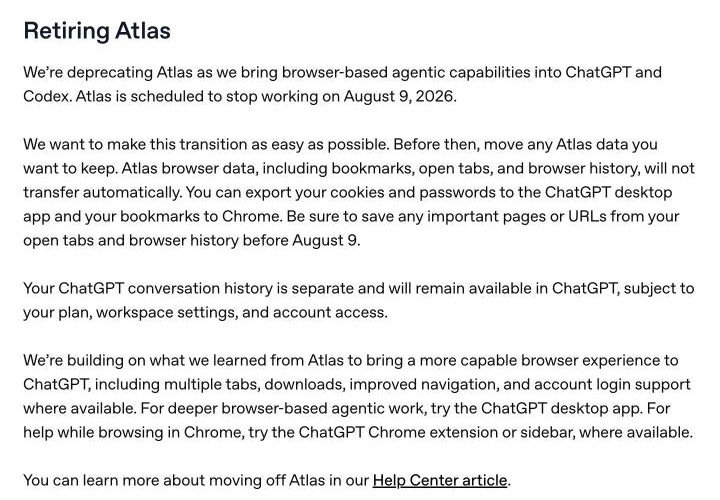
AI tools reach a business website two ways. Some fetch the page to build an answer, and those fetchers have generally not run JavaScript. Others open the page in a real browser and act on it for the customer. OpenAI’s release notes scheduled its standalone Atlas browser to stop working on 9 August 2026, with that work moving into the browser built into the ChatGPT desktop app. Perplexity’s Comet browser runs on Mac, Windows, iOS and Android.
Both kinds have to get through the door first. Security services are tightening it: Cloudflare has asked every new domain since 1 July 2025 whether to allow AI crawlers, with blocking as the starting position (Cloudflare, July 2025). That can be the right call for a publisher. For a locksmith who wants the call, it may not be.
What to do about it
Structure before scale. Fix the door before you polish the room.
- Check the door. Run the free AI Browser Readiness Check. If it says your site turned our reader away, ask your web host or developer what bot protection is switched on and whether verified AI crawlers and agents are allowed. Decide it on purpose.
- Put the phone number in the page as text and wrap it in a tel: link. Not only in a picture or a button.
- Add your town and postcode, or your service area, in plain text. A map embed does not count.
- Name your buttons. Every icon-only button needs a label a screen reader can say.
- If your site is a single-page app, ask for server-side rendering or pre-rendering, so the words are in the page before any script runs.
For robots.txt, an llms.txt file and ready-made fixes, run the free Visibility Check as well. The two checks look at different things and work together.
How we ran this
- Sample: 643 homepages of plumbers (155), heating engineers (159), locksmiths (124), electricians (119) and dental practices (86) in Belfast, Birmingham, Bristol, Cardiff, Glasgow, Leeds, Manchester and Norwich, taken from Whito’s October 2026 call-out price studies. One website builder’s homepage was removed, leaving 642. The sample leans towards businesses that publish prices and appear in search for emergency work.
- Reader: one request per homepage on 8 October 2026 from Whito’s web server, identified as WhitoAIBrowserCheck, no JavaScript, no cookies, a 15-second limit, up to five redirects. It records the HTTP status, the readable words, UK phone numbers and postcodes in the text, tel: links, structured data, headings, links and buttons with no name, and images with no alt text.
- Browser check: all 132 homepages that were refused, failed, near-empty (under 50 words) or showed no phone number were opened in Google Chrome on a UK broadband connection the same evening, and the visible words and phone numbers were counted.
- People-only door: the reader got a 403, 429 or 5xx response, a holding page with no words, or no answer before the reader timed out, and Chrome showed the real site.
- Working homepages: all 642 except the 32 that failed in Chrome as well and 4 we could not classify (the browser check could not read their text either).
What this does not prove
- Our reader is not ChatGPT, Perplexity or Claude. It names itself honestly. Some firewalls let named, verified AI crawlers through while blocking unknown ones, and some do the reverse. A site that refused us may let a particular AI tool in, or block it too. What it shows is that the door is not open to any automated reader.
- One request per homepage, one evening, from one server. The figures come from the evening pass on 8 October; a test pass that morning with an earlier version of the reader is not used. Firewalls change their minds by the hour, and some sites moved between groups across the two passes. A rerun will move some again.
- Homepages only. A phone number on the contact page does not count here.
- The Chrome check ran on a home connection with an everyday browser. A customer on another network may get a different answer.
- Phone and postcode detection is pattern matching. It misses numbers written in unusual ways and can count a postcode that is not the firm’s own.
- This study does not test whether any AI engine recommends these businesses. That is a different question.
Data
The full dataset is free to download: whito-ai-browser-readiness-2026-10-08.csv (642 rows: trade, city, outcome, status code, platform, words without JavaScript, phone and postcode findings, unnamed links and buttons, and the browser check where one was run). Business names and web addresses are left out. We do not publish a list of firms.
Cite this: Whito (2026), AI Browser Readiness: how UK trade websites treat automated readers, October 2026, whito.co.uk/research/ai-browser-readiness-uk/, collected 8 October 2026.
Corrections: if you think we have put a site in the wrong group, email hello@whito.co.uk with the row number. We will re-check it and publish any change on this page with its date.
The working behind this study, with every web address and the full readout for each one, can be run for your own sector, region or client list as a built-to-order research file. See Whito Data. The study above stays free.
Questions
Can AI browsers read websites built with JavaScript?
AI browsers such as Perplexity’s Comet run JavaScript like any browser. The tools that fetch pages for AI answers have generally not. In Whito’s 8 October 2026 study, only 6 of 606 working UK trade and dental homepages (1%) were empty without JavaScript.
How many UK small business websites block automated readers?
On 8 October 2026, 69 of 606 working UK trade and dental homepages (11.4%) turned away Whito’s automated reader while opening normally in Chrome. 60 returned a 403 error, 7 sent a holding page and 2 did not answer.
What is a people-only door?
Whito’s term for a website that opens for a person in a browser but sends an automated reader an error or a holding page. It usually comes from firewall or bot protection settings, not from robots.txt.
Is ChatGPT Atlas still available?
No. OpenAI’s release notes say Atlas was scheduled to stop working on 9 August 2026, with browser-based work moving into the ChatGPT desktop app and Codex.
How do I check my own website?
Run the free AI Browser Readiness Check at whito.co.uk/ai-browser-check/. It uses the same reader as this study, reads your homepage once and lists what an automated reader can and cannot find, with a fix for each gap.
Will this be repeated?
Yes. The same reader and the same rules will be run again each quarter and published as a new dated edition beside this one.
The structural checks behind this research run on any website in about twenty seconds. Enter yours and read the full result on the page. Free, and we do not ask for your email.
Run the free Visibility CheckIf your business is named here and you think we have a fact wrong, email hello@whito.co.uk and we will check it and correct it. If you want to respond, send us a statement and we will publish it alongside. Full detail: Corrections, right of reply and removals.