Last Updated on October 3, 2026
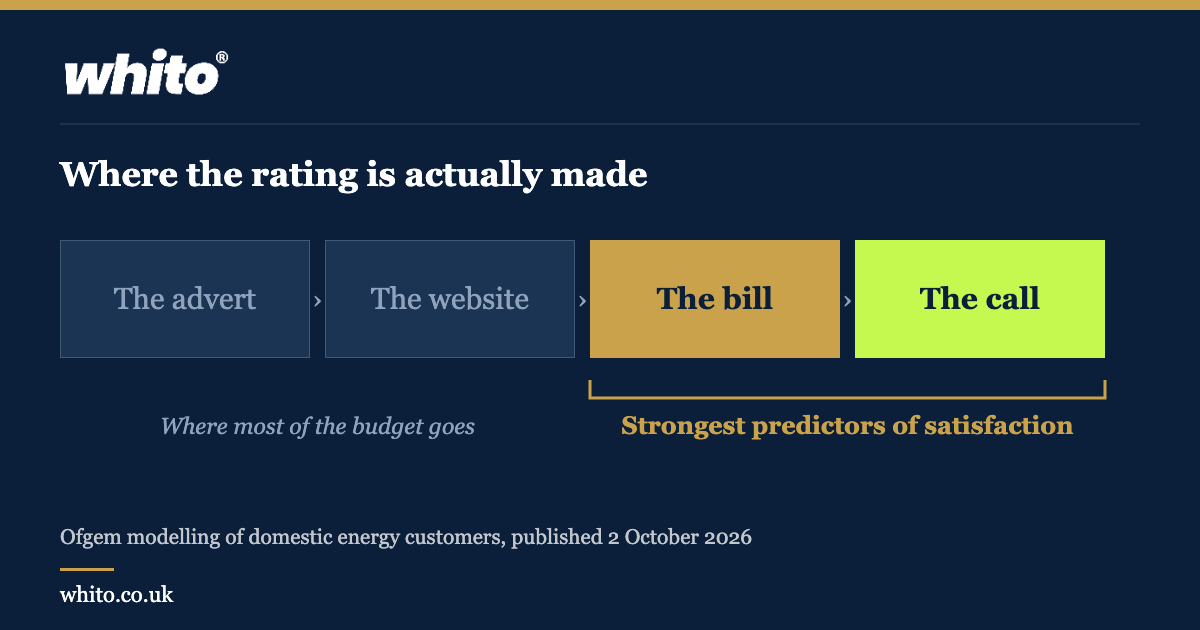
A regulator has just published the arithmetic on why customers rate a company well, and almost none of it is marketing.
What Ofgem published
On 2 October, Ofgem published a statistical analysis of what drives satisfaction among domestic energy customers. It is not a survey write-up. It is a set of logistic regression models built on the Energy Consumer Satisfaction Survey, which BMG Research has run for Ofgem and Citizens Advice since 2023. Ofgem says it ran the extra analysis after record-high satisfaction of 81% in January 2026.
Two results are worth the attention of anyone who sells anything.
In the model built from customer service measures, satisfaction with billing and ease of contact were the strongest predictors of overall satisfaction, followed by satisfaction with smart meters. That model explained 38% of the variation in overall satisfaction. A separate model built from demographics and energy characteristics explained 14%.
Then, among customers who had contacted or tried to contact their supplier, a model built on how that contact was perceived explained 54% of the variation in customer service satisfaction. The strongest predictors were empathy and the overall handling of the interaction, closely followed by whether the issue was resolved.
Ofgem does not name price or tariff among the strongest predictors in either model.
The mistake most businesses make
Ask an owner how they plan to improve what customers think of them and you will usually get a marketing answer. Collect more reviews. Refresh the website. Put a promise on the van.
Those are outputs. The Ofgem models point at inputs: whether the bill makes sense, whether somebody answers, and whether the problem actually gets fixed. None of those three sit in a marketing budget. They sit in how the business is run day to day.
It is the same gap behind the ASA ruling on a 24/7 availability claim. The promise was easy to put in an advert. The records showing it was true were not there.
| Where the budget usually goes | What Ofgem’s models rewarded |
|---|---|
| Getting more strangers to the door | Ease of contact for the people already there |
| Asking happy customers for a review | Empathy and handling when someone is unhappy |
| Clearer marketing copy | A clearer bill |
| Promising a fast response | Resolving it on the first interaction |
Why this is a structure problem, not a campaign problem
Structure before scale is the rule, and this is a clean example of why.
If your invoice prompts a question, every new customer adds a phone call you then have to handle. If nobody picks that call up, the money that created it is wasted twice: once on the advertising, once on the goodwill. Scaling an unclear bill does not grow the business, it manufactures complaints faster.
Being easy to reach also starts before anyone rings. Our study of 179 emergency plumber websites, checked on 2 October, found 117 of them published no price at all. That turns a question a website could answer in one line into a phone call, and phone calls are exactly where Ofgem found satisfaction is won or lost.
Ofgem modelled domestic energy customers, and the two figures come from different bases. The 38% is a customer service model of overall satisfaction across 7,701 respondents. The 54% is a contact perceptions model of customer service satisfaction among the 4,262 who had contacted or tried to contact their supplier. Regression shows association, not proof of cause, and neither figure is a forecast for your business. What travels is the shape of the finding: the parts customers rated hardest were the parts they experienced directly.
Three checks worth doing this week
- Ring your own number. At 4pm on a Friday, and again from a withheld mobile. Note who answers, how long it takes, and what they say first.
- Read your last invoice as a stranger. Does it state what was done, what it cost, what is owed and when it is due, without needing a follow-up call?
- Count first-contact resolutions. Of your last ten enquiries or complaints, how many were finished in one interaction? That single number tells you more than your review average.
The takeaway
The regulator went looking for what sits behind a satisfaction score and found the bill and the phone call. Spending more on being found, while contact handling stays poor, buys a larger audience for the same problem.
Read our breakdown of what a UK marketing stack actually costs with that order in mind. The tools are cheap next to the cost of a customer who could not get an answer.
The cheapest reputation work in your business is answering the phone and writing a bill nobody has to query.