
Last Updated on September 29, 2026
Most small business owners have met one. The builder who took the deposit and disappeared. The supplier who went quiet in March and was trading again by June under a name one word different. You wrote off the money and assumed nobody was counting.
Somebody has started counting.
What happened
The Insolvency Service launches a five-year strategy with abusive phoenixing as its leading enforcement priority. Abusive phoenixing is the practice of repeatedly running up debts in a company, closing it, then starting the same business again free of what it owed.
Business Matters reported on 28 September that 146 investigations have started since April, with another 87 about to begin. Chief executive Duncan Beach, who took the job in January, called the practice “a blight on the economy” and said it was his main concern.
For scale, the agency’s own annual report for 2025-26 records 148 completed civil investigations into abusive phoenixism across the entire year.
| Measure | Figure | Source |
|---|---|---|
| Civil investigations completed, full year 2025-26 | 148 | Insolvency Service annual report |
| Companies wound up as a result | 18 | Insolvency Service annual report |
| Directors disqualified | 87 | Insolvency Service annual report |
| Directors convicted of criminal offences | 5 | Insolvency Service annual report |
| Investigations opened since April 2026 | 146 | Business Matters, 28 Sept |
| Further investigations about to begin | 87 | Business Matters, 28 Sept |
The two 87s in that table are unrelated. One counts directors disqualified last year. The other counts investigations not yet opened. Worth saying, because they will get added together somewhere this week.
The two things that are actually new
The headline number is not the change. Two other things are.
First, they are not waiting for companies to fail. Investigators are targeting live businesses where they suspect wrongdoing, rather than picking through the wreckage afterwards.
Second, they are joining up records that used to sit in separate silos. The Insolvency Service, HMRC and Companies House are sharing data, and AI is being used to assemble evidence held across those bodies. A director whose pattern was invisible because it was split across three registers is harder to miss now.
The money behind it is real but modest. The 2025 Autumn Budget allocated £25 million over five years for 50 additional posts. The annual report says recruitment planning is underway and the taskforce is building over the coming months. This is a capability being assembled, not one already at full strength.
What it actually looks like
Beach gave two examples. A small housebuilder sells a new home off-plan to a family, closes the business, walks away, then sets up again and repeats it. A small hotel makes its staff redundant, shuts the company, and reopens the next day under a different corporate structure with none of the liabilities.
Neither of those is a clever tax arrangement. Both leave real people out of pocket, and one of those people is often a small supplier who never gets a vote.
Why this matters even if nobody owes you a penny
Here is the part that gets missed.
Most owners read a story like this and file it under enforcement, not my problem. It is your problem, because you are standing on the other side of the same check.
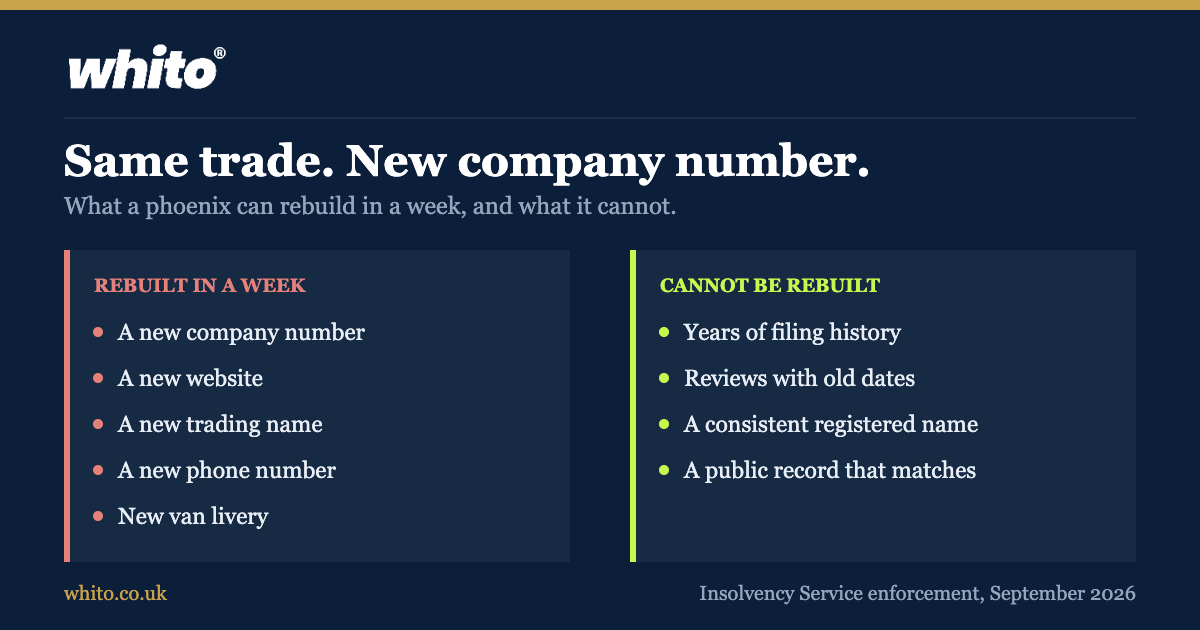
A phoenix company has a recognisable profile. Incorporated recently. No trading history. No reviews older than a few months. A website that went up last quarter. When enforcement tightens and buyers get more careful, those are exactly the signals people start looking at. A perfectly legitimate two-year-old business with a thin public record looks identical from the outside.
The signals that prove you are not a phoenix are the same signals that win you the work. A consistent registered name. A trading history anyone can verify. Reviews with dates on them. A public record that matches what your website claims. You cannot build any of those in a hurry, and that is precisely why they are worth something.
We have tested how well that public record actually holds up, and it is thinner than most owners assume. Our check of 100 UK Cylex listings against Companies House found 18 did not lead to an active company. The directory did not know. Neither would a customer reading it. Our 12-city study of AI recommendations against the UK public registers found the same gap in the tools people increasingly use to pick a supplier.
If the record is that loose, a phoenix has an easy time looking established, and an honest firm has a harder time proving it is.
What to do this week
Three things. None of them take long.
Check who owes you money. Search each name on Companies House. Look at the incorporation date, the filing history, and whether the director sits on other companies that were dissolved. Two minutes per firm, and it is free.
Check your own record the way a cautious customer would. Search your business name. If your registered name, your trading name and your reviews do not line up, fix that before somebody else has to interpret it for themselves.
Get your director verification done. Identity verification is already a legal requirement, and the deadline that binds you is your confirmation statement date, not a single national cut-off.
The takeaway
Enforcement catches the fraud after the money has gone. Your own checks catch it before. And the firms that come through a tightening like this one are not the ones with the best lawyers. They are the ones whose public record already says what they say it says.
Structure before scale.