Last Updated on October 16, 2026

Some links in this article are commission-based, meaning we may earn a small fee if you purchase through them, at no extra cost to you. They do not buy a place in any ranking. Full disclosure: https://whito.co.uk/how-we-make-money/ and https://whito.co.uk/review-methodology/
Every accountancy practice has the same demand curve: a cliff in January, a bump at year-ends, and a long quiet middle where the website could be earning but usually is not. The practices that grow are not winning January; January wins itself. They are winning the quiet months, when a limited company director finally snaps after the third unanswered email to their current accountant and goes looking for someone who publishes a price and replies like a human. Your website’s job is to be standing there when that happens, all year round.
Everything else we publish for practices is at whito.co.uk/accountants/.
Begin at the end: the enquiry form
Most trades want the phone to ring. You want the right phone to ring, because a mispriced client relationship lasts years. So before designing anything, decide what your enquiry form asks. Four questions qualify almost every lead:
- What kind of business are you? (Sole trader / limited company / landlord / not trading yet)
- Roughly what turnover? (Bands, not a blank box)
- What do you need? (Year-end accounts / bookkeeping / VAT / payroll / “HMRC has written to me”)
- Who looks after this now? (Nobody / another accountant / I do it myself)
Those four answers tell you the service, the complexity, the likely fee and the switching friction before you pick up the phone. A form that asks only for “name, email, message” outsources triage to your inbox at the busiest time of your year.
The four dropdown questions an accountancy enquiry form should ask: business type, turnover band, service needed, and who looks after it now.
Four questions that qualify every lead
Question 1
What kind of business are you?
Sole trader / limited company / landlord / not trading yet
Question 2 · the one that saves the awkward call
Roughly what turnover?
Bands, not a blank box.
Question 3
What do you need?
Year-end accounts / bookkeeping / VAT / payroll / “HMRC has written to me”
Question 4
Who looks after this now?
Nobody / another accountant / I do it myself
Four dropdowns tell you the service, the complexity and the likely fee before the first call. A blank message box tells you nothing.
Pages that match what clients are actually buying
Clients do not buy “accounting services”. They buy relief from specific letters and deadlines. Name the pages accordingly:
- Home
- Limited company accountants (the money page)
- Self Assessment and sole traders
- VAT returns
- Payroll
- Making Tax Digital, explained for the people it just hit
- Pricing
- About the team, and contact
Offer only what you actually run. A payroll page when you quietly outsource payroll and hate it will fill your diary with your least profitable conversations. And the MTD page has earned its place at the table: Making Tax Digital for Income Tax now applies to sole traders and landlords over the first threshold, with lower bands following in the next two Aprils, which means a rolling supply of confused people typing questions into Google for years. A clear, current MTD page is the closest thing this industry has to an evergreen lead magnet.
Making Tax Digital for Income Tax applies from 6 April 2026 for qualifying income over £50,000, from 6 April 2027 for income over £30,000, and from 6 April 2028 at £20,000, per gov.uk guidance.
Making Tax Digital for Income Tax: the rollout
6 April 2026
Qualifying income over £50,000 (2024–25 tax year). Already in force.
6 April 2027
Qualifying income over £30,000 (2025–26 tax year).
6 April 2028
Qualifying income of £20,000 (2026–27 tax year).
Each threshold drop delivers a new wave of confused sole traders and landlords into Google. Keep your MTD page dated and current.
Source: gov.uk, Making Tax Digital for Income Tax eligibility, checked 19 September 2026.
The money page: the limited company package
One director paying £120 a month is worth more than a dozen January tax returns, and renews without being resold. The limited company page earns the full treatment:
- The monthly price, on the page. “From £95 a month for accounts, corporation tax, confirmation statement and director Self Assessment.” Every practice that hides fees trains the market to assume they are the expensive one; the practices growing fastest in the UK almost all publish packages.
- What “from” means. List what moves it: VAT registration, payroll headcount, bookkeeping volume. Three tiers beat a configurator.
- What switching involves. “We write to your current accountant, we handle the handover, it takes about two weeks and costs nothing.” The single biggest brake on switching is the imagined awkwardness; dissolve it in two sentences.
- Deadlines as a promise. “Nothing filed late in eleven years” is the accountancy equivalent of tidy pipework, if you can honestly say it, say it.
An example three-tier monthly pricing layout for an accountancy practice: £75 a month basic, £120 a month standard highlighted as the tier most directors choose, and £195 a month full service.
Three tiers, and why the middle one sells
Tier 1
£75/mo
Accounts and corporation tax
The floor. Keeps the comparison honest.
Most chosen
£120/mo
+ VAT returns and director Self Assessment
Honest and slightly boring. That is the point.
Tier 3
£195/mo
+ payroll and bookkeeping
The anchor. Makes the middle look sensible.
Illustrative tiers using this guide’s example figures. Anchor high, sell the middle, list inclusions in plain English.
Letters after names, explained like a human
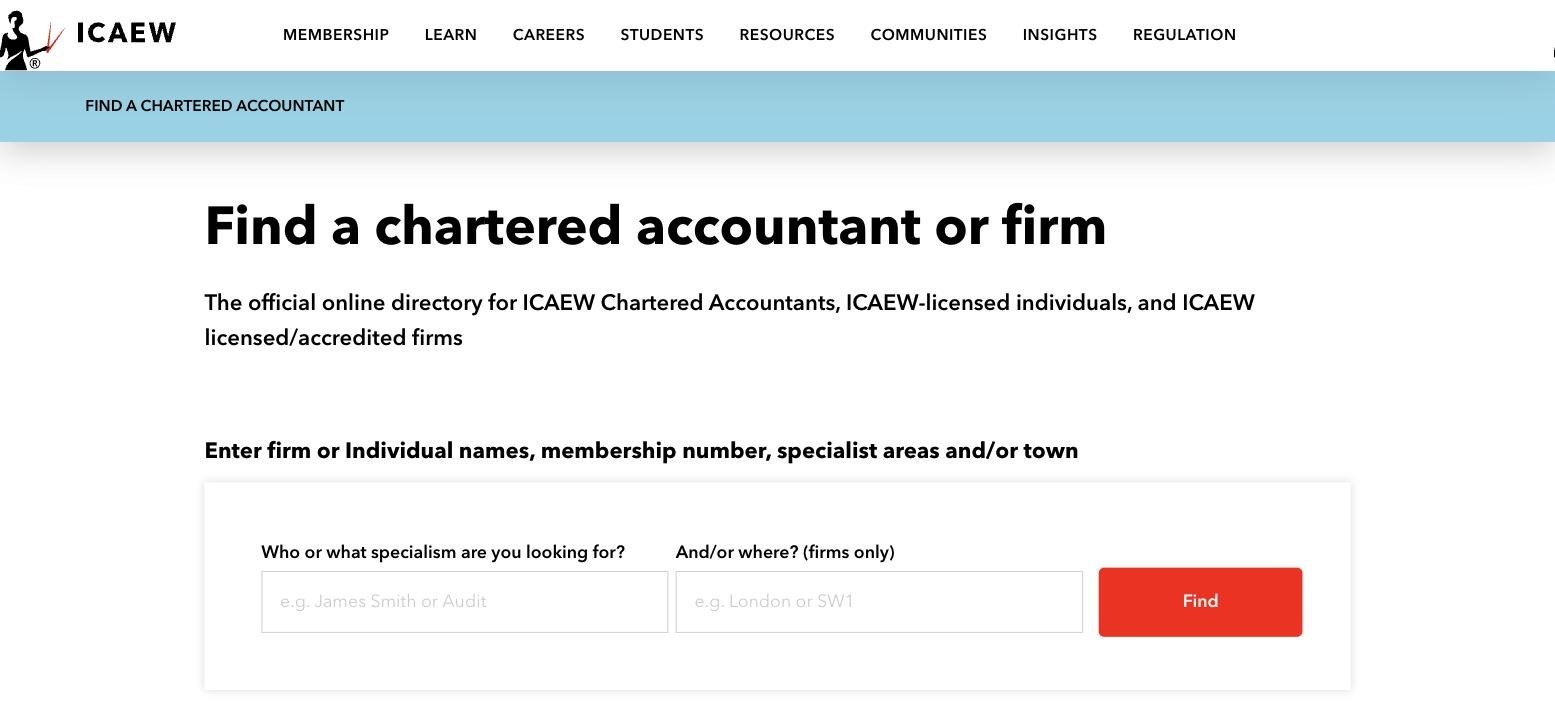
One fact civilians half-know deserves space on your website: “accountant” is not a protected term. Anyone can trade as one tomorrow. “Chartered accountant” and “chartered certified accountant” are protected, and membership of ICAEW, ACCA or AAT is checkable on public registers. So say it plainly: “We are ACCA members, which means regulated, insured, and checkable here.” Link the register. You are not showing off; you are handing the client the one screening tool that separates you from the unregulated bookkeeper with a home-made logo three results down.
Round out the proof with Google reviews that mention outcomes (“sorted three years of late returns”, “saved us from a VAT mess”) and photographs of the actual team. No calculators on banknotes. Everyone in your industry uses that photo; be the practice that looks like people instead. Bought imagery must be licensed for use without attribution.
The five-second test, accountancy edition
On a phone, in five seconds, a director should see: who you serve (“Fixed monthly accounting for Leeds limited companies”), one price signal (“from £95 a month”), a real qualification (“ACCA”), and one button (“Get a fixed quote”). Note what is missing: “full range of accounting services”, which is the sound a website makes when nobody decided who it was for.
Local SEO for a practice that is half online anyway
Accountancy sits between the van trades and the pure-online world. You likely have an office, so claim the Google Business Profile with the address, set “Accountant” as the primary category and add the tax and bookkeeping secondaries. But your real local battleground is the “[service] + [town]” pages, “accountant for limited company Leeds”, and your real differentiator can be a niche instead of a postcode: contractors, ecommerce, landlords, GP practices. One honest niche page (“Accountants for Amazon sellers: we handle the VAT nobody else will touch”) often outperforms three town pages, because the searcher is more desperate and the competition thinner. Do town pages only for places where you have real clients you can mention.
Build route: WordPress, for the same reason you use ledgers
Default: WordPress with solid hosting (Hostinger, the host our review backs), £1,200 to £3,000 through a freelancer. A practice site accumulates: service pages, niche pages, MTD explainers that need updating every Budget, a pricing page you will revise annually. WordPress treats content as the asset it is, and the practice owns the lot. Put the annual hosting and domain renewals in your own recurring payments, filed next to your practising certificate. If you take the WordPress route, check current Hostinger UK pricing.
When not to: a brand-new practice with one service and no content plan can start on a builder at £15 to £25 a month, and the Wix vs WordPress vs Squarespace comparison will settle which. Migrate when the page count passes about fifteen. Avoid the industry-specific “accountancy website platforms” that rent you a templated site plus “content included”; the content is the same tax articles on four hundred other practice sites, and duplicated content earns none of them anything.
Buy the domain yourself through Namecheap (our review covers the renewal maths), in the practice’s account: fourshiresaccounting.co.uk energy, not tax-experts-uk-2026.com.
Accountancy has real calendar events: Budget days, MTD thresholds, year-end, the January deadline. A short email before each one (“three things to do before 5 April, two of which take ten minutes”) is genuinely useful, keeps you visible between filings, and quietly reminds recipients’ mates that they know an accountant. MailerLite runs this for next to nothing at practice scale. Collect addresses on the MTD page, where the confused people already are, with a plain offer: “One email when the rules change. Nothing else.”
Seven ways practice websites underperform
- No prices, in the industry clients most suspect of clock-running.
- “Full range of accounting services” instead of naming who it is for.
- A tax rates page from two Budgets ago, publicly demonstrating outdatedness.
- Qualifications listed as acronyms with no explanation or register link.
- A blank contact form doing no qualifying.
- Stock imagery of calculators, causing every practice site to look like every other.
- Chasing “accountant [big city]” while the winnable searches, service plus suburb plus niche, go uncontested.
Fifteen checks before you tell a single client
- Limited company page live with monthly pricing and tiers.
- Self Assessment, VAT and payroll pages live for services you actually run, and only those.
- MTD page live, current, and dated so readers can see it is maintained.
- Enquiry form asks the four qualifying questions.
- Qualification stated in plain English, linked to the ICAEW/ACCA/AAT register.
- Switching-accountants paragraph on every service page.
- Pricing page reachable in one tap from the homepage.
- Real team photos; any bought images licensed without attribution.
- Google Business Profile: address, “Accountant” primary, tax and bookkeeping secondaries.
- Five Google reviews, at least two mentioning a specific service.
- Domain held by the practice itself, Namecheap auto-renew on, renewal billed to the practice card.
- Google Search Console verified, sitemap submitted; it is free and sufficient.
- Email capture live on the MTD page with the one-line promise.
- Deadline promise (“nothing filed late”) included only if true.
- Someone who is not an accountant has read every page and flagged the jargon.
The month after launch
Week one: reviews, ten asks, sent by whoever the client actually dealt with. Week two: watch the form answers; if everyone ticks “HMRC has written to me”, build a page for exactly that panic. Week three: Search Console queries into page titles, verbatim where honest. Week four: send the first calendar email to however small the list is, because a list this useful only compounds from the day it starts.
Four questions practices actually ask
Won’t publishing prices attract cheapskates? It repels them. The £40-a-year-return hunter sees “from £95 a month” and self-deselects, which is the form doing your least favourite phone call for you.
We’re AAT, not chartered. Is that a problem online? Only if you hide it. “AAT licensed, regulated and insured” beats unexplained silence, and it beats the unregulated competition by a distance the client can verify.
Do we need to blog about tax news? No. You need six correct service pages and one living MTD page. A feed of rehashed HMRC announcements maintained out of guilt helps nobody rank and bores everyone equally.
Is January too late to start? For this January, yes, and that is fine. Build in February when the practice exhales, and by the quiet summer, the season the site is really for, it will be doing its actual job: catching the directors whose accountants went quiet.