
Finding
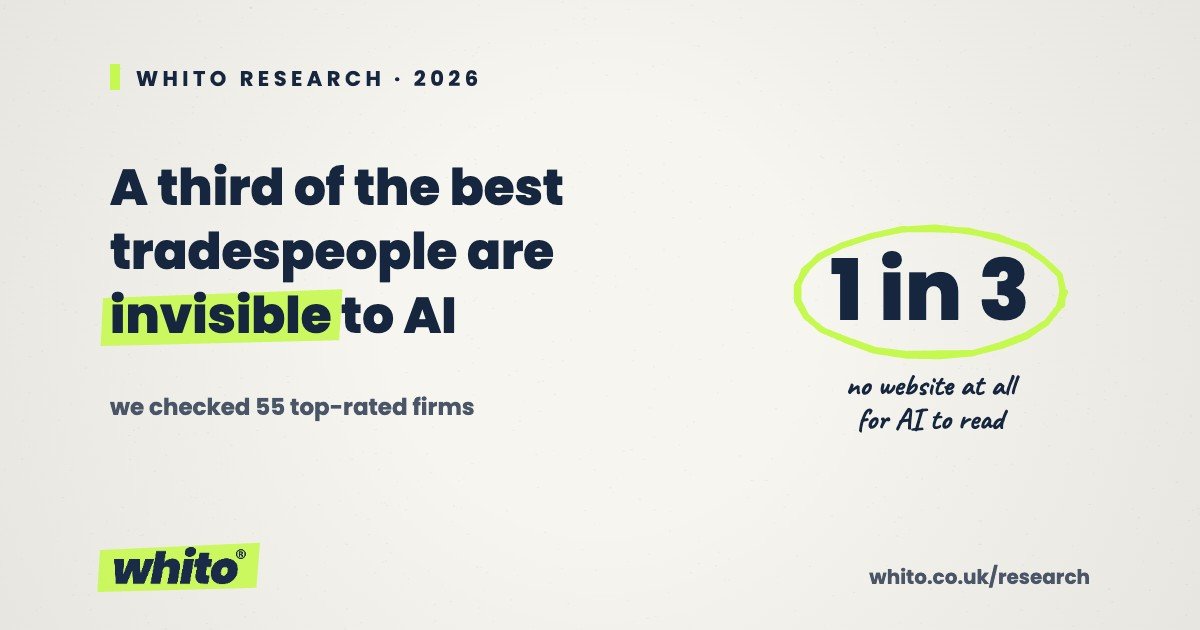
19 of 55 top-rated UK electricians, plumbers and roofers, 35%, have no website at all for AI to read, only a Google listing, and only half of those with websites carry machine-readable business details, according to Whito's June 2026 study across seven UK cities.
Source: Whito, whito.co.uk/trades/research/uk-trades-invisible-to-ai-structured-data-study, June 2026. Free to quote with a link to this page.
Last Updated on September 17, 2026
Published by Whito Research · Last updated 2 July 2026 · Data checked July 2026
If AI is going to decide which local businesses get recommended, there is an awkward question nobody is asking: can it even see them? We went through the top-rated tradespeople in our own directory research and checked. For a large share of them, the answer is no.
What we did
We took 55 of the highest-rated electricians, plumbers and roofers we had gathered across seven UK city pages, the kind of businesses a person would be glad to hire, and looked at two things. First, do they even have a website. Then, for those that do, is the information on it structured so a machine can read who they are, where they work and what they do.
What we found
- More than a third had no website at all. 19 of the 55 top-rated firms exist online only as a Google listing. There is nothing for an AI to read beyond a name and a star rating.
- Of the websites we did check, only half carried machine-readable business details. The rest had generic page code that does not tell a machine it is even looking at an electrician or a plumber.
- Almost none answered questions in a form AI can lift. Just one of six sites we inspected had FAQ structured data, the exact format AI uses to pull answers.
Finding 1: a third of the best are not really online
This is the part people miss. A business can have a five star rating and hundreds of reviews and still have no website. Of our 55 top-rated firms, 19 had none. For them, the entire online presence is a Google profile. An AI assistant asked to recommend them has almost nothing to work with, no services list, no coverage area, no story, no proof of accreditation. It is recommending a name and a number, or skipping them entirely.
| Top-rated local trades we checked | Share |
|---|---|
| Had a working website | 36 of 55 (65%) |
| No website at all, Google profile only | 19 of 55 (35%) |
55 top-rated electricians, plumbers and roofers from our seven-city directory research, June 2026.
Finding 2: having a website is not the same as being readable
You might think the ones with websites are fine. Not really. A website can look perfectly good to a person and still be a blank to a machine, if the underlying page does not spell out, in structured data, what the business is and where it operates.
We inspected a sample of these trade websites for that structured data. Every one had some generic code, the kind a website builder adds automatically. But only half actually identified the business as a local trade a machine could understand. And the structured data that AI leans on most for answering questions, the FAQ format, was present on just one of the six we looked at.
| In our sample of trade websites | Had it |
|---|---|
| Any structured data at all | All of them |
| Machine-readable business identity (what and where they are) | Half |
| FAQ structured data (the format AI lifts for answers) | One in six |
A sample of trade business websites inspected for structured data, June 2026. Counts reported in aggregate.
Why this matters
Put this next to what we found when we asked AI to actually recommend a tradesperson. It fell back on Google ratings, accreditation registers, the big directories and Reddit, because the businesses themselves often give it nothing to read. The good local firm with no website, or a website a machine cannot parse, is not in the conversation. It is invisible, not because it is bad, but because its information is missing, generic or scattered.
This is the quiet shift. For twenty years, being findable meant ranking on Google. Increasingly it means being legible to a machine: structured, accredited, consistent, and present in the places an AI checks. Most good tradespeople are nowhere near ready for that, and most do not know it yet.
Cite this research
Whito Research (2026). A third of the best local tradespeople are invisible to AI. We checked 55 of them.. Whito. https://whito.co.uk/research/uk-trades-invisible-to-ai-structured-data-study/
Key finding: 19 of 55 top-rated UK tradespeople have no website at all for AI to read, and only around half of those with websites carry machine-readable business details.
This is original Whito research. You are welcome to reuse these figures with a link to this page as the source.
Common questions
Are local tradespeople visible to AI?
Often not. In our June 2026 study of 55 top-rated UK trades, more than a third had no website at all, only a Google listing. Of those with websites, only about half carried machine-readable business details and just one in six had FAQ structured data, the format AI uses to pull answers.
Why does AI ignore good local businesses?
Because it cannot read them. A business with no website, or a website without structured data describing what and where it is, gives an AI assistant almost nothing to work with. AI then falls back on Google ratings, accreditation registers, directories and Reddit, and the unreadable business is left out.
How can a business become visible to AI?
Have a presence that is structured and consistent: clear, machine-readable details of what the business does and where, verifiable accreditation, an up to date Google rating, and information laid out in formats AI can lift, such as FAQ structured data. Consistency across the places AI checks matters more than any single listing.
If your business is named here and you think we have a fact wrong, email hello@whito.co.uk and we will check it and correct it. If you want to respond, send us a statement and we will publish it alongside. Full detail: Corrections, right of reply and removals.