

Last Updated on June 22, 2026
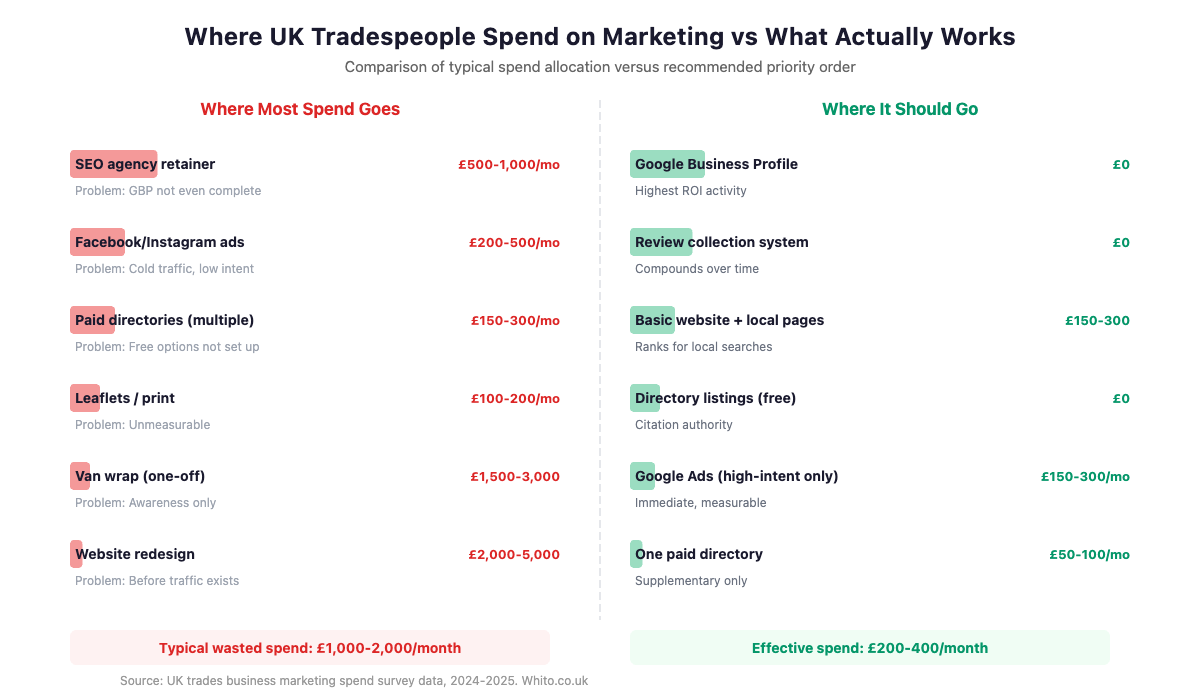
Most tradespeople who spend money on marketing are spending it on the wrong things, in the wrong order, at the wrong time. Not because they are stupid. Because nobody told them what to fix first.
The marketing industry loves trades businesses. You have money, you need leads, and you do not have time to learn what actually works. So you buy whatever sounds convincing from whoever contacts you first.
Here is where that money actually goes and what to do differently.
The three most common wastes
Paying for SEO when your Google Business Profile is empty. An agency charging you £500 a month for “SEO” while your Google Business Profile has no photos, two reviews, and the wrong category set. That is not SEO. That is theft dressed up as a service.
Your Google Business Profile is free. It takes an hour to complete properly. It should be finished before you spend a single pound on anything else. Any agency that starts charging before that is done is not working in your interest.
Running Facebook ads to a website that does not convert. You are paying to send people to a site that has no clear phone number, no mention of where you work, and a “Contact Us” form that goes to an email you check once a week.
Paid traffic to a broken website is like paying for a billboard that points to a boarded-up shop. The traffic is not the problem. What it lands on is the problem.
Paying for leads from directories you could list on for free. Some directories charge £100+ a month. Some of the same visibility comes from free listings on Yell, FreeIndex, and Google itself. If you have not set up the free options, why are you paying for the premium ones?
The real issue: doing things out of order
Marketing is not complicated for tradespeople. It is just sequence-dependent. The right action at the wrong time wastes money. The right action at the right time compounds.
The sequence that works:
First: Free foundations. Google Business Profile (complete, with photos and correct category). Free directory listings with consistent business details. A basic website that says what you do and where. This costs time, not money.
Second: Review collection. After every job, a text message with your Google review link. This is free and it directly impacts your ranking in Google’s map pack. Twenty genuine reviews will outperform hundreds of pounds in advertising.
Third: Small paid tests. Google Ads on high-intent keywords for your specific services. £5-10 a day, tracked properly, testing whether paid leads convert at a cost that makes sense for your business.
Fourth: Scale what works. Only after you know which channel produces profitable work should you increase spend on it.
Most tradespeople jump to step three or four without finishing steps one and two. That is where the waste happens.
How to spot a bad agency
The trades marketing space is full of agencies that promise “page one of Google” and “guaranteed leads.” Here is what separates legitimate help from money down the drain.
Red flags: They cannot explain what they are actually doing. They lock you into long contracts. They own your website or domain (so you lose everything if you leave). They show you vanity metrics like “impressions” instead of actual calls. They do not ask about your Google Business Profile. They guarantee specific rankings.
Green flags: They audit what you already have before proposing work. They explain their approach in plain language. You own everything they create. They report on leads and calls, not just traffic. They ask what a new customer is worth to you before recommending a budget.
If your current provider cannot explain what they did last month in terms you understand, that is a problem.
The numbers: what marketing should actually cost
For most tradespeople in their first year of marketing properly, the costs look like this:
Google Business Profile: £0. Directory listings: £0 (or £50-100/month for one paid directory like Checkatrade). Website: £150-500 one-off, or £30-50/month hosted. Google Ads (if appropriate): £150-300/month on specific, high-intent keywords.
Total realistic spend for a trades business getting started: £200-400 per month, not £1,000+.
If you are spending more than this without a clear understanding of how many leads each channel produces, you are overspending. If an agency is charging you £500+ monthly and you cannot point to specific jobs that came from their work, ask them to show you.
The test that reveals waste
Ask yourself one question for every marketing expense: “Can I trace this spend to actual jobs?”
Not impressions. Not clicks. Not “brand awareness.” Actual phone calls from actual customers who found you because of this specific thing you are paying for.
If you cannot answer that question, you are guessing. And guessing with marketing spend is how tradespeople end up £3,000 poorer with nothing to show for it.
What to do this week
If you are currently spending money on marketing and unsure whether it is working:
Audit your Google Business Profile. Is it complete? Correct category? Ten or more photos? Is your phone number and service area accurate? If not, fix this before doing anything else.
Check your directory listings. Is your business name, address, and phone number identical everywhere? Search your business name and check. Inconsistencies dilute everything else you do.
Ask your current providers one question: “How many calls did I get from your work last month?” If they cannot answer clearly, that tells you something.
Start collecting reviews. Today. After your next job. One text message with a link. This is free and it works.
The bottom line
The tradespeople who get steady work from Google are not spending the most money. They are spending it in the right order. Free foundations first. Social proof second. Paid amplification third.
Whether you are a plumber, electrician, builder, or roofer, the sequence is the same. The businesses pulling ahead are not doing anything complicated. They are just doing the basics properly while everyone else skips ahead to the expensive stuff.
Structure before scale. Get the foundations right and the expensive tactics become optional rather than desperate.