

Last Updated on June 22, 2026
You have £500 and no marketing in place. Every agency wants £1,000 a month. Every platform wants your card details. Everyone has an opinion.
Here is what actually works when you are starting from zero. Not theory. Not what works for businesses with existing traffic. What works for a plumber with £500, no website presence, and a phone that is not ringing from Google.
The order matters. Do these out of sequence and you waste money sending people to things that are not ready.
Step 1: Google Business Profile (£0)
This is not optional. It is the single most important thing you can do for free.
When someone searches “plumber near me,” Google shows a map with three businesses. If you are not one of those three, you do not exist for that search. Your Google Business Profile is what gets you into that map.
Set your primary category to “Plumber.” Not “contractor,” not “home improvement,” not “handyman.” Plumber. Add your service areas covering the actual towns you work in. Upload 10 photos of finished jobs. Write a description that says what you do and where.
This takes an hour. It costs nothing. It is the foundation everything else builds on.
If you have already claimed your profile but never finished it, go back and complete it properly. A half-done profile is almost as bad as no profile.
Step 2: A one-page website (£150-200)
You do not need a 10-page website. You need one page that does three things: says what you do, says where you do it, and makes it easy to call you.
A single page with your services, your areas, a few photos, and a clickable phone number. That is it. WordPress with a starter theme, or even a hosted landing page builder. The goal is not to impress designers. The goal is to give Google something to rank and give customers somewhere to land.
What to include: your services listed individually (boiler installation, emergency plumbing, bathroom fitting), the areas you cover by name, your phone number large and clickable, one or two photos of your work.
What to skip: a blog (not yet), an “about” page (fold it into the main page), animation, sliders, or anything that makes the page slower.
Budget: £150-200 for a simple WordPress setup on hosting like Hostinger or SiteGround. Or £0 if you build it yourself using a free theme.
Step 3: Directory listings (£0)
Get listed on the directories that matter for plumbers in the UK. These are free and they send signals to Google that your business is real.
Priority listings: Yell.com, Thomson Local, Bing Places, Apple Maps, FreeIndex.
Trades-specific: Checkatrade (paid membership but strong for plumbers), MyBuilder, Rated People, Bark.
The critical rule: your business name, address, and phone number must be identical on every listing. Not similar. Identical. “J Smith Plumbing” on one and “John Smith Plumbing” on another looks like two different businesses to Google. Pick one format and stick to it everywhere.
This takes an afternoon. It costs nothing. It builds the citation base that helps your local SEO over time.
Step 4: Google Ads on emergency keywords (£100-150)
This is the only paid advertising worth doing at this stage, and only on specific keywords.
Emergency plumbing searches convert at higher rates than almost any other trade search. Someone with a burst pipe at 10pm is not browsing. They are calling the first plumber they find.
Set up a small Google Ads campaign targeting only emergency and urgent keywords in your area. “Emergency plumber [your town],” “burst pipe plumber near me,” “24 hour plumber [your area].”
Budget: £100-150 to test over 2-4 weeks. Set a daily cap of £5-10. If you get calls that convert to jobs, increase it. If you do not, pause it and revisit your ad copy or landing page.
Do not run ads for general keywords like “plumber” or “plumbing services.” The cost per click is higher and the intent is lower. Emergency keywords only, until you know the numbers work.
Step 5: Review collection system (£0)
After every job, send a text with a direct link to your Google review page. Same day. While the customer is still happy.
Something like: “Thanks for having us today. If you were happy with the work, a quick Google review really helps. Here is the link: [your link].”
Most plumbers do not ask because it feels awkward. That is exactly why doing it puts you ahead of the plumbers who also feel awkward about it.
Reviews are a direct ranking factor for your Google Business Profile. More reviews, higher ratings, and recent review activity all push you higher in the map pack. Ten five-star reviews from real customers will do more for your visibility than £500 spent on Facebook ads.
What to ignore at this stage
Social media management. You do not need to post on Instagram three times a week. You do not need a TikTok strategy. Not yet. Not until the foundations are bringing in work.
SEO agencies on retainer. Anyone charging you £500-1,000 a month for “SEO” when you do not even have a complete Google Business Profile is taking money you cannot afford to waste.
Leaflet drops and van wraps. Not bad forever, but not where your first £500 should go. Digital channels are measurable. You can see exactly what is working.
Facebook ads for general awareness. The conversion rate for plumbing services from cold Facebook traffic is poor compared to Google, where people are actively searching for a plumber right now.
The £500 breakdown
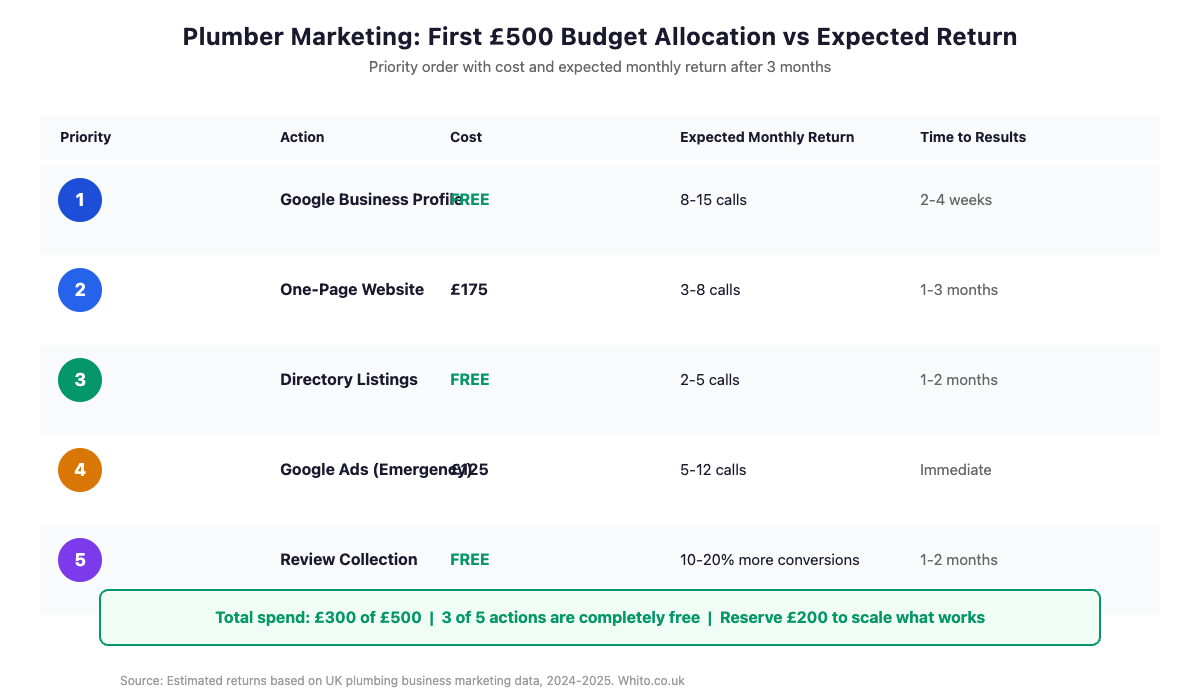
Google Business Profile: £0. One-page website: £150-200. Directory listings: £0. Google Ads (emergency keywords): £100-150. Review collection: £0. Total: £250-350 in hard costs, leaving budget in reserve.
The remaining £150-250 stays in your pocket until you know what is working. If Google Ads convert, put more in. If they do not, spend it on getting your website ranking for your key service areas instead.
The bottom line
Most plumbers spend their first marketing budget on the wrong things because someone sold them on it. The right order is: free foundations first, then small paid tests, then scale what works.
You are a plumber competing against other plumbers who are mostly not doing this properly. That is not a problem. That is your gap to fill.
Get the basics right. Let them compound. Then decide what to spend money on based on evidence, not guesswork.