
Last Updated on May 20, 2026
TL;DR
Sims Hilditch leads UK interior design websites in 2026 with an overall score of 8.6/10, driven by strong project case studies, polished UX, an active journal, and clear positioning as the go-to studio for elegant British country house design. Studio Ashby (7.7) and Banda Property (7.3) follow.
The biggest differentiator is not how beautiful the photography is. Every studio at this level has beautiful photography. It is whether the website turns that photography into a reason to get in touch. Case studies with context, clear service descriptions, and an obvious path from browsing to enquiry separate the leaders from the galleries.
Three things that separate the best from the rest: project case studies that tell a story (not just a photo grid), a services page that explains what working with the studio actually looks like, and a website that loads fast and works properly on a phone.
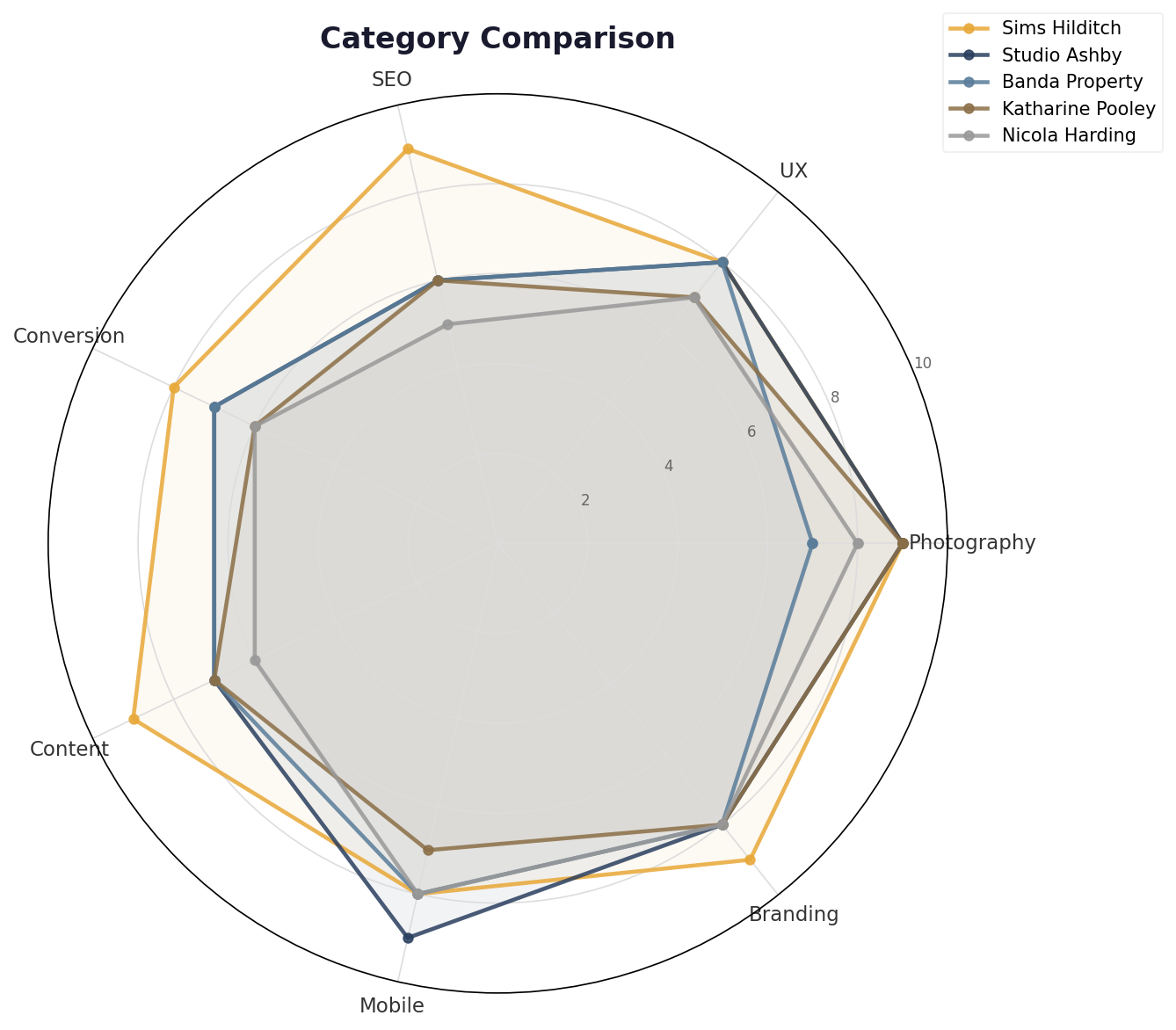
This post scores all five studios across photography, UX, SEO, conversion, content, mobile experience and branding, with practical takeaways you can apply to your own site.
Top 5 UK Interior Designer Websites Breakdown (2026)
Most interior design websites are online galleries. They look good. They display the work. And they do almost nothing else.
The best ones go further. They answer the questions a potential client has before they pick up the phone: what does this designer specialise in, how much does it cost, what is the process, and is this person right for my project?
This is a full breakdown of five UK interior design studios with websites that go beyond pretty pictures. Photography, user experience, SEO, conversion design, content depth, mobile performance and branding. All compared side by side with scores and practical takeaways.
Whether you run a design studio, work as an independent designer, or are rebuilding your website from scratch, this is the benchmark. If you are at the Build stage, this is what “good” looks like. If you are at the Start stage, focus on the quick wins at the bottom.
WHAT’S IN THIS BREAKDOWN
- The five studios
- Photography and portfolio presentation
- User experience and navigation
- SEO and search visibility
- Conversion design (turning visitors into enquiries)
- Content depth (case studies, blog, resources)
- Mobile experience
- Branding and positioning
- Key lessons and quick wins
- Overall website scorecard
- Frequently asked questions
1. The Five Studios
These are not the five largest UK interior design firms by revenue. They are five with notably strong websites that demonstrate different approaches to presenting design work online in 2026.
Sims Hilditch
Studio Ashby
Katharine Pooley
Nicola Harding & Co
Banda Property
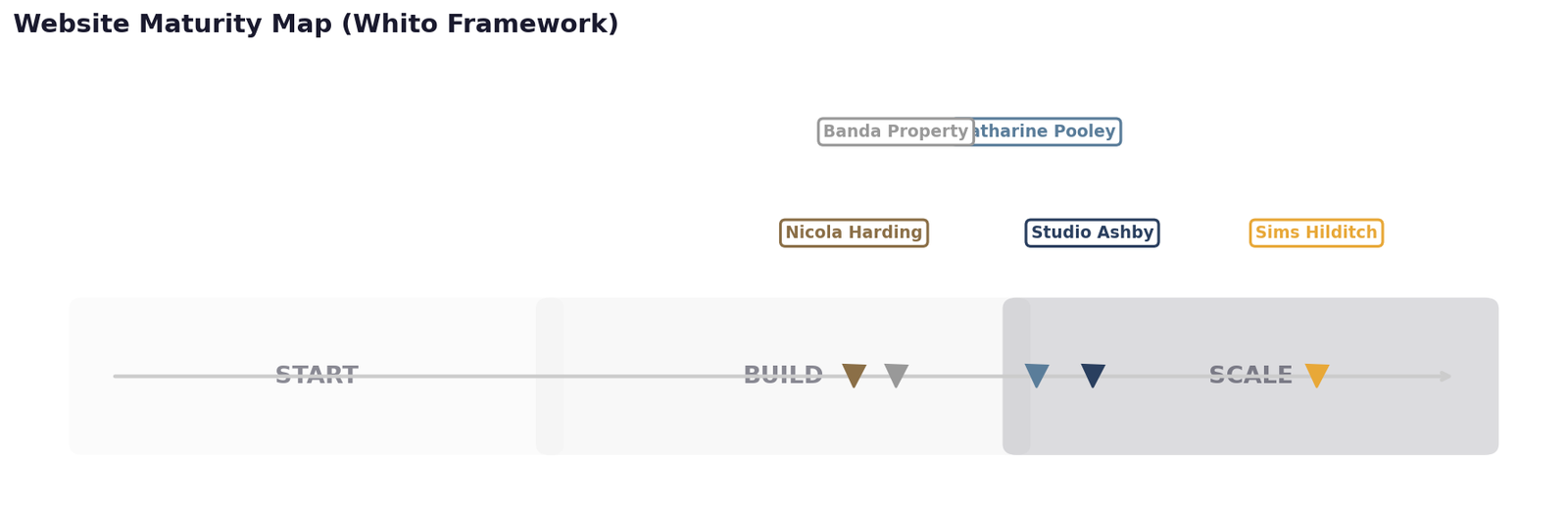
WEBSITE MATURITY MAP (2026)
Where each studio’s website sits on the Whito framework based on how well it works as a marketing tool, not just a portfolio.
START → BUILD → SCALE
- Sims Hilditch: Scale stage (full content ecosystem, journal, project filtering, clear conversion paths)
- Studio Ashby: Build/Scale (strong design, growing content, clean UX)
- Katharine Pooley: Build/Scale (strong portfolio, awards, shop integration)
- Nicola Harding & Co: Build stage (beautiful presentation, limited conversion structure)
- Banda Property: Build stage (clear services, multi-disciplinary positioning, growing content)
2. Photography and Portfolio Presentation
Photography is not a feature of an interior design website. It is the website. Every image is a piece of evidence. The studios that win here are the ones where every project tells a complete visual story, not just a collection of room shots.
| Studio | Image Quality | Project Depth | Consistency | Standout Feature |
|---|---|---|---|---|
| Sims Hilditch | Professional architectural photography throughout | Full project pages with multiple rooms, design narrative | Highly consistent colour grading and styling | Projects filterable by type (country house, London, international) |
| Studio Ashby | Editorial-quality photography with natural light emphasis | Full project pages, curated selection | Consistent warm, layered aesthetic | Photography feels like a magazine editorial |
| Katharine Pooley | High-end professional photography, dramatic lighting | Full project pages with room-by-room breakdowns | Consistent luxury aesthetic | Wide-angle and detail shots give a complete sense of each space |
| Nicola Harding | Atmospheric, warm photography with strong sense of place | Project pages with curated image selection | Consistent moody, layered tone | Photography captures atmosphere and emotion, not just rooms |
| Banda Property | Clean professional photography | Project pages with multiple images | Consistent pared-back aesthetic | Photography matches the "old meets new" design philosophy |
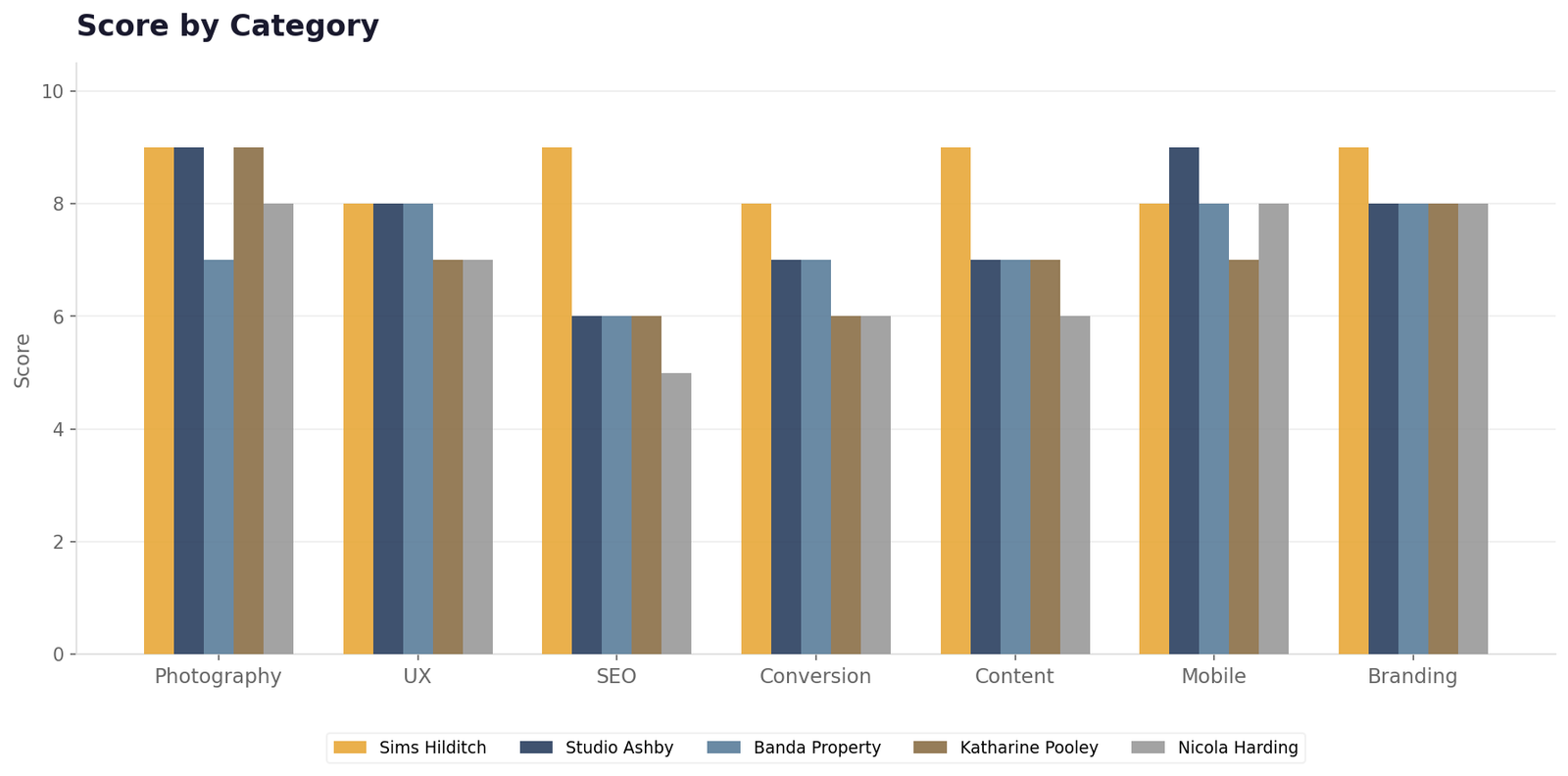
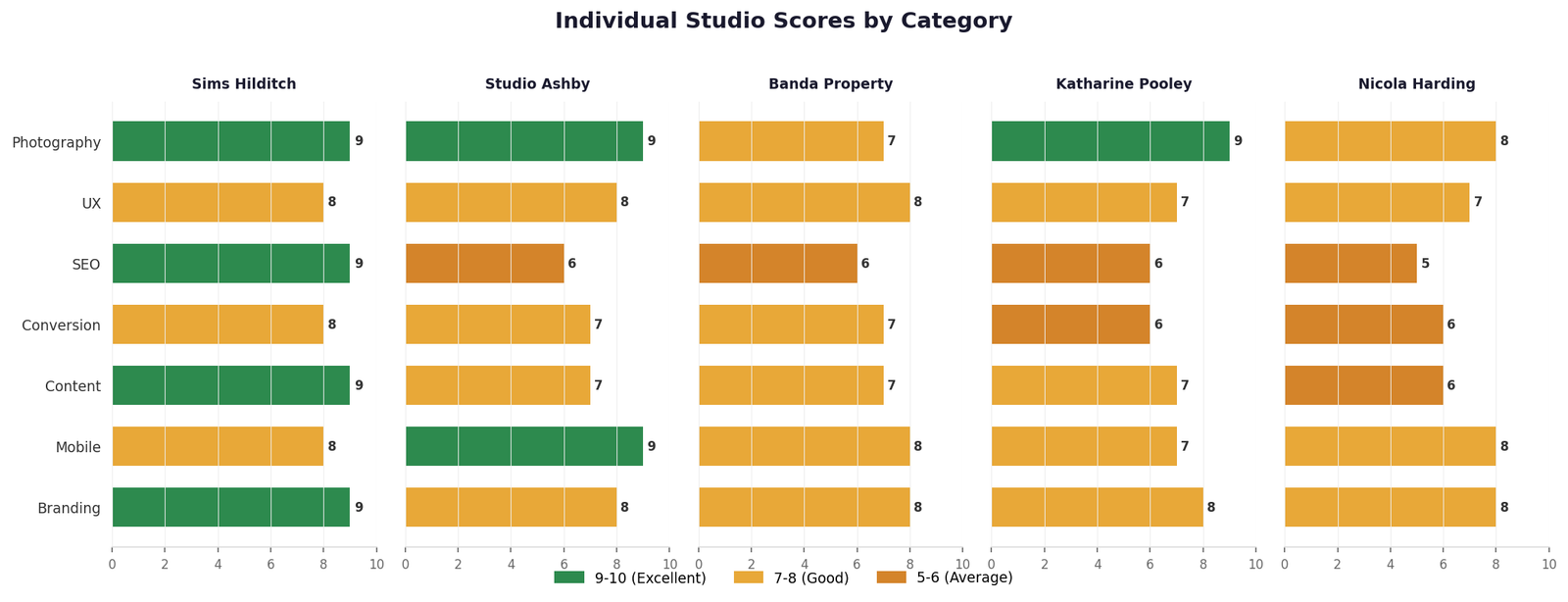
Whito takeaway: All five studios use professional architectural photography. That is table stakes at this level. The difference is in storytelling. Sims Hilditch lets you filter projects by type, so a potential client looking for country house design lands on relevant work immediately. Studio Ashby’s photography feels like a feature in Elle Decoration, which is exactly the point. For smaller studios, the lesson is not “spend more on photography” (though you should invest in it). It is to present each project as a complete story with enough images to show the full scope of your work.
A beautiful website that is hard to navigate is a beautiful website that loses clients. The studios winning on UX make it easy to find relevant projects, understand services, and get in touch without hunting for a contact page.
| Studio | Navigation | Filtering | Load Speed | Standout Feature |
|---|---|---|---|---|
| Sims Hilditch | Clean top nav with clear categories | Filter by project type (country, city, international) | Good | Project filtering saves visitors time and shows specialisms clearly |
| Studio Ashby | Minimal nav, editorial layout | By project (no category filter) | Fast | Restraint in design keeps focus entirely on the work |
| Katharine Pooley | Traditional nav with portfolio, about, shop | By project (no category filter) | Moderate | Shop integration turns website into a revenue channel |
| Nicola Harding | Simple nav, image-led layout | By project (no category filter) | Good | Image-forward design puts the work first |
| Banda Property | Clear nav with services breakdown | By project (no category filter) | Good | Services page clearly explains the end-to-end model |
Whito takeaway: Sims Hilditch is the only studio in this group offering project filtering, and it matters. A potential client looking for a Cotswolds country house renovation does not want to scroll past London apartments to find relevant work. For any designer serving more than one project type or location, adding basic filtering (by room type, project type, or area) is one of the highest-impact UX improvements you can make. Banda Property earns credit for having one of the clearest services pages in the group, breaking down exactly what each service includes.
4. SEO and Search Visibility
Most interior designers treat SEO as an afterthought. The websites winning on search are the ones that have pages matching what potential clients actually type into Google, whether that is “interior designer Cotswolds” or “how much does an interior designer cost.”
| Studio | Page Titles | Blog/Journal | Location Targeting | Service Pages |
|---|---|---|---|---|
| Sims Hilditch | Descriptive, keyword-aware titles on project pages | Active journal with design insights and project stories | Mentions Cotswolds and London across the site | Services page with clear breakdown |
| Studio Ashby | Clean but minimal keyword targeting | No active blog | London referenced but not heavily targeted | About page covers services (no dedicated page) |
| Katharine Pooley | Descriptive project titles with location names | Press section (not a blog) | London and international referenced | No dedicated services page |
| Nicola Harding | Clean project titles | No active blog | London referenced | No dedicated services page |
| Banda Property | Descriptive titles with service keywords | No active blog | London referenced | Strong dedicated services page |
Whito takeaway: Sims Hilditch is the clear winner on SEO because it is the only studio consistently publishing content through its journal. Blog content ranks in Google, builds authority, and gives potential clients a reason to visit the site before they are ready to hire. The rest of the group is leaving search traffic on the table. For any designer, the minimum SEO play is three things: descriptive project titles that include the location (not “Project 12”), a Google Business Profile with reviews, and one blog post per month answering a question your clients commonly ask.
5. Conversion Design
A portfolio that generates enquiries is fundamentally different from a portfolio that generates compliments. The studios winning on conversion make it obvious what to do next, qualify leads before the first call, and remove friction from the enquiry process.
| Studio | CTA Visibility | Enquiry Form | Qualifying Questions | Standout Feature |
|---|---|---|---|---|
| Sims Hilditch | Visible in nav, mentioned throughout | Yes, with project details fields | Asks about project type and location | Form gathers useful project context before the first conversation |
| Studio Ashby | In nav, minimal prompting | Basic contact form | Minimal qualifying | Clean and simple, matches brand restraint |
| Katharine Pooley | In nav | Basic contact form | Minimal qualifying | Multiple office locations listed |
| Nicola Harding | In nav | Basic form or email | Minimal qualifying | Simple and direct |
| Banda Property | In nav, services pages link to contact | Yes, with project interest fields | Asks about service type | Services pages naturally funnel towards enquiry |
Whito takeaway: None of these five studios are doing conversion design particularly aggressively, which is common in luxury design where the brand deliberately avoids “salesy” tactics. But Sims Hilditch and Banda Property both stand out for having forms that gather project context, which means the first conversation is more productive. For most interior designers, the single biggest conversion improvement is adding three qualifying questions to your contact form: project type, location, and rough timeline. This filters out tyre-kickers and gives you something useful to respond to.
6. Content Depth
The websites that build long-term authority are the ones publishing content beyond their portfolio. Case studies that explain the design process, blog posts that answer client questions, and resources that position the studio as an expert in their niche.
| Studio | Case Studies | Blog/Journal | Process Content | Standout Feature |
|---|---|---|---|---|
| Sims Hilditch | Detailed project pages with design narrative and multiple rooms | Active journal with regular posts | Some process insight in journal posts | Journal builds SEO authority and gives the site freshness beyond portfolio |
| Studio Ashby | Project pages with curated photography and brief descriptions | No active blog | Limited | Sister product line adds commercial depth |
| Katharine Pooley | Project pages with room-by-room photography | Press section collects media features | Limited | Press section acts as third-party validation |
| Nicola Harding | Project pages with atmospheric photography | No active blog | Limited | NiX lifestyle brand adds a product dimension |
| Banda Property | Project pages with photography | No active blog | Services page explains the process clearly | Services page is the strongest content asset |
Whito takeaway: Sims Hilditch is the only studio here with an active content programme, and it shows in their search visibility and brand authority. For the others, the press and awards sections do good work as trust signals, but they rely on third-party coverage rather than building their own content engine. For any interior designer, the quickest content win is turning your existing project photography into proper case studies: the brief, the challenge, the design decisions, and the outcome. You already have the photos. You just need the words.
7. Mobile Experience
Over 60% of web traffic is mobile. A potential client browsing on their phone during a renovation planning session needs to see your best work, understand your services, and contact you without pinching and zooming.
| Studio | Mobile Layout | Image Loading | Mobile Nav | Standout Feature |
|---|---|---|---|---|
| Sims Hilditch | Fully responsive, clean mobile layout | Images optimised, reasonable load times | Hamburger menu, clear and functional | Full project pages work well on mobile with no loss of content |
| Studio Ashby | Responsive minimal layout | Fast image loading | Clean hamburger menu | Minimal design translates beautifully to mobile |
| Katharine Pooley | Responsive layout | Moderate load times (heavy imagery) | Functional mobile nav | Portfolio browsing works on mobile, though some pages feel heavy |
| Nicola Harding | Responsive layout | Good load times | Simple mobile nav | Image-led design works well on smaller screens |
| Banda Property | Responsive layout | Good load times | Clear mobile nav | Services page structures well on mobile |
Whito takeaway: Studio Ashby’s minimal design gives it a natural advantage on mobile. Less visual clutter means faster loading and cleaner small-screen browsing. For designers with image-heavy portfolios (which is all of them), the key is image compression. A 5MB hero image that looks identical at 500KB is costing you visitors. Compress your images, use modern formats like WebP, and test your own site on your phone. If you would not hire yourself based on the mobile experience, fix it.
8. Branding and Positioning
Branding for an interior designer is not a logo. It is the instant impression a potential client gets when they land on your site: who is this for, what do they do, and should I keep looking?
| Studio | Brand Position | Tone of Voice | Target Client | Standout Feature |
|---|---|---|---|---|
| Sims Hilditch | Extraordinary interior design inspired by the British countryside | Approachable, confident, British | Luxury residential clients seeking country house and London design | Positioning is immediately clear: British country elegance |
| Studio Ashby | Richly layered interiors with a focus on art, craft, and storytelling | Understated, creative, considered | Design-conscious clients seeking soulful, layered spaces | Editorial quality reinforces creative credibility |
| Katharine Pooley | British Interior Designer of the Decade | Authoritative, refined, global | Ultra-high-net-worth clients seeking bespoke luxury | Awards and accolades are the primary trust signal |
| Nicola Harding | Places people feel enchanted by and connected to | Warm, personal, storytelling-led | Clients seeking characterful residential and boutique hospitality design | Feels personal and human, not corporate |
| Banda Property | Design for Living with end-to-end property services | Professional, clear, direct | Clients wanting architecture, design, and build under one roof | Clearest proposition: one team handles everything |
Whito takeaway: Every studio here has a clear brand position, but they express it differently. Sims Hilditch tells you exactly what they do and who they do it for within seconds of landing on the homepage. Banda Property’s proposition is the most differentiated because it offers something structurally different (design and build combined). Nicola Harding feels the most personal. For smaller studios, the lesson is that your positioning needs to be obvious before someone scrolls. If a visitor cannot tell what you specialise in, where you work, and what kind of client you serve within 5 seconds, your homepage needs rewriting.
9. Key Lessons for Any UK Interior Designer
You do not need a Sims Hilditch budget to build a website that wins clients. You need the elements that actually drive enquiries, applied consistently.
| Area | What Winners Do | Common Mistake | Quick Win |
|---|---|---|---|
| Photography | Professional architectural photography, consistent styling, full project stories | Using phone photos, inconsistent lighting, showing only one room per project | Invest in one professional shoot of your best project and make it the centrepiece of your site |
| UX | Clean navigation, project filtering, clear path from portfolio to contact | Confusing menus, no filtering, burying the contact page | Add project categories (by room type or project type) so visitors find relevant work faster |
| SEO | Descriptive project titles with locations, active blog, Google Business Profile | Projects named "Project 7", no blog, no alt text on images | Rename every project page to include location and type (e.g. "Victorian Terrace, Clifton, Bristol") |
| Conversion | Contact form with qualifying questions, clear CTAs, pricing guidance | Contact page with just an email address, no qualifying questions | Add three fields to your contact form: project type, location, and rough timeline |
| Content | Project case studies with narrative, blog answering client questions | Portfolio is just a photo grid with no context, no blog | Write a 300-word description for each project covering the brief, challenge, and outcome |
| Mobile | Compressed images, responsive layout, easy contact on small screens | Uncompressed 5MB images, text too small to read | Test your site on your phone right now and fix anything that frustrates you |
| Branding | Clear specialism visible on homepage, consistent visual identity | Generic "full-service design" positioning, inconsistent photography styles | Write one sentence: who you design for, what you specialise in, where you work. Put it on your homepage. |
10. Overall Website Scorecard (2026)
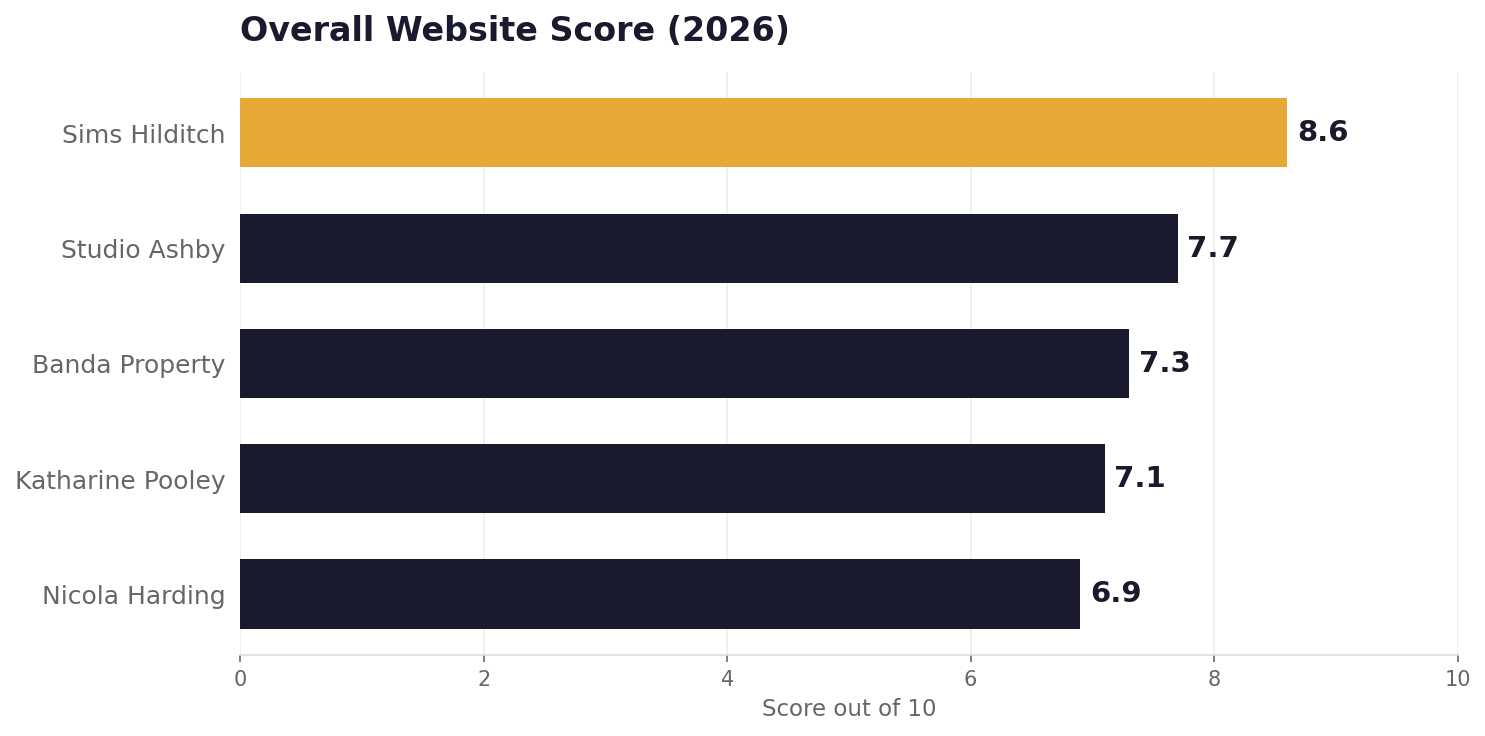
Each studio scored out of 10 across seven website criteria. Scores are based on publicly visible website features, not internal analytics.
| Studio | Photo | UX | SEO | Conversion | Content | Mobile | Branding | Overall |
|---|---|---|---|---|---|---|---|---|
| Sims Hilditch | 9 | 8 | 9 | 8 | 9 | 8 | 9 | 8.6 |
| Studio Ashby | 9 | 8 | 6 | 7 | 7 | 9 | 8 | 7.7 |
| Banda Property | 7 | 8 | 6 | 7 | 7 | 8 | 8 | 7.3 |
| Katharine Pooley | 9 | 7 | 6 | 6 | 7 | 7 | 8 | 7.1 |
| Nicola Harding | 8 | 7 | 5 | 6 | 6 | 8 | 8 | 6.9 |
OVERALL SCORE AT A GLANCE
- Sims Hilditch: 8.6 / 10
- Studio Ashby: 7.7 / 10
- Banda Property: 7.3 / 10
- Katharine Pooley: 7.1 / 10
- Nicola Harding & Co: 6.9 / 10
Each Studio’s Biggest Strength and Biggest Gap
| Studio | Strongest Area | Weakest Area | Biggest Opportunity |
|---|---|---|---|
| Sims Hilditch | SEO + Content (9/10) | Mobile (8/10) | Already strong across the board, could add pricing guidance to further qualify leads |
| Studio Ashby | Photography + Mobile (9/10) | SEO (6/10) | Starting a blog or journal would significantly boost search visibility |
| Katharine Pooley | Photography (9/10) | Conversion (6/10) | Adding qualifying questions to contact form and a services page with process detail |
| Nicola Harding | Branding + Mobile (8/10) | SEO (5/10) | Adding blog content answering common client questions would transform search visibility |
| Banda Property | UX + Branding (8/10) | Photography (7/10) | Investing in more consistent, editorial-quality project photography |
11. Frequently Asked Questions
Which UK interior designer has the best website in 2026?
Sims Hilditch leads UK interior designer websites in 2026 with an overall score of 8.6 out of 10. The website combines strong project case studies, an active journal, project filtering by type, and clear brand positioning. It is the only studio in this comparison consistently publishing content that builds SEO authority beyond the portfolio itself.
What makes an interior design website effective at winning clients?
The websites that win clients go beyond beautiful photography. They include project case studies with context (the brief, the challenge, the outcome), a clear services page explaining how the process works, a contact form with qualifying questions, and content that answers the questions potential clients search for on Google. Photography gets people to the site. Structure and content get them to enquire.
Do interior designers need a blog on their website?
A blog is not mandatory, but it is the single most effective way to appear in Google search results for the questions potential clients ask before hiring a designer. Terms like “how much does an interior designer cost UK” or “interior designer for period properties” get hundreds of searches per month. A studio that publishes one article per month answering these questions will build search traffic that compounds over time. Sims Hilditch is the only studio in this comparison doing this consistently, and their search visibility reflects it.
How important is mobile for interior design websites?
Over 60% of web traffic is mobile. For interior design, where clients often browse during the research phase (evenings, weekends, while visiting a property), mobile performance is critical. A site that loads slowly or displays poorly on a phone loses potential clients before they see the portfolio. Image compression is the single biggest factor. A 5MB hero image that could be 500KB with no visible quality loss is the most common mobile performance killer on design websites.
Should interior designers include pricing on their website?
You do not need to publish fixed prices. But a starting point (“projects typically start from £X”), a day rate, or a “typical project range” does three things: it filters out enquiries from clients who cannot afford your services, it builds trust by being transparent, and it saves you hours on calls with the wrong people. None of the five studios in this comparison publish pricing, which is common at the luxury end. For designers working at mid-market price points, pricing guidance is a competitive advantage most of your competitors will not offer.
MORE INDUSTRY LEADERBOARDS
See how the top companies in other industries compare across the same marketing channels.
- Cleaning Companies Marketing Leaderboard
- Beauty Salons Marketing Leaderboard
- Recruitment Agencies Marketing Leaderboard
- Trades & Home Services Marketing Leaderboard
How We Scored This
Each studio was scored out of 10 across seven website criteria. Scores are based on publicly visible website features only: portfolio presentation, navigation structure, page speed, content depth, mobile responsiveness, SEO fundamentals and brand clarity. We did not have access to internal analytics, enquiry rates or conversion data.
Scores reflect the strength of each website relative to the other four studios in this comparison, not against an absolute standard. This breakdown will be updated annually. Data was collected in May 2026.
Studios were selected based on website quality and variety of approach, not revenue or company size. This is a website comparison, not a design quality review.
Research compiled by Whito, May 2026. Data sourced from studio websites, Google PageSpeed Insights, search visibility analysis and publicly available company information. Scores are based on visible public website features and are not endorsed by the studios listed.
What to Read Next
- SEO for Interior Designers: What the Data Actually Says goes deeper on the search channel specifically.
- The UK Interior Design Marketing Playbook walks through the complete system from positioning to pipeline.
- How UK Interior Designers Actually Get Clients in 2026 covers the full breakdown of acquisition channels.