Last Updated on September 15, 2026
Every UK business waiting for the new late payment law to fix its cash flow is waiting for a right it already has.
The Commercial Payments Bill is the Government’s late payment legislation. Introduced in the House of Lords on 19 May 2026, unopposed second reading on 9 June, 30 government amendments in committee, committee stage finished 21 July. It is now at report stage in the Lords and it has not reached the Commons.
Enterprise Nation’s Growth On Hold report, out last week, surveyed 526 UK small businesses. Of those, 69 per cent had delayed or cancelled a growth plan in the past year and half had cut investment.
So the law is a long way off and the cash is short.
The Bill’s headline interest rate is one you can already charge
The Government’s response to its late payment consultation says it intends “to make it a requirement that all commercial contracts will contain a right to statutory interest at 8% above the Bank of England base rate”.
Eight per cent above base is not a new rate. It is the rate in the Late Payment of Commercial Debts (Interest) Act 1998, and it has been there the whole time.
GOV.UK sets out the mechanics. For invoices becoming late between 1 July and 31 December, the base rate used is the one in force on 30 June; for the first half of a year, the one in force on 31 December. Base rate was 3.75 per cent on 30 June 2026, so an invoice that went late in the second half of this year carries statutory interest of 11.75 per cent a year.
On top of that you can charge a fixed sum for the cost of recovery, once per late payment: £40 on debts up to £999.99, £70 from £1,000 to £9,999.99, and £100 at £10,000 or more.
You do not need a late payment clause in your contract to use any of it. The one thing that takes it away is a different interest rate you agreed to in the contract.
What the Bill changes, and what it does not
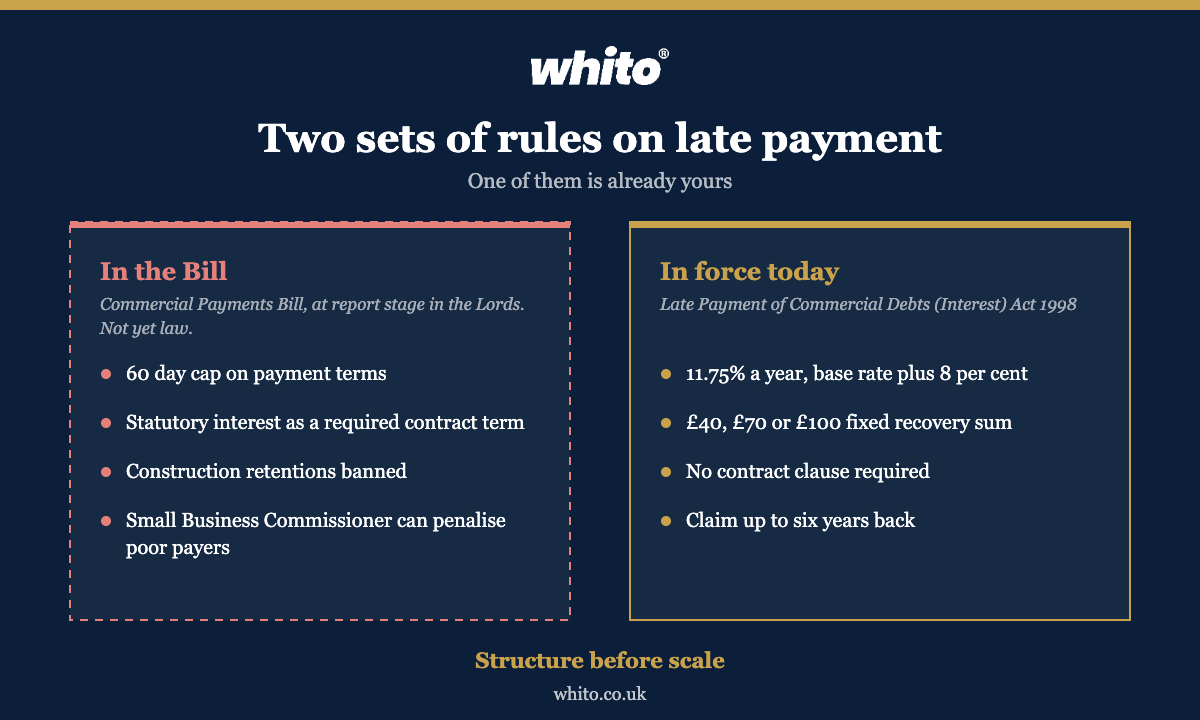
| Point | In force today | Intended under the Bill |
|---|---|---|
| Interest rate on a late invoice | Base rate plus 8 per cent, so 11.75 per cent for the second half of 2026 | Base rate plus 8 per cent |
| Can it be written out of a contract | Yes, if you agree a different rate | Intended to become a required term in all commercial contracts |
| Fixed recovery sum | £40, £70 or £100 by size of debt | Not the subject of the headline changes |
| Maximum payment terms | Longer than 60 days allowed if fair to both businesses | Maximum of 60 days intended, with strictly limited exemptions |
| Who enforces it | You do, by invoicing for it | Small Business Commissioner given powers to adjudicate disputes and penalise poor payers |
The Bill is worth having, mostly for the 60 day cap, the construction retentions ban and an enforcer who is not you. On the interest rate, it locks in something you can already invoice for.
The figures behind the impatience
Evidence given to the Commons Business and Trade Committee, cited in the House of Lords Library briefing on the Bill, puts the share of SME invoices paid late at 44 per cent. The Government’s consultation response puts the cost to the UK economy at almost £11 billion a year, with 14,000 businesses closing annually, or 38 a day.
Two smaller figures in that document matter more to you than the national totals. Businesses are owed an estimated £26 billion at any one time, an average of £17,000 per affected business. And owners affected by late payment spend an average of 86 hours a year chasing invoices. Price those hours at your own day rate, using our comparison of freelance and agency day rates in the UK, and the chasing alone is a cost line.
Structure before scale.
Late payment is not a marketing problem, but it sets your marketing budget. With £17,000 of finished work sitting unpaid, the ad spend and the website rebuild get postponed. Our study of what UK marketing work actually costs shows what that money buys. Fix collection before you fix reach.
Why hardly anyone charges it
Because invoicing a customer for interest feels like picking a fight with someone you need. That is a real commercial judgement.
Look at what the fear funds, though. A customer who pays in 75 days because nothing happens when they do is running their working capital on yours, at zero per cent. You became their cheapest lender without being asked and without being paid. Charging the interest is not the only option either. Naming it is often enough.
What to do this week
- Read your own contract first. If it names an interest rate lower than base plus 8 per cent, that clause is what you get instead of the statutory rate. Saying nothing about interest leaves you better off than saying something bad.
- Work out what one overdue invoice is worth. The Small Business Commissioner runs a free interest calculator that applies the 1998 Act, including the base rate rule and the fixed compensation.
- Put the entitlement on the invoice. One line saying overdue amounts may carry statutory interest at 8 per cent above base plus the fixed recovery sum. That is a statement of law, not a threat.
- Take your biggest overdue invoice and issue a separate interest and compensation invoice for it. GOV.UK says to send a new invoice rather than adjust the old one, and you can claim up to six years back.
- Get the chasing into software. Reminders on a schedule take the decision out of every individual invoice. We looked at one common UK option in our FreeAgent review. For costs across the main tools, see our invoicing software comparison.
The takeaway
The Commercial Payments Bill is still in the Lords, and the 60 day cap and the retentions ban are worth waiting for. The interest is not. Base plus 8 per cent, 11.75 per cent right now, plus £40, £70 or £100, and no clause required. The only person stopping you invoicing for it is you.