Last Updated on September 19, 2026

Some links in this article are commission-based, meaning we may earn a small fee if you purchase through them, at no extra cost to you. They do not buy a place in any ranking. Full disclosure: https://whito.co.uk/how-we-make-money/ and https://whito.co.uk/review-methodology/
Electricians are the most regulated trade on the average street and the worst at showing it. The paperwork exists: scheme registration, Part P, the 18th Edition, insurance. Then the website says “all electrical work undertaken, no job too small” next to a Hotmail address, and the customer, who cannot tell a competent person scheme from a loyalty card, picks whoever looked most official. This guide fixes that, and points the site at the one page that produces repeat work rather than one-off socket jobs.
More for the trade lives at whito.co.uk/electricians/.
Lead with the proof, because you actually have it
Most trades have to manufacture trust. You have it issued to you by a scheme. Use it in this order:
Scheme registration. NICEIC or NAPIT, logo and registration number in the header of every page, linked to your entry on the scheme’s public register so a suspicious customer can check in one tap. Suspicion converting to confidence is the whole transaction.
Part P, translated. Customers do not know what Part P is. One sentence on the site: “We are registered to self-certify notifiable electrical work, so you get a compliance certificate without paying Building Control separately.” That sentence quietly explains why the cheap unregistered quote is not cheap. Never imply you can self-certify if you are not scheme-registered; that is the trade’s version of writing cheques you cannot cash, with Building Control holding the chequebook.
Photos of your boards. One good photograph beats ten paragraphs: a consumer unit you fitted, circuits labelled in legible handwriting, cables dressed straight. Electricians read tidiness as competence and so, instinctively, does everyone else. No stock sparks, no American breaker panels, and every image licensed for use without attribution.
The pages: seven, and three of them are certificates on legs
Name the pages after the jobs, in the customer’s words:
- Home
- EICR / landlord electrical certificates
- Consumer unit upgrades
- EV charger installation
- Rewires and extra sockets
- Fault finding (the tripping fuse box page)
- Contact and areas covered
EICR, consumer unit and EV charger each earn their own page because each is a different buyer with a different trigger: a legal deadline, a scary noise from the hallway cupboard, a new car on order. A single “domestic electrical services” page gives Google nothing to rank and gives none of those three buyers the feeling of being understood.
The money page is the EICR page, and it is a subscription in disguise
A rewire is a bigger invoice, but the EICR is the better business. Rental properties in England need one at least every five years, landlords forget, and letting agents manage dozens of properties each. One agent who trusts your turnaround is a standing order.
Build the page like this:
The order of blocks on an EICR landing page: fixed price first, what happens on the day, the C1 C2 and C3 codes in plain English, a landlord and letting agent portfolio block, then booking.
The money page
The EICR page, block by block
Top of page
“EICR in Bristol: £165 fixed, up to 10 circuits”
The commodity buyer wants a number. Give it in the first line.
Block 2
What happens on the day
How long it takes, what gets switched off, what they receive.
Block 3
C1, C2 and C3 in plain English
Two sentences each. The remedial work goes to whoever explains them first.
Block 4
Landlords and letting agents: portfolio pricing
Aimed at eleven people in your town. It only has to land once.
Bottom
Book
Name, number, postcode, property type. Nothing else.
Price first, process second, jargon translated third, agents last. Copy the order before the wording.
- A fixed price in the H1. “EICR in Bristol: £165 fixed, up to 10 circuits.” The EICR is a commodity search and the commodity buyer wants a number. If circuits change your price, publish the bands.
- What the codes mean. Two sentences each on C1, C2 and C3, because the report you hand over is otherwise a page of alarming abbreviations, and the follow-up remedial work goes to whoever explained them first.
- The remedials promise. “If we find C1 or C2 faults, you get a fixed quote to fix them, and we do not fail boards to invent work.” Say it, because every landlord has been burned or has heard of one who was. Never promise a pass; promising a pass on an inspection you have not done is the fastest way to look like the cowboy you are differentiating against.
- An agent block. “Letting agents: bulk pricing, digital certificates within 24 hours, reminders before expiry.” That paragraph is aimed at eleven people in your town, and it only has to land once.
Where the work actually comes from: a van and a spreadsheet of postcodes
Local SEO for an electrician is the van-business playbook with one twist: half your best customers are businesses.
- Google Business Profile as a service-area business, home address hidden, towns listed honestly. Primary category “Electrician”, with EICR and EV charger services added as services and mentioned in the description.
- The EICR search has commercial intent all year round. Look at who ranks for it in your town before you write a word, then write a page that deserves to sit among them.
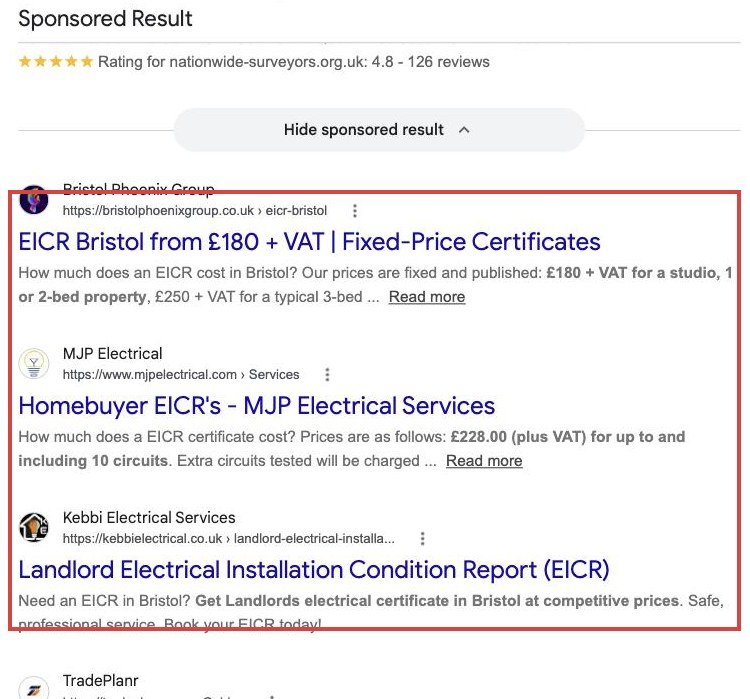
- Letting agents do not search Google for electricians; they inherit them. But they do check you out after an email. Your EICR page is the thing that makes your introduction email land, so send ten of those emails in launch week and let the page do the vouching.
- Reviews: ask the landlord, not the tenant, and ask them to mention the town and “EICR” by name.
The screen test, run at arm’s length
Hand your phone to someone, show them the homepage for five seconds, take it back. Ask three questions. Who is this? What would you tap to get a fuse box looked at? Are they qualified? If any answer is a shrug, the fold has failed. The passing layout is one headline (“NICEIC registered electricians in Bristol”), the scheme badge with a number, a tappable phone number, and two buttons: “Book an EICR” and “Electrical fault?”. No slider, no drone footage of your town, no mission statement.
Build it without becoming a web designer
The three ways a electrician gets a website built: doing it yourself on a website builder (£10–£20/mo), hiring a freelancer (£600–£1,500), or a monthly website deal (£40–£100/mo).
The three build routes
What a electrician website costs in 2026
Do it yourself
£10–£20/mo
Wix or similar plus a £10/yr domain. Seven pages and a sticky call button.
Freelancer
£600–£1,500
One-off. Bring this guide’s page list, your prices and your board photos.
Monthly deal
£40–£100/mo
Check who owns the domain and what happens when you stop paying.
The bands this guide uses throughout, side by side. Full reasoning in the build-route section below.
The default: DIY on Wix, £10 to £20 a month. Seven pages, fixed-price blocks, a booking-friendly contact form and a sticky call button are all comfortably inside Wix’s mobile templates, and there is no software to maintain while you are up a ladder. The comparisons that led us there: best website builders UK and Wix vs WordPress vs Squarespace.
The exception: if you are building a contracting firm rather than a diary, with commercial work, several vans and an intention to publish a page for every town and every service, start on WordPress with decent hosting (Hostinger is the one our review backs), and accept the updates and backups that come with it. Fifteen pages is the rough crossover.
Freelancer, £600 to £1,500: worth it if you hand over this article’s page list, your prices and your photos. Benchmark any quote against our electrician website cost guide. Monthly deals, £40 to £100: read who owns the domain and what happens when you stop paying, then read it again.
Buy the domain yourself either way, in your own account. wattselectrical.co.uk beats bristol-sparky-247.com, and it will still be yours if you ever fall out with whoever builds the site. Read our Namecheap review, then check current domain pricing, including the renewal price.
The homepage, done badly and done well
The bad version is real and everywhere: a navy template, a lightning-bolt logo, “Powering Bristol since 2009. All electrical work undertaken.” No scheme number, a form with nine fields, and the phone number as an image nobody can tap. It looks like every site the customer has just closed.
The good version opens “NICEIC registered electricians in Bristol. EICRs from £165, fault finding today, EV chargers from £949.” Registration number under the headline. Two buttons matching the two states of mind: booked-in-advance and mildly-on-fire. Below the fold: three labelled consumer unit photos, four Google reviews, the letting-agent paragraph. That is the whole homepage. It does not win a design award; it wins the letting agent.
Seven ways electricians’ sites go wrong
- No scheme number anywhere, making the registration you pay for invisible.
- “All electrical work undertaken”, the sentence that ranks for nothing and persuades no one.
- No prices on commodity work like EICRs, in a market where competitors print theirs in the search result title.
- EV chargers buried in a services list while you wait for the phone to ring with charger work.
- A nine-field quote form. Name, number, postcode, problem. Four fields.
- Stock photos of sparks. Sparks are what customers are afraid of.
- Treating letting agents as a lead source the site does not need to address, when they are the only customer who buys twelve EICRs at once.
Fifteen things to check before you tell anyone the site exists
- Scheme logo and registration number on every page, linked to the public register.
- EICR page live with a fixed price or published bands.
- C1, C2, C3 explained in plain English on that page.
- EV charger page live with a from-price.
- Fault-finding page names the symptoms customers type (“fuse box keeps tripping”).
- Phone number tappable and sticky on mobile.
- Two-button fold: book ahead, or urgent fault.
- Landlord and letting agent paragraph, with bulk pricing mentioned.
- Six or more photos of your own work, labelled boards included, licences clean.
- Google Business Profile: service-area mode, “Electrician” primary, EICR and EV charger listed as services.
- Five Google reviews minimum, newest embedded on the homepage.
- Domain bought by you, in your own Namecheap account, renewing on your own card.
- Forms tested to a monitored inbox, twice.
- Google Search Console verified, sitemap submitted. It is free and it is the only dashboard you need this year.
- Site read aloud by someone who is not an electrician, with every phrase they stumbled on rewritten.
Days 1 to 30
Send the ten letting-agent introduction emails in week one, each linking the EICR page. Text your last ten private customers the Google review link. In week two, photograph two finished jobs properly, daylight, straight-on, and add them with a line of context each. Week three, open Search Console, find the queries you already appear for, and move the exact wording into your page titles. Week four, raise your EICR price if the diary filled; the page that produced the demand can absorb a £10 rise nobody will notice.
Four questions electricians actually ask
Is a website worth it when all my work is word of mouth? Word of mouth now ends at a search box. The recommendation gets you considered; the site with the scheme number and the fixed price gets you chosen. They are one system.
Should I list prices when other sparks will see them? Your competitors already know the going rate for an EICR. The only person the secrecy hurts is the landlord who cannot compare you, so compares nobody and picks the agency’s usual firm.
Do I need a separate site for EV charging? No. A separate page, yes. A separate site splits your reviews, your domain history and your attention into two piles, neither big enough to rank.
What if I am NAPIT, not NICEIC? Same playbook, same prominence. Customers recognise neither brand as strongly as electricians assume; what they recognise is a registration number they can check, next to a person willing to be checked.