Last Updated on July 16, 2026
Most UK small business owners heard “Google update” this week and immediately assumed the worst.
Rankings tanked. Traffic dropped. Someone in a Facebook group said SEO is dead again.
Here is what actually happened, and what you should do about it.
What Google actually did
Google’s May 2026 Core Update finished rolling out on 2 June. It ran for 12 days. It was the fourth ranking update this year and the second major core update since March.
The update uses new Gemini-based quality models to decide which pages deserve to rank. The goal, according to Google, is to surface “original insights, genuine expertise, and helpful content.”
Translation: pages that exist purely to rank are getting pushed down. Pages that exist to help real people are getting pushed up.
Who got hit
Early data shows three categories took the biggest losses:
YMYL sites (health, finance, legal) that lacked clear expertise signals. E-commerce pages with thin product descriptions and no original content. Affiliate sites built around keyword volume rather than genuine recommendations.
If you run a local service business, a trades company, or a small consultancy with a proper website, you are likely fine. Local signals like your Google Business Profile, real customer reviews, and location-specific content remained stable through this update.
The real problem nobody is talking about
The bigger shift is not this single update. It is the pace.
Four ranking updates in five months. AI Overviews now appearing in 41% of UK search queries. Google is redesigning how search works in real time, and most small businesses are still optimising for a version of Google that existed two years ago.
The businesses getting hurt are not getting hurt by one update. They are getting hurt by a strategy that never adapted.
What to actually do
If your traffic dropped:
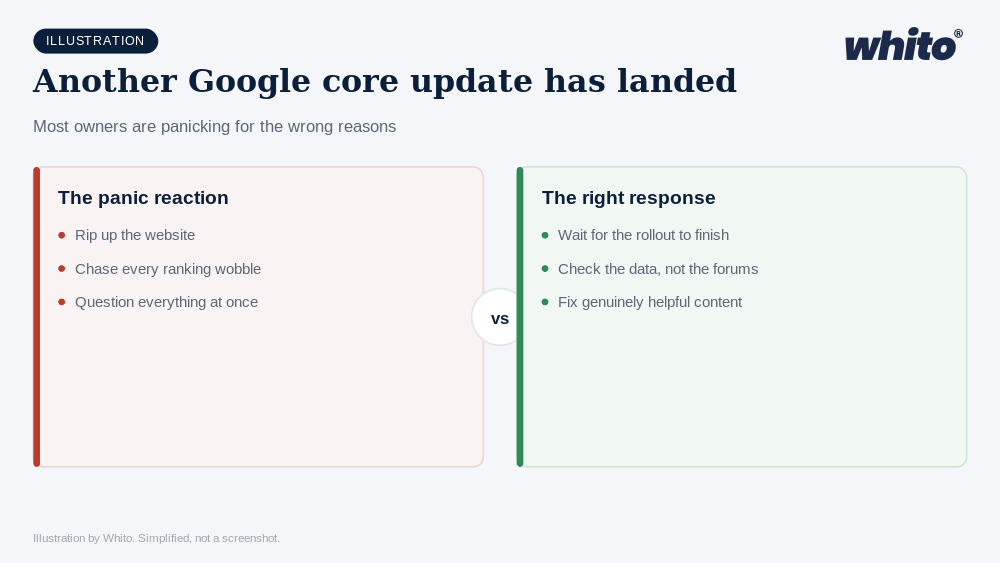
Check whether it dropped across your whole site or just specific pages. Open Google Search Console and compare the last 28 days against the previous period. If the drop is isolated to a few pages, those pages need work. If it is site-wide, you have a bigger content quality issue.
If your traffic stayed the same:
Good. But do not get comfortable. The next update is probably eight weeks away based on this year’s pattern. Use this window to strengthen what is already working.
If you are not sure what happened:
Look at your top 10 pages by traffic. Are they genuinely useful? Would you send them to a friend who asked that question? If the honest answer is no, that is your starting point.
Three things worth doing this week
First, check your Google Business Profile is complete and current. Local signals are holding strong while organic gets reshuffled. Make sure your opening hours, services, and photos are accurate.
Second, pick your three most important pages and read them as a customer. Not as a marketer. As someone who actually needs help. If they read like SEO content, rewrite them like advice.
Third, stop reading SEO Twitter threads about “what Google wants” and start talking to your actual customers about what they need. The businesses winning after this update are the ones who built their sites around real questions, not keyword tools.
Related reading: How to Choose an SEO Agency in the UK, Google May 2026 Core Update: What UK Businesses Should Do, and Google AI Mode Just Hit 1 Billion Users.
The takeaway
Google is not trying to kill small businesses. It is trying to kill lazy content. If your website exists to help real people solve real problems, you are on the right side of every update they will ever release.
Structure before scale. Substance before tricks. That has always been the rule. Google is just getting better at enforcing it.