
Data last verified: 24 November 2026. Figures re-checked against their primary sources under the Whito rolling re-verification programme.
Finding
Fire services in England issued 1,224 prohibition notices in the year to March 2026, up 55.3% on 2019/20 (788), while prosecutions fell 36.5% to 33.
Source: Whito, whito.co.uk/fire-safety/uk-fire-safety-enforcement, 2026-11-24. Free to quote with a link to this page.
By Jacob Whitmore · Published
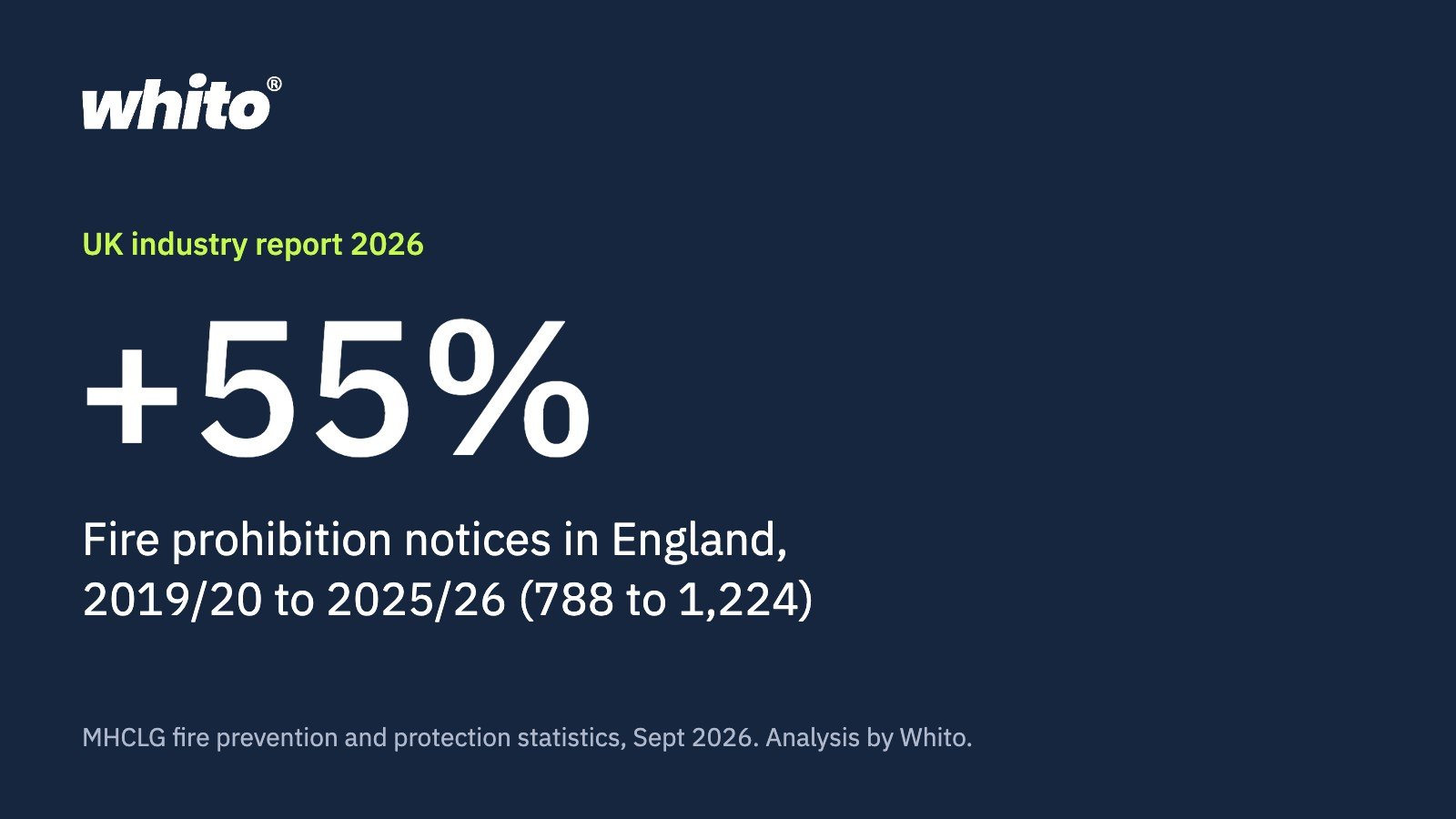
Short answer: Fire and rescue services in England issued 1,224 prohibition notices in the year to March 2026, up 26.8% on the year before (965) and up 55.3% on the year to March 2020 (788). Four in ten of the 50,195 fire safety audits they carried out (20,286, or 40.4%) found premises unsatisfactory. Prosecutions went the other way: 33, down from 52 in 2019/20.
A prohibition notice is the strongest step short of court. It stops or restricts the use of all or part of a building until the risk is fixed. Our reading of the numbers: fire services are finding more serious problems and closing more premises on the spot, but taking fewer owners to court.
All figures cover England only. They come from the Ministry of Housing, Communities and Local Government’s “Fire prevention and protection statistics, England, April 2025 to March 2026”, published 2 September 2026. The percentage changes and rates are Whito’s own calculations from that release. Analysis by Jacob Whitmore, 24 November 2026.
Key figures
- 50,195 fire safety audits in the year to March 2026, 3.7% more than in 2019/20 (48,414).
- 40.4% unsatisfactory, against 33.9% in 2019/20. The share has sat near 40% for three years.
- 1,224 prohibition notices, up 55.3% on 2019/20. That is 24.4 for every 1,000 audits, against 16.3 in 2019/20.
- 1,896 enforcement notices, up 40.8% on 2019/20.
- 33 prosecutions, down 36.5% on 2019/20. There was roughly one prosecution for every 100 formal actions (notices plus prosecutions), against about one in 44 in 2019/20.
- 9,271 audits found a breach of the duty to carry out a fire risk assessment (Article 9), 18.5% of all audits. In 2019/20 it was 13.9%.
Audits and outcomes, three years compared
| Measure | Year to Mar 2020 | Year to Mar 2025 | Year to Mar 2026 | Change since 2020 |
|---|---|---|---|---|
| Fire safety audits | 48,414 | 50,996 | 50,195 | +3.7% |
| Satisfactory | 31,978 | 30,301 | 29,909 | -6.5% |
| Unsatisfactory | 16,436 | 20,695 | 20,286 | +23.4% |
| Unsatisfactory share | 33.9% | 40.6% | 40.4% | +6.5 points |
| Average hours per audit | 4.4 | 5.2 | 5.6 | +1.2 hours |
Notices and prosecutions
| Action | Year to Mar 2020 | Year to Mar 2025 | Year to Mar 2026 | Change on a year | Change since 2020 |
|---|---|---|---|---|---|
| Informal notifications | 13,727 | 19,232 | 18,039 | -6.2% | +31.4% |
| Enforcement notices (Article 30) | 1,347 | 1,773 | 1,896 | +6.9% | +40.8% |
| Prohibition notices (Article 31) | 788 | 965 | 1,224 | +26.8% | +55.3% |
| Alteration notices (Article 29) | 108 | 253 | 202 | -20.2% | +87.0% |
| Prosecutions (Article 32) | 52 | 35 | 33 | -5.7% | -36.5% |
| Formal notifications, total | 2,295 | 3,026 | 3,355 | +10.9% | +46.2% |
Which premises fail most often
The release gives satisfactory rates for some premises types but not a full ranking. Of the types it reports for the year to March 2026:
| Premises type | Audits | Satisfactory |
|---|---|---|
| Purpose-built flats, 6 to 9 storeys | 1,303 | 49% |
| Licensed premises (pubs, bars, clubs) | 4,940 | 52% |
| Shops | 8,932 | 58% |
| Care homes | 6,004 | 61% |
| Schools | 2,234 | 72% |
Shops were the most audited type, 18% of all audits. Nearly half of licensed premises audited were found unsatisfactory. For owners of pubs, bars and shops this matters more than the national average: an audit is close to a coin toss.
What the inspectors found
One audit can record several breaches. These were the most common articles of the Regulatory Reform (Fire Safety) Order 2005 found broken:
| Breach | Year to Mar 2020 | Year to Mar 2026 | Change |
|---|---|---|---|
| Article 14: emergency routes and exits | 8,111 | 11,286 | +39.1% |
| Article 17: maintenance | 6,398 | 9,727 | +52.0% |
| Article 9: risk assessment | 6,723 | 9,271 | +37.9% |
| Article 8: general fire precautions | 6,149 | 8,792 | +43.0% |
| Article 15: serious and imminent danger | 5,003 | 7,955 | +59.0% |
What stands out
The paperwork is the problem a business can fix cheapest. Almost one audit in five found the fire risk assessment itself was missing, out of date or not good enough. Since 1 October 2023 every responsible person in England and Wales must record the whole assessment in writing, whatever the size of the business, according to London Fire Brigade’s guidance on the change. A missing record is now an easy breach to find.
Blocked exits and poor maintenance come first. Exits and maintenance breaches grew faster than audits. These are day-to-day management failures: fire doors wedged open, alarms not tested, escape routes used for storage.
Closure is now more likely than court. Prohibition notices rose 55% in six years while prosecutions fell by more than a third. For a small business, a prohibition notice on a kitchen, a stockroom or an upper floor can cost more in lost trade than a fine.
Audits take longer. The average audit rose from 4.4 to 5.6 hours. Unsatisfactory audits took 6.6 hours on average. Fire services are spending more time per building, not visiting many more.
What this means for a UK small business
- Check you have a written fire risk assessment for each premises, dated, with the name of whoever did it. If you cannot find it, that is the first job.
- Walk your escape routes this week. Nothing stored in corridors, fire doors closing on their own, exit signs lit.
- Keep a log of alarm tests, emergency lighting checks and extinguisher servicing. Maintenance was the second most common breach.
- If you pay someone to do the assessment, check their competence. Our fire risk assessment price and register check shows how.
What we do not know yet
- How many audits led to a prohibition notice by premises type. The release does not break notices down this way.
- Equivalent figures for Scotland, Wales and Northern Ireland. This release covers England only.
- Why prosecutions have fallen. The release gives counts, not reasons.
Method and limits
We read the MHCLG release on 24 November 2026 and took the figures as published. Percentage changes, shares and rates per 1,000 audits are Whito’s arithmetic. Fire services choose which premises to audit, mostly on risk, so the unsatisfactory share describes the premises they chose, not all UK businesses. Year-on-year comparisons can move when a fire service changes how it targets audits.
Questions
How many fire safety audits fail in England? 40.4% of the 50,195 audits in the year to March 2026 had an unsatisfactory outcome (20,286), according to MHCLG figures published 2 September 2026.
How many prohibition notices do fire services issue? 1,224 in England in the year to March 2026, up from 965 a year earlier and 788 in the year to March 2020.
Which premises fail fire safety audits most? Of the types MHCLG reports, purpose-built flats of 6 to 9 storeys had the lowest satisfactory rate (49%), followed by licensed premises (52%) and shops (58%).
Sources
- MHCLG: Fire prevention and protection statistics, England, April 2025 to March 2026 (published 2 September 2026, opened 24 November 2026)
- London Fire Brigade: Changes to fire safety law, how it affects you (opened 24 November 2026)
More on this sector: the Whito fire safety industry hub.