
Last Updated on October 22, 2026
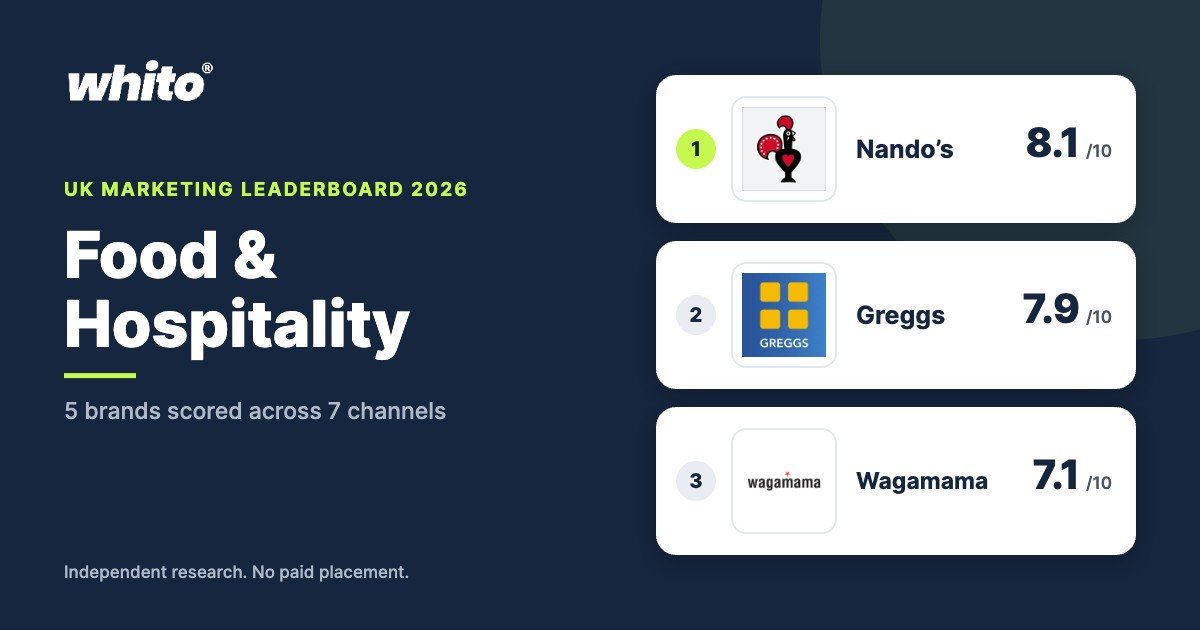
PizzaExpress scores highest of the ten UK restaurant and food brands compared, at 5.1 out of 10 on the Whito leaderboard.
Opinion and analysis. Whito read every brand below by hand on 22 October 2026, using publicly visible activity only, against fixed anchors and the same ten UK searches. Each channel is scored 0 to 10, set out under How we scored, so a score describes what we could see on the day, not the quality of the food. Brands cannot pay to appear or to change a score. Where a figure is not published, we say so.
Restaurant chains are household names, so it is easy to assume their marketing is strong everywhere. On our fixed anchors it is not. None of the ten appeared in any of 10 UK searches, and no brand scores above 4 on reviews.
PizzaExpress scores 5.1, just ahead of Côte and Nando’s on 5.0. PizzaExpress lets you book or order online with prices in its offers, has an app and club, and ran 44 Google ads. The searches went to booking platforms, guides and news sites, not the chains.
Leon scores lowest at 2.9. It takes no orders on its homepage, its LEON Club is a newsletter, and no Google ads or chain Trustpilot profile were found.
The leaderboard
| Rank | Brand | Social | Website | SEO | Paid | Reviews | Brand | Average | |
|---|---|---|---|---|---|---|---|---|---|
| 1 | PizzaExpress | 4 | 10 | 7 | 2 | 6 | 3 | 4 | 5.1 |
| 2 | Côte | 4 | 10 | 6 | 2 | 6 | 3 | 4 | 5.0 |
| 2 | Nando’s | 6 | 10 | 7 | 2 | 6 | 0 | 4 | 5.0 |
| 4 | Five Guys | 6 | 10 | 7 | 2 | 2 | 3 | 4 | 4.9 |
| 4 | Wagamama | 4 | 10 | 7 | 2 | 4 | 3 | 4 | 4.9 |
| 6 | Wingstop | 6 | 7 | 6 | 2 | 4 | 2 | 4 | 4.4 |
| 7 | Greggs | 6 | 7 | 7 | 2 | 2 | 3 | 2 | 4.1 |
| 8 | Dishoom | 6 | 10 | 2 | 2 | 2 | 2 | 4 | 4.0 |
| 8 | itsu | 6 | 6 | 2 | 2 | 4 | 4 | 4 | 4.0 |
| 10 | Leon | 4 | 6 | 2 | 2 | 2 | 0 | 4 | 2.9 |
Average is the simple mean of the seven channel scores, rounded to one decimal place. Brands on the same average share a rank and are listed A to Z. All ten brands read 22 October 2026. The Meta Ad Library could not be read on 22 October 2026, so Paid reflects Google ads only and is capped at 6. We will add Meta counts and update the scores when it can be read.
Company verdicts
PizzaExpress, 5.1
PizzaExpress scores 5.1, the highest of the ten. Its website scores 10 for booking and ordering with prices in its offers, and email 7 for its app and club. Paid scores 6 on 44 Google ads. Social scores 4 for three platforms. Reviews score 3, from 2.9 on 1,182 Trustpilot reviews with no replies, and pizzaexpress.com appeared in none of 10 UK searches.
Côte, 5.0
Côte scores 5.0, level second with Nando’s. Its website scores 10 for booking with prices shown, and paid 6 on 78 Google ads. Email scores 6 for a newsletter and loyalty scheme, and social 4 for three platforms. Côte is the only brand here that replies on Trustpilot, on 16 of its latest 20 reviews, but 2.9 from 43 reviews holds reviews to 3. cote.co.uk appeared in none of 10 UK searches.
Nando’s, 5.0
Nando’s scores 5.0, level second with Côte. Its website scores 10 for online ordering, email 7 for its Rewards app, and social 6 for four platforms. Paid scores 6 on 96 Google ads, the most on the board. Reviews score 0, because Trustpilot shows no rating for nandos.co.uk after a breach of its guidelines. nandos.co.uk appeared in none of 10 UK searches.
Five Guys, 4.9
Five Guys scores 4.9, level fourth with Wagamama. Its website scores 10 for online ordering, email 7 for a newsletter plus app, and social 6 for six platforms, the most linked on the board. No Google ads were found. Reviews score 3, from 2.3 on 1,503 Trustpilot reviews with no replies, and fiveguys.co.uk appeared in none of 10 UK searches.
Wagamama, 4.9
Wagamama scores 4.9, level fourth with Five Guys. Its website scores 10 for ordering and table booking, and email 7 for its soul club loyalty scheme. Social scores 4 for three platforms. Paid scores 4 on 6 Google ads. Reviews score 3, from 2.6 on 1,064 Trustpilot reviews with no replies, and wagamama.com appeared in none of 10 UK searches.
Wingstop, 4.4
Wingstop scores 4.4, sixth on the board. Social scores 6 for four platforms, its website 7 for an order route without prices, and email 6 for a club and rewards sign-up. Paid scores 4 on 6 Google ads. Reviews score 2, from 2.7 on 136 Trustpilot reviews with no replies, and wingstop.co.uk appeared in none of 10 UK searches.
Greggs, 4.1
Greggs scores 4.1, seventh on the board. Email scores 7 for its rewards app with an email sign-up, and social 6 for four platforms. Its website scores 7 for an order route without prices. No Google ads were found for greggs.com. Reviews score 3, from 2.4 on 3,779 Trustpilot reviews (the profile is listed under greggs.co.uk) with no replies, and greggs.com appeared in none of 10 UK searches.
Dishoom, 4.0
Dishoom scores 4.0, level eighth with itsu. Its website scores 10 for table booking and ordering, and social 6 for five platforms. Email scores 2 for a newsletter form. No Google ads were found. Reviews score 2, from 3.0 on 208 Trustpilot reviews with no replies, and dishoom.com appeared in none of 10 UK searches.
itsu, 4.0
itsu scores 4.0, level eighth with Dishoom. It replies on 16 of its latest 20 Trustpilot reviews, so reviews score 4 from 3.1 on 332, the best reviews score here. Social scores 6 for four platforms. Its website scores 6 for menu pages without ordering, and email 2 for a sign-up. Paid scores 4 on 1 Google ad, and itsu.com appeared in none of 10 UK searches.
Leon, 2.9
Leon scores 2.9, the lowest of the ten. Its website scores 6 for a page per menu item without ordering or prices, and email 2, as the LEON Club is a newsletter sign-up. Social scores 4 for three platforms. No Google ads were found for leon.co, no Trustpilot profile for the chain was confirmed, and leon.co appeared in none of 10 UK searches.
What the channels show
Search belongs to booking platforms and guides
None of the ten appeared in any of 10 UK searches. ‘Restaurants near me’ and the city searches went to booking platforms, review sites and local guides, and the cost and deals searches to news sites.
Booking and ordering online is now normal
Six of the ten score 10 on website for table booking or online ordering. Leon and itsu, which take no orders on the homepage, score 6.
Replying to reviews is rare
Only Côte and itsu reply to their latest Trustpilot reviews, each on 16 of 20. Every brand here rates 3.1 or below on Trustpilot, where diners mostly leave complaints.
Loyalty apps carry email
Nando’s Rewards, the Greggs app, Wagamama’s soul club, the Five Guys app and the PizzaExpress club each score 7 on email. A bare newsletter, as at Dishoom, Leon and itsu, scores 2.
Key lessons for any restaurant or food business
Be complete on the platforms that rank
Diners searching went to booking platforms and guides. Keep your listings there full and current, with menus, hours and photos.
Let people book or order from your own site
Six of the ten score 10 on website for booking or ordering. Leon and itsu, with neither on the homepage, score 6.
Reply to reviews
Côte and itsu reply to most recent reviews. A short, human reply tells the next diner someone is listening.
Give regulars a reason to come back
A loyalty scheme scores higher than a newsletter because it gives the customer a reason to return. A stamp card does the same job for a small business.
Steal this playbook
Five moves from this leaderboard, ranked by return on effort.
- Complete your booking and listing profiles. None of the ten brands appeared in our searches; platforms and guides did.
- Reply to every review. Only Côte and itsu reply to their latest Trustpilot reviews.
- Take bookings or orders on your site. Six of the ten score 10 on website for doing so.
- Run a simple loyalty scheme. Loyalty apps score 7 on email; a newsletter alone scores 2.
- Show prices. PizzaExpress and Côte show prices on the homepage, so a customer knows what to expect.
The evidence behind the scores
One line per channel, as read on the date shown for each brand. Review figures change daily; these are the numbers on the day we looked.
PizzaExpress
Read 22 October 2026.
- Social 4: Links to X, Facebook and Instagram, three platforms in all.
- Website 10: ‘Book a table or order pizza online’, with prices shown in offers (£1 mains, favourites for £5 each).
- Email 7: The PizzaExpress app and its club scheme.
- SEO 2: 0 of 10 UK web searches returned pizzaexpress.com in the top ten.
- Paid 6: Google Ads Transparency Centre, UK, last 30 days, by domain pizzaexpress.com: 44 ads. Meta Ad Library: could not be read on 22 October 2026 (it returned no results for any search, including brands known to advertise), so Meta is not counted.
- Reviews 3: Trustpilot 2.9 from 1,182 reviews, with no company reply on the latest 20.
- Brand 4: Same name everywhere and a clear positioning line (‘YOUR MARBLE TABLE AWAITS’); no named people confirmed; three recent news mentions not checked.
Côte
Read 22 October 2026.
- Social 4: Links to Instagram, Facebook and LinkedIn, three platforms in all (other TikTok and Facebook links go to policy pages).
- Website 10: Table booking and ordering, with prices shown (set courses from £19.95, £10 mains).
- Email 6: A newsletter sign-up plus a loyalty and rewards scheme.
- SEO 2: 0 of 10 UK web searches returned cote.co.uk in the top ten.
- Paid 6: Google Ads Transparency Centre, UK, last 30 days, by domain cote.co.uk: 78 ads. Meta Ad Library: could not be read on 22 October 2026 (it returned no results for any search, including brands known to advertise), so Meta is not counted.
- Reviews 3: Trustpilot 2.9 from 43 reviews, with a company reply on 16 of the latest 20.
- Brand 4: Same name everywhere and a clear positioning line (‘modern French food seven days a week’); no named people confirmed; three recent news mentions not checked.
Nando’s
Read 22 October 2026.
- Social 6: Links to Facebook, X, Instagram and YouTube, four platforms in all, read to the foot of the page.
- Website 10: Online ordering and a menu, with a gift card route; no prices on the homepage beyond reward terms.
- Email 7: The Nando’s Rewards app and loyalty scheme (a Chilli for every visit with £7 or more spent) plus a customer login.
- SEO 2: 0 of 10 UK web searches returned nandos.co.uk in the top ten.
- Paid 6: Google Ads Transparency Centre, UK, last 30 days, by domain nandos.co.uk: 96 ads. Meta Ad Library: could not be read on 22 October 2026 (it returned no results for any search, including brands known to advertise), so Meta is not counted.
- Reviews 0: Trustpilot shows no rating for nandos.co.uk: the profile carries a notice that its rating is unavailable after a breach of Trustpilot’s guidelines. No company reply on the latest reviews, so scored 0.
- Brand 4: Same name everywhere and a clear positioning line (‘Home of PERi-PERi & Flame-Grilled Chicken’); no named people confirmed; three recent news mentions not checked.
Five Guys
Read 22 October 2026.
- Social 6: Links to Facebook, X, Instagram, LinkedIn, YouTube and TikTok, six platforms in all.
- Website 10: Online ordering (‘Order online or find a Five Guys near you’); no prices on the homepage.
- Email 7: A newsletter sign-up plus an app download and rewards.
- SEO 2: 0 of 10 UK web searches returned fiveguys.co.uk in the top ten.
- Paid 2: Google Ads Transparency Centre, UK, last 30 days, by domain fiveguys.co.uk: no ads found. Meta Ad Library: could not be read on 22 October 2026 (it returned no results for any search, including brands known to advertise), so Meta is not counted.
- Reviews 3: Trustpilot 2.3 from 1,503 reviews, with no company reply on the latest 20.
- Brand 4: Same name everywhere and a clear positioning line (‘Hand-cut fries, made-to-order burgers, and creamy shakes’); no named people confirmed; three recent news mentions not checked.
Wagamama
Read 22 October 2026.
- Social 4: Links to X, Facebook and Instagram, three platforms in all.
- Website 10: Online ordering and ‘book a table’ on the homepage.
- Email 7: The soul club loyalty scheme with app and rewards, plus an email sign-up field.
- SEO 2: 0 of 10 UK web searches returned wagamama.com in the top ten.
- Paid 4: Google Ads Transparency Centre, UK, last 30 days, by domain wagamama.com: 6 ads. Meta Ad Library: could not be read on 22 October 2026 (it returned no results for any search, including brands known to advertise), so Meta is not counted.
- Reviews 3: Trustpilot 2.6 from 1,064 reviews, with no company reply on the latest 20.
- Brand 4: Same name everywhere and a clear positioning line (‘pan-asian restaurant serving food from the bench’); no named people confirmed; three recent news mentions not checked.
Wingstop
Read 22 October 2026.
- Social 6: Links to TikTok, Facebook, Instagram and X, four platforms in all.
- Website 7: A menu and an order route; no prices on the homepage.
- Email 6: A club and rewards sign-up.
- SEO 2: 0 of 10 UK web searches returned wingstop.co.uk in the top ten.
- Paid 4: Google Ads Transparency Centre, UK, last 30 days, by domain wingstop.co.uk: 6 ads. Meta Ad Library: could not be read on 22 October 2026 (it returned no results for any search, including brands known to advertise), so Meta is not counted.
- Reviews 2: Trustpilot 2.7 from 136 reviews, with no company reply on the latest 20.
- Brand 4: Same name everywhere and a clear positioning line (‘Chicken Wings from the Wing Experts’); no named people confirmed; three recent news mentions not checked.
Greggs
Read 22 October 2026.
- Social 6: Links to Facebook, Instagram, X and TikTok, four platforms in all, read to the foot of the page.
- Website 7: Menus and an order route; no prices on the homepage.
- Email 7: The Greggs app with rewards (‘Download the app, get free Greggs’) plus an email sign-up field.
- SEO 2: 0 of 10 UK web searches returned greggs.com in the top ten.
- Paid 2: Google Ads Transparency Centre, UK, last 30 days, by domain greggs.com: no ads found. Meta Ad Library: could not be read on 22 October 2026 (it returned no results for any search, including brands known to advertise), so Meta is not counted.
- Reviews 3: Trustpilot 2.4 from 3,779 reviews, with no company reply on the latest 20.
- Brand 2: Same name everywhere; no clear positioning line on the homepage, and no named people confirmed; three recent news mentions not checked.
Dishoom
Read 22 October 2026.
- Social 6: Links to Instagram, LinkedIn, TikTok, X and YouTube, five platforms in all.
- Website 10: ‘Book a table’ and order routes on the homepage, with a shop; no prices on the homepage.
- Email 2: A newsletter sign-up form; no app or loyalty scheme seen.
- SEO 2: 0 of 10 UK web searches returned dishoom.com in the top ten.
- Paid 2: Google Ads Transparency Centre, UK, last 30 days, by domain dishoom.com: no ads found. Meta Ad Library: could not be read on 22 October 2026 (it returned no results for any search, including brands known to advertise), so Meta is not counted.
- Reviews 2: Trustpilot 3.0 from 208 reviews, with no company reply on the latest 20.
- Brand 4: Same name everywhere and a clear positioning line (‘From Bombay with Love’); no named people confirmed; three recent news mentions not checked.
itsu
Read 22 October 2026.
- Social 6: Links to Facebook, X, Instagram and LinkedIn, four platforms in all, read to the foot of the page.
- Website 6: Menu pages, a restaurant finder and a grocery section with recipes; no online ordering or prices on the homepage.
- Email 2: A sign-up for ‘health[ier] offers, updates & more’; no app or loyalty scheme seen.
- SEO 2: 0 of 10 UK web searches returned itsu.com in the top ten.
- Paid 4: Google Ads Transparency Centre, UK, last 30 days, by domain itsu.com: 1 ad. Meta Ad Library: could not be read on 22 October 2026 (it returned no results for any search, including brands known to advertise), so Meta is not counted.
- Reviews 4: Trustpilot 3.1 from 332 reviews, with a company reply on 16 of the latest 20.
- Brand 4: Same name everywhere and a clear positioning line (‘eat beautiful’); no named people confirmed; three recent news mentions not checked.
Leon
Read 22 October 2026.
- Social 4: Links to Instagram, Facebook and YouTube, three platforms in all, read to the foot of the page.
- Website 6: A page for each menu item, locations and a contact page; no online ordering or prices on the homepage.
- Email 2: The LEON Club, which is a newsletter sign-up with a 30% off voucher; no app seen.
- SEO 2: 0 of 10 UK web searches returned leon.co in the top ten.
- Paid 2: Google Ads Transparency Centre, UK, last 30 days, by domain leon.co: no ads found. Meta Ad Library: could not be read on 22 October 2026 (it returned no results for any search, including brands known to advertise), so Meta is not counted.
- Reviews 0: The Trustpilot profile at leon.co is titled ‘LEON CO NGO’ and shows 2.3 from 7 reviews with no replies, with a notice on the page; no profile for the restaurant chain was confirmed, so scored 0.
- Brand 4: Same name everywhere and a clear positioning line (‘Naturally Fast Food’); no named people confirmed; three recent news mentions not checked.
How we scored
Who is on the board. Ten UK restaurant and food brands a diner is likely to meet: Nando’s (flame-grilled chicken restaurants), Greggs (bakery and food-to-go), Wagamama (pan-Asian restaurants), Dishoom (Bombay café restaurants), Five Guys (burger restaurants), PizzaExpress (pizza restaurants), Wingstop (chicken wing restaurants), Côte (French brasseries), Leon (fast food restaurants) and itsu (Asian food-to-go and grocery). Chosen for relevance and size, not marketing strength.
This board was first published with scores relative to the other brands on it. On 22 October 2026 it was rescored on Whito’s fixed anchors and expanded to ten brands, so scores are not comparable with the earlier edition.
When we looked. All ten brands were read on 22 October 2026, with the ten searches below run once on that date. The Meta Ad Library could not be read on 22 October 2026, so Paid reflects Google ads only and is capped at 6. We will add Meta counts and update the scores when it can be read.
- Social: which platforms the brand links to from its own site, and whether we could see recent posting and video.
- Website: 2 for a brochure page, 4 with a contact route on mobile, 6 with a page per service and a one-step enquiry, 8 with prices or ranges and registration numbers shown, 10 with online booking or an instant priced quote.
- Email: visible capture only, as we did not subscribe test inboxes for this edition. 2 for a bare newsletter form, up to 10 for a loyalty or app ecosystem with personal offers.
- SEO: ten UK searches for this trade, run through a standard web search API on 22 October 2026 (not personalised, no location set beyond the town in the query); we counted how many returned the brand’s own site in the top ten results. 0 of 10 scores 2, 1 to 2 scores 4, 3 to 4 scores 6, 5 to 6 scores 8, 7 or more scores 10, plus 1 for a substantial advice library. The searches: restaurants near me; average cost of a meal out UK; restaurant deals UK; best chain restaurants UK; book a table restaurant tonight; restaurants London; restaurants Manchester; restaurants Birmingham; restaurants Leeds; restaurants Bristol.
- Paid: the Google Ads Transparency Centre (UK, last 30 days, by domain) and the Meta Ad Library (UK, active ads whose text names the brand, counted by the advertiser page). 2 for nothing found in either, 4 for active in one with fewer than 10 ads, 6 for active in both or 10+ in one, 8 for active in both with 10+ in at least one, 10 for 50+ Google ads and 10+ Meta ads. Paid describes visible activity, not quality. A low paid score is not a fault.
- Reviews: a fixed formula. Rating (4.7+ scores 4, 4.5 to 4.69 scores 3, 4.0 to 4.49 scores 2, 3.5 to 3.99 scores 1) plus volume (10,000+ scores 4, 1,000+ scores 3, 100+ scores 2, 20+ scores 1) plus replies to the latest 20 reviews (half or more scores 2, some scores 1).
- Brand: five checks worth 2 each: the same name and logo everywhere, one clear positioning line, a distinctive asset used for years, three or more independent press mentions in 90 days, and named people or expertise on the site.
These anchors are fixed for this edition, so the ten scores can be read against each other. Boards published before October 2026 used scores relative to the other brands on the board, so compare across boards with care.
Common questions
Which restaurant brand scores highest on the Whito leaderboard?
PizzaExpress scores highest at 5.1 out of 10, ahead of Côte and Nando’s on 5.0. PizzaExpress takes bookings and orders online, shows prices in its offers, has an app and club, and ran 44 Google ads in 30 days.
Which brand scores lowest, and why?
Leon scores 2.9. It takes no orders on its homepage, its LEON Club is a newsletter sign-up, no Google ads were found, and no Trustpilot profile for the chain was confirmed.
Why did none of the brands appear in search?
The ten searches returned booking platforms, review sites, local guides and news articles. Chains rank for their own name, but general searches for restaurants go to the platforms that list many of them.
What can a small restaurant or café copy from these brands?
Take bookings or orders on your own site, keep your booking platform listings complete, run a simple loyalty scheme, and reply to reviews wherever they appear.
Why is the paid score capped at 6 on this board?
The Meta Ad Library returned no results for any search on 22 October 2026, so we could not confirm Meta ads for any brand. Paid scores here rest on Google ads alone, where 10 or more ads scores 6.
Corrections and right of reply
If your business is scored here and you think we have a fact wrong, email hello@whito.co.uk. We check it against the source, correct it within five working days if we are wrong, and publish your statement alongside if you want us to. Scores are never changed for payment or because a business has claimed a Whito listing. Full route: corrections, right of reply and removals.
Related: all UK marketing leaderboards · Hospitality on Whito
If your business is named here and you think we have a fact wrong, email hello@whito.co.uk and we will check it and correct it. If you want to respond, send us a statement and we will publish it alongside. Full detail: Corrections, right of reply and removals.