Finding
The best UK solar export rate, 25p a unit, is open only to customers whose supplier installed the panels. Customers who buy their electricity from that supplier top out at 16p, and everyone else at 6p, on MoneySavingExpert's tariff table dated 1 September 2026.
Source: Whito, whito.co.uk/renewable-installers/guides/solar-panel-cost-uk, September 2026. Free to quote with a link to this page.
Last Updated on September 17, 2026
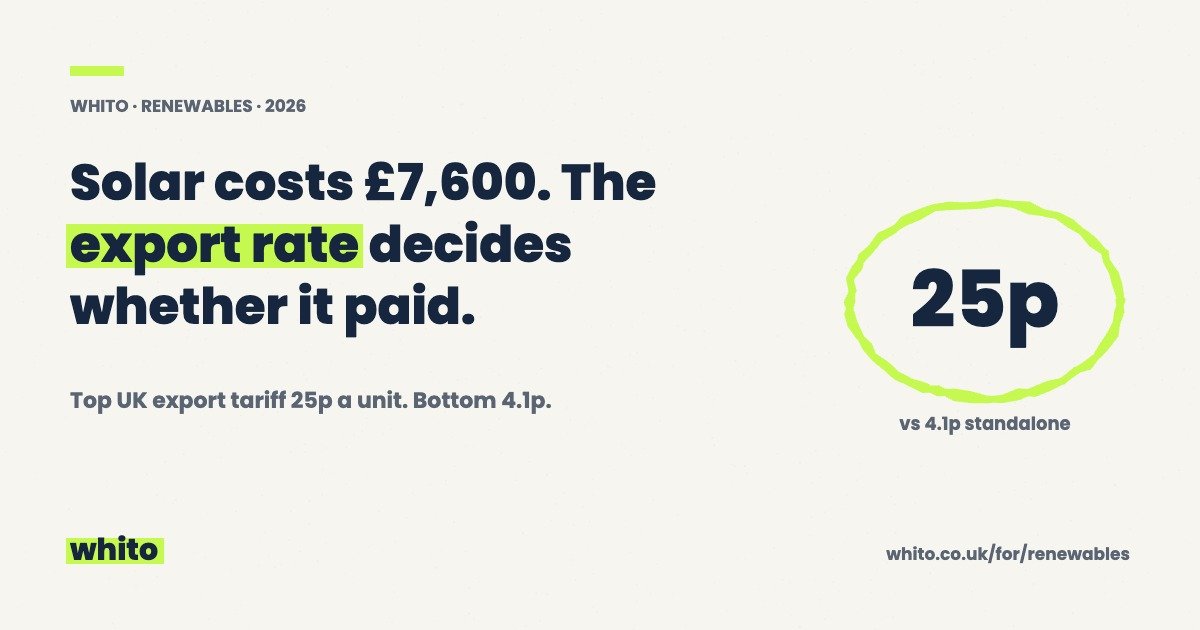
A typical UK home fits about 4.5 kilowatt peak of solar and pays around £7,600 for it. That number is easy to find. The number that decides whether the system was worth buying is the one most people never check before they sign: what a supplier will pay for the electricity the panels send back to the grid. On the rates published on 1 September 2026 that runs from 25p a unit down to 4.1p, and the top of the range is closed to you unless the supplier fitted the panels.
What a solar panel system costs in 2026
The Energy Saving Trust puts a domestic system at around 4.5 kilowatt peak costing around £7,600, on figures it says are based on fuel prices as of July 2026. MoneySavingExpert, updated on 30 July 2026, gives the same system size and about the same price.
Two independent guides give the same figure. Treat £7,600 as the anchor for a straightforward roof, then expect the quote to move with scaffolding, roof type, panel choice and whether anyone has to work around a chimney.
A battery is a separate purchase and a separate decision. If a quote bundles the two into one headline price, ask for them apart, because the payback maths for each is different.
What it saves, and why payback still takes about ten years
MoneySavingExpert puts the bill saving for a typical household with a 4.5 kilowatt peak system at between £190 and £330 a year, and says it could take a typical home at least ten years to recoup the cost.
Run the first number on its own and it does not get there. £7,600 divided by £330 a year is 23 years. Divided by £190 it is 40 years. That is Whito’s arithmetic on MoneySavingExpert’s published figures.
The Energy Saving Trust’s payback table, which counts export payments as well as bill savings, comes out at nine years in London, nine to ten in Aberystwyth, ten to eleven in Manchester and eleven to twelve in Stirling.
On these published figures the export payment carries most of the return.
The export rate depends on who fitted the panels
Export rates are not set by the government. Ofgem’s rule is only that a Smart Export Guarantee licensee must set a rate and that the rate must always be above zero. The scheme launched on 1 January 2020, and the shape of the rates published since says a good deal about what suppliers are using it for.
On MoneySavingExpert’s table dated 1 September 2026, the rates fall into three tiers, and the tier you land in has nothing to do with your roof.
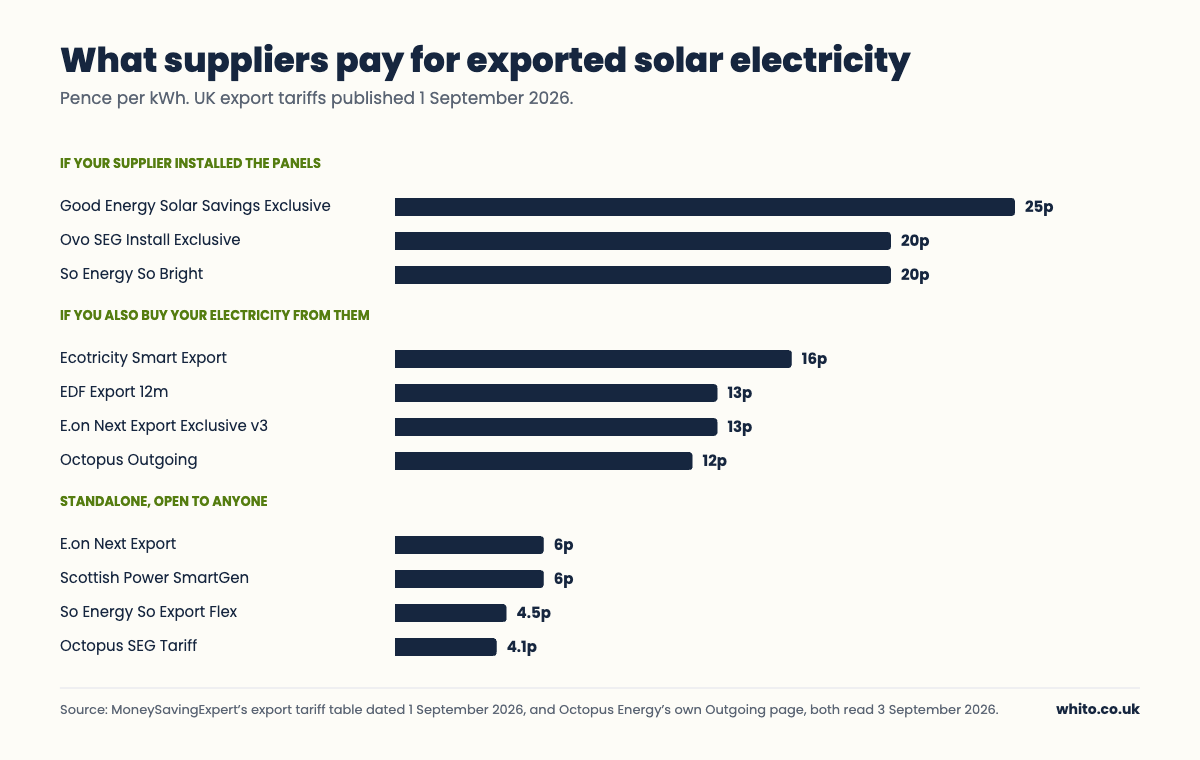
If your supplier installed the panels. Good Energy’s Solar Savings Exclusive pays 25p a unit. Ovo’s SEG Install Exclusive and So Energy’s So Bright both pay 20p. These are not open to a customer who bought from an independent installer.
If you buy your electricity from them. Ecotricity Smart Export pays 16p, EDF Export 12m and E.on Next Export Exclusive v3 both pay 13p. Octopus publishes its own numbers on its Outgoing page: 12p a unit flat, or 16p between 4pm and 7pm and 9p the rest of the day on Prime Outgoing, both requiring an Octopus import account and a smart meter that reports half hourly.
If neither applies. E.on Next Export and Scottish Power SmartGen pay 6p, So Energy So Export Flex 4.5p and the standalone Octopus SEG tariff 4.1p.
On every 1,000 units exported, 25p pays £250 and 4.1p pays £41. The roof and the panels are identical.
If a payback figure in a quote assumes a rate near the top of that table, ask which tariff it is and whether you can actually get it.
Without MCS there is no export payment at all
To qualify for the Smart Export Guarantee, MoneySavingExpert states that the system and the installer must meet the standards of the Microgeneration Certification Scheme, and that the panels must be MCS certified and rated at five megawatts or less.
That makes the certificate the thing that turns a roof full of panels into an income. Without it the panels only cut the bill. MCS runs a public Find an Installer directory, so an installer’s certification is checkable in a minute by anyone who thinks to look.
The same certificate gates the heat pump money. On gov.uk, read on 3 September 2026, the Boiler Upgrade Scheme pays £7,500 towards an air source or ground source heat pump, £5,000 towards a biomass boiler and £2,500 towards an air to air heat pump, with an extra £1,500 for homes off the gas grid running on oil or LPG until March 2027. The installer applies to Ofgem on the customer’s behalf.
How many people are actually buying this
MCS reported in February 2026 that 369,000 certified renewable installations were completed across the UK in 2025, one every 90 seconds, and 34 per cent more than in 2024. Solar PV accounted for 267,032 of them, 31 per cent above the previous record set in 2011. Heat pumps passed 60,000 and battery storage passed 40,000. Certified installations since 2009 now total 2.4 million, and the number of MCS certified installers grew 7 per cent during 2025.
The new build split is the line to read if you sell installs. 28 per cent of 2025 installations went onto new build properties, and 36 per cent of solar installations did. Better than a third of solar volume is going to housebuilders, on contracts an independent installer never gets to quote for.
What to ask before you sign
Is the installer MCS certified, and what is the certificate number. Which export tariff does the payback figure in this quote assume, and can I get it. Is the battery priced separately from the panels. What happens to the payback if I change electricity supplier next year.
Four questions. Any installer worth buying from will answer all four without going quiet.
If you fit these systems for a living
The export tier table belongs in your sales conversation. You are competing with the installer down the road and with a national supplier offering 25p a unit to anyone who buys the panels from it. You cannot match the tariff, so publish what you can: a real price range, your MCS number in text on the page, and an honest statement of which export tariffs your customers actually end up on.
Figures in this guide are published prices and rates read at source on 3 September 2026: the Energy Saving Trust and MoneySavingExpert for system costs and savings, MoneySavingExpert’s export tariff table dated 1 September 2026 and Octopus Energy’s own Outgoing page for export rates, Ofgem for the Smart Export Guarantee rules, MCS for installation volumes and gov.uk for the Boiler Upgrade Scheme. Tariffs change often and most fixed export deals last twelve months, so check current rates before you rely on them.
Whito is independent and companies cannot pay to appear. This is general information, not financial advice.
Related reading
- The heat pump price gap: what UK households really pay
- What a heat pump really costs after the £7,500 grant
- Marketing for renewable energy installers