
Last Updated on September 19, 2026

Some links in this article are commission-based, meaning we may earn a small fee if you purchase through them, at no extra cost to you. They do not buy a place in any ranking. Full disclosure: https://whito.co.uk/how-we-make-money/ and https://whito.co.uk/review-methodology/
At 23:40, somewhere in your town, a woman is lying in bed deciding she is finally getting her colour sorted, and she is holding a phone. If your website lets her book Saturday 2pm with the stylist her mate recommended, you have a client for a decade. If it says “call us to book” or, worse, “DM us”, she keeps scrolling to the salon that lets her finish the job tonight. Every other decision about your website, the fonts, the photography, the name of the pastel you paint the walls, is downstream of this one fact: in your trade, booking is the product. The website is its shop window and its till.
The rest of what we publish for salons and barbers is at whito.co.uk/hairdressers/.
The diary goes in first, everything else decorates it
Before a homepage exists, connect the booking system: your diary, your services, your stylists, your prices, live, so the site’s only truly important button has something real behind it. Fresha is the dominant option at independent scale, and its economics suit a small salon; what Fresha actually costs a salon breaks the marketplace commission model down before you commit. Whatever you choose, the tests are the same five: real-time slots per stylist, deposits for colour and no-show protection, automatic reminders, patch-test enforcement on first colour bookings, and a booking flow that finishes in under a minute on a phone. Salon software that fails any of the five is a diary with a website problem.
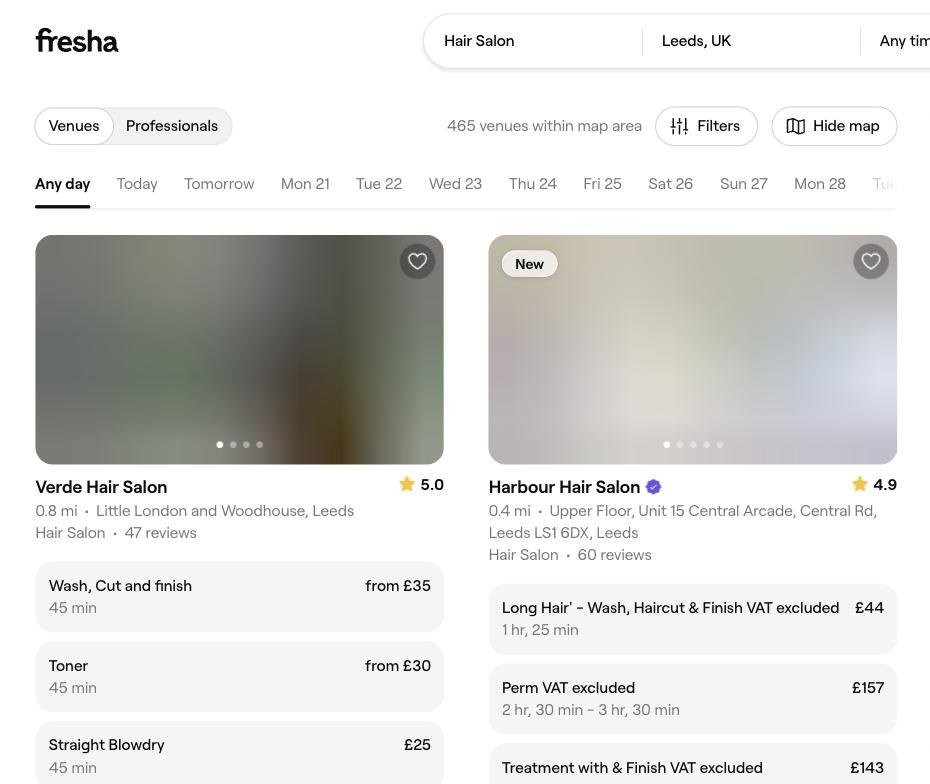
Then put the “Book” button in the top right of every page, in the colour nothing else on the site is allowed to use.
Prices are content, not confession
The strangest habit in this industry is treating the price list like a secret to be extracted by DM. Publish everything: cut and finish by stylist level, all colour services with realistic “from” prices, and the two sentences under the colour section that prevent every awkward conversation: “Colour prices are from-prices; long or very thick hair and colour correction take more time and product, and your stylist will confirm the price at consultation before anything is mixed.” That is price honesty in salon dialect, and it reads as professionalism, not smallness.
Structure the list the way clients scan it: Cuts, Colour, Treatments, Occasion. Name services in both languages, yours and theirs: “Balayage (the lived-in, grown-out-nicely colour)”. The client who does not know the word books the picture; the one who knows it respects the fluency.
An example salon price list layout with three stylist levels for cuts, colour from-prices, and a highlighted note explaining why colour prices start from a figure.
Prices are content
The price list that answers the DM
Illustrative figures; publish your own. Levels explained and from-prices defended in plain English is price honesty in salon dialect.
Clients do not rebook salons; they rebook people. The team page is therefore a product catalogue: each stylist and barber gets a photo taken in your light, their specialism in their own words (“curls and colour corrections”, “skin fades and beard work”), three photos of their own recent work, and a button that books them specifically. That button matters more than it looks: it converts the friend-recommendation, which arrives as “ask for Jade”, into a booking without a phone call, and it lets new talent build a column fast.
The quiet business logic: a stylist with a page and a book-me button is building a following your business hosts, which strengthens both the salon and the retention conversation. Their followers land on your diary.
An example stylist profile card with the stylist’s name, specialism, work photos and an individual booking button.
The team as product range
“Ask for Jade” becomes a button
The friend-recommendation arrives as “ask for Jade”. This card converts it at midnight without a receptionist, and lets new talent build a column fast.
The unglamorous page that fills Tuesdays
Somewhere on the site, one plain page answers the questions that actually decide bookings: exact opening hours including which nights you run late, parking that is true (“free after 6pm on the retail park behind us, two minutes’ walk”), how walk-ins work at the barbershop end, deposits and the no-show policy in human words, and the patch-test rule with the why (“new colour clients need a patch test 48 hours ahead; it is skin safety, not ceremony, and you can pop in for it without an appointment”). Late-night opening deserves headline treatment, not a footnote: “Open until 8pm Thursdays” is, for the commuting client, the entire buying decision.
Proof, in a trade where everyone can see your work
- Your own work only. Every photo of hair on the site came out of your chairs. Borrowed Instagram colour is theft a reverse-image search exposes, and clients do search. Shoot finished work in the same spot by the window, same angle, and the feed becomes a portfolio automatically. Any decorative imagery you buy must be licensed for use without attribution.
- Google reviews with names in them. “Jade fixed a colour disaster from another salon” is the review that books three strangers. Ask at the till, while the mirror moment is still warm.
- Your Google Business Profile is half your bookings. Categories right (“Hair salon” or “Barber shop” primary), hours exact, photos recent, and the booking link connected so slots are bookable from the profile itself. For “near me open now” searches, which is most barbershop demand, the profile is the website.
Instagram is the trailer; the site is the cinema
Instagram shows the work and the personality; it is where the colour-curious lurk for months. What it cannot do is show live availability, hold a deposit, enforce a patch test or survive an algorithm mood swing. So run them as a system: every post’s profile link goes to the booking page, the site embeds a current feed strip so the homepage never looks stale, and “DM to book” is retired as a sentence. DMs are where bookings go to die politely: unanswered at busy times, unpaid, undeposited, and unprotected against the no-show who would never have skipped a £20-deposited slot.
Five seconds, freshly recommended
The test for your fold: a stranger, sent by a friend, five seconds on a phone. They must see the salon’s name and town, one photo of work that looks like them, the price signal (“cuts from £34, balayage from £120”), late nights if you run them, and the Book button. Not a manifesto about your passion for hair. The passion is visible in the balayage.
Build route: Squarespace, and this is the trade it was made for
The three ways a salon gets a website built: doing it yourself on a website builder (£15–£25/mo), hiring a freelancer (£500–£1,200), or a monthly website deal (£40–£100/mo).
The three build routes
What a salon website costs in 2026
Do it yourself
£15–£25/mo
Squarespace plus your booking system embedded. The one trade where the design-led builder earns its default.
Freelancer
£500–£1,200
Buys taste and a finished weekend if you supply photos, prices and this structure.
Monthly deal
£40–£100/mo
Rarely needed. The booking platform’s free mini-site can hold a one-chair studio for a season.
The bands this guide uses throughout, side by side. Full reasoning in the build-route section below.
Default: Squarespace, £15 to £25 a month (check current plans), with the booking system embedded. This is the one trade in this series where the design-led builder earns its default: a salon site is closer to a fashion brand’s than a plumber’s, image-first templates reward your photography, and the whole build is four pages plus a diary you already run elsewhere. The comparisons behind the pick: best website builders UK and Wix vs WordPress vs Squarespace.
When not to use it: if the booking platform’s own free mini-site is genuinely doing everything, a very new one-chair studio can live on that plus a Google Business Profile for a season; build the real site when the prices and the team stop fitting. And a multi-site salon group with a training academy and product line has outgrown builders altogether; that is a WordPress project with hosting (Hostinger) to match.
A freelancer at £500 to £1,200 buys you taste and a finished weekend if you supply photos, prices and this structure.
The domain is the salon’s, from its own account: fable-and-fringe.co.uk energy, whatever matches the fascia. Check current Namecheap domain pricing (the renewal trap is covered in our review) and register it yourself with auto-renew on, so the brand on the window is the brand in the address bar for as long as you trade.
Price list cards for the window and the till, and the “meet the team” frames for launch posts, are Canva work: one template, updated whenever prices change, matching the site because you copied the site’s two colours into it.
Two salon homepages, five seconds apart
The moodboard: full-screen video of slow-motion hair, a serif word (“beauty.”), a hamburger menu hiding everything, “DM to book” in the bio energy, no prices, no hours. Gorgeous. Books nobody at midnight.
The till: one great colour photo from your own chair, “Fable & Fringe, Stockbridge. Cuts from £34, balayage from £120. Open late Thursdays.” Book button glowing top right. Jade’s card two scrolls down. The 23:40 client is asleep now, appointment confirmed, deposit paid.
Seven ways salon sites lose the midnight booking
- “Call to book” as the only route, on a site visited mostly after closing.
- No prices, sending the colour-curious to DM purgatory or a rival’s published list.
- A team page with no individual booking buttons, wasting every “ask for Jade”.
- Borrowed photography one reverse-image search from embarrassment.
- Patch-test policy revealed at checkout, detonating the first-time colour booking.
- Hours and parking missing, the two facts that decide the commuter’s Tuesday.
- A dead Instagram embed, timestamping the neglect on the homepage.
Fifteen checks before the launch post
- Online booking live for every service and every stylist, tested on a phone at night.
- Deposits on colour and the no-show policy in human words.
- Patch-test rule stated at booking and on the practical page, with the why.
- Full price list published, levels explained, colour from-prices defended.
- Every stylist has a card: photo, specialism, three work shots, individual book button.
- Late nights and parking on the homepage, not buried.
- Walk-in policy stated (barbers especially).
- Every hair photo is your own; anything decorative licensed without attribution.
- Book button top right on every page in its own colour.
- Google Business Profile: correct category, exact hours, booking link live, photos under three months old.
- Five Google reviews, at least two naming a stylist.
- Instagram profile link points at the booking page; site embeds a live feed strip.
- Domain in the salon’s own Namecheap account, auto-renew on.
- Google Search Console verified, sitemap in; free, and it will show whether “balayage [town]” is finding you.
- Someone’s mum has booked a cut with a specific stylist without help or a phone call.
The first month behind the new till
Week one: staff say “you can rebook online tonight” at every till moment, and the reminder card in Canva says the same. Week two: watch where bookings abandon (your booking tool shows the step); the usual culprit is a service list organised for stylists instead of clients, so rename in client language. Week three: Search Console will show your first queries; if a stylist’s name appears, their card just earned a bigger photo. Week four: post the “we’re open late Thursdays” graphic, link the booking page, and count the Thursday column fill; that number is the website, measured.
Four questions from behind the chair
Fresha’s own page already takes bookings. Why a website? The marketplace page books people who found you; the website convinces people deciding between you and two rivals, with your prices, your people and your work in your own frame. And on a marketplace you are one swipe from a discount competitor; on your site you are the only salon in the room.
Do barbers really need this, or just a Google profile? A walk-in barbershop lives off the profile and exact hours. Add queue or booking tech the day the Saturday line frustrates people, and a one-page site with prices and faces the day you raise prices past the shop next door.
Should prices really include the expensive stuff? Especially the expensive stuff. The £180 colour correction booked by someone who read what it involves and paid a deposit is your best appointment of the week. The same client arriving expecting £60 is your worst.
What about TikTok and Instagram replacing all of it? They feed it. Social wins attention, the site converts attention into deposited bookings while you sleep. The salons that boomed off one viral video all had somewhere for the wave to land; be the wave with a harbour.