
By Jacob Whitmore · Published
Short answer: If you run a UK business from any premises, someone has a legal duty to carry out a fire risk assessment, keep it up to date and, in England and Wales, record all of it in writing. That someone is usually you. You can do it yourself if you are competent to. If you pay someone, they must be competent, and you should check that before you book.
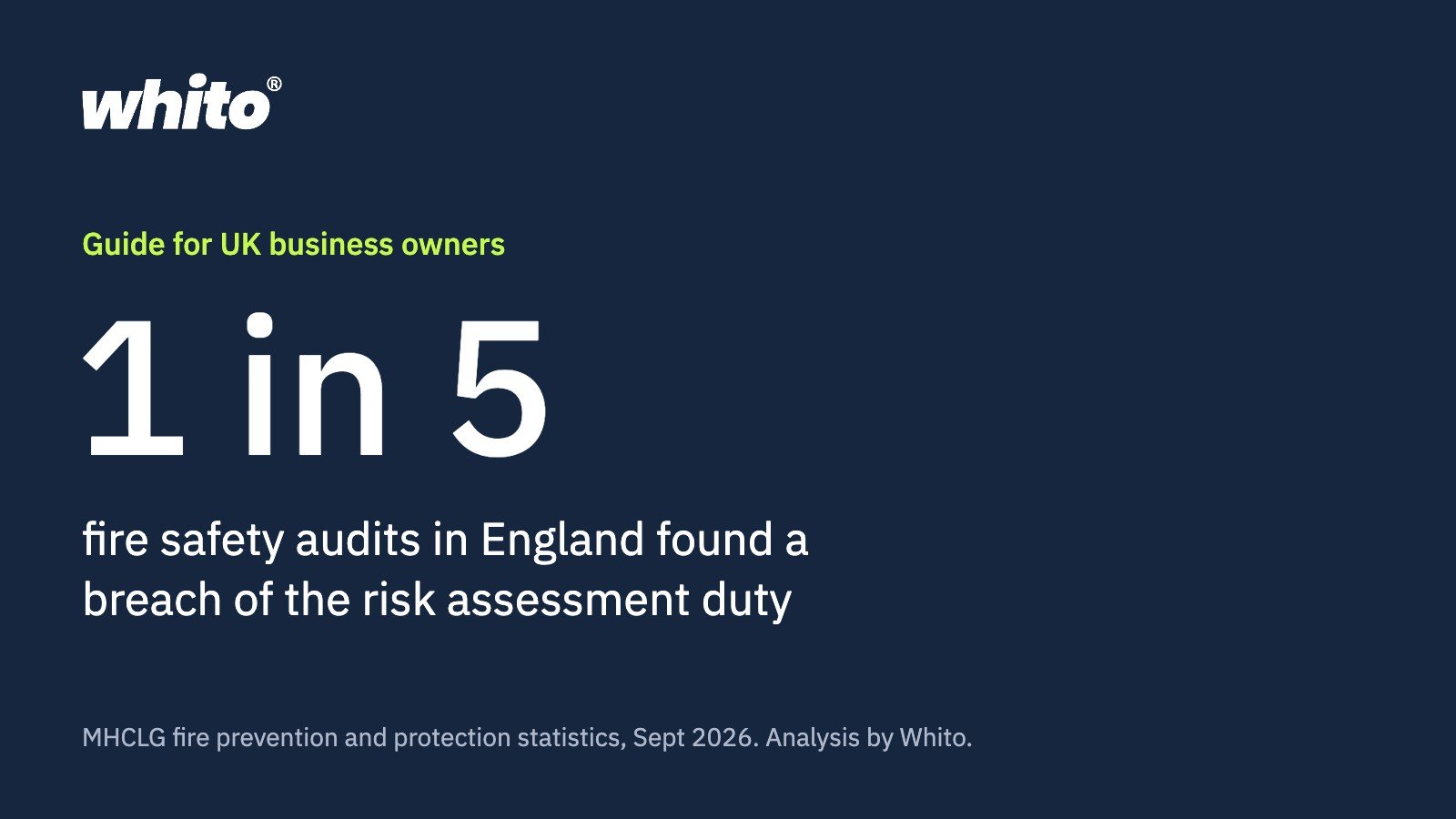
Fire services in England found a breach of the risk assessment duty in 9,271 audits in the year to March 2026, 18.5% of all audits, according to MHCLG figures published 2 September 2026. It is one of the most common reasons a business fails a fire safety audit, and one of the cheapest to fix.
This guide covers England and Wales unless it says otherwise. It is not legal advice. Sources were opened and checked on 24 November 2026.
Who has to do it
GOV.UK calls this person the “responsible person”. It is the employer, owner, landlord, occupier or anyone else with control of the premises, such as a facilities manager or managing agent. Where several people share control, for example a landlord and a tenant, they have to work together. The rules also cover businesses with paying guests, such as B&Bs and holiday lets.
What the responsible person must do
- Carry out a fire risk assessment and review it regularly.
- Tell staff or their representatives about the risks found.
- Put in place, and maintain, the right fire safety measures.
- Plan for an emergency.
- Give staff fire safety information, instruction and training.
What changed on 1 October 2023
Section 156 of the Building Safety Act 2022 amended the Regulatory Reform (Fire Safety) Order 2005. London Fire Brigade’s summary of the changes lists these for every responsible person:
- Record everything. The whole fire risk assessment must be written down, whatever the size of the business. Before, only significant findings had to be recorded, and only if you had five or more employees, a licence or an alterations notice.
- Record your fire safety arrangements: how fire safety is managed, such as procedures and policies.
- Name the assessor. Record the full name, and organisation if any, of anyone you pay to carry out or review the assessment.
- Use someone competent. Anyone appointed to help must have enough training, experience or knowledge.
- Give a UK address for notices, and share it with other responsible persons at the same premises.
- Hand over information to whoever takes over responsibility when you leave.
Some offences now carry an unlimited fine, including failing to give an inspector a copy of your fire risk assessment when asked.
Can I do my own fire risk assessment?
Yes, if you are competent to. For a small, simple premises, such as a single-storey shop or office with no one sleeping there, many owners do. Use the government’s guidance for your type of premises and record the result.
Pay for help if any of these apply: people sleep on the premises; you have a commercial kitchen; you store flammable stock; the building has several floors or shared escape routes; or you are not sure what the alarm and lighting systems should be. An audit is not the moment to find out your own assessment missed something.
How much a fire risk assessment costs
We collected the published starting price for an on-site assessment of small business premises from 16 UK providers on 24 November 2026. The middle price was £249. The full table, with each provider’s stated certification, is in our fire risk assessment price and register check.
How to check an assessor before you book
- Ask which scheme they are on. Company schemes include BAFE SP205. Individual registers include those run by the Institution of Fire Engineers (IFE), the Institute of Fire Safety Managers (IFSM) and the Fire Protection Association (FPA).
- Check the register yourself. A logo on a website is a claim. The register is the evidence. BAFE’s register can be searched by scheme and region.
- Ask who will visit. A company can hold a certificate while the person who walks your building is someone else.
- Ask what the report includes. You want findings specific to your premises and a dated, prioritised action plan.
- Be wary of a “fire safety certificate”. The law asks for an assessment, not a certificate.
How often to review it
The law says “regularly” and gives no fixed period. Review it whenever something changes: a refit, a new layout, more staff, new equipment, a change of use, or after a fire or near miss. Many businesses set an annual review date so it does not slip.
Scotland and Northern Ireland
Different laws apply. In Scotland the duties come from the Fire (Scotland) Act 2005 and the Fire Safety (Scotland) Regulations 2006. In Northern Ireland, guidance comes from the Northern Ireland Fire and Rescue Service. GOV.UK’s workplace fire safety page links to both. The principle is the same: assess the risk, act on it and keep it current.
The takeaway
A written, dated, premises-specific fire risk assessment is the cheapest protection a business can buy against a prohibition notice. Fire services in England issued 1,224 of those in the year to March 2026, up 55% on 2019/20. See the UK fire safety enforcement report for the full figures.
Sources
- GOV.UK: Fire safety in the workplace
- London Fire Brigade: Changes to fire safety law, how it affects you
- GOV.UK: Check your fire safety responsibilities under Section 156 of the Building Safety Act 2022
- MHCLG: Fire prevention and protection statistics, England, April 2025 to March 2026
- BAFE Register Search
More on this sector: the Whito fire safety industry hub.