
By Jacob Whitmore · Published · Updated
Most CRMs promise everything: automation, AI, enterprise power and an all-in-one ecosystem. Pipedrive promises something simpler, which is a clear view of your sales pipeline.
Note: Pipedrive is the best first CRM for UK service businesses with 1 to 10 employees. It does one thing well: pipeline management. If you need email marketing, landing pages, or complex automation, you will need additional tools alongside it.
The question is whether it stays simple enough as you grow.
Note: Pipedrive scales well to about 5 to 10 salespeople. Beyond that, businesses typically outgrow it and move to HubSpot or Salesforce. If you expect rapid team growth, factor migration costs into your decision now.
The Whito stage check
What Pipedrive is built for
Pipedrive is built for sales first and marketing second. It focuses on:
- Visual deal pipelines
- Activity tracking
- Sales forecasting
- Contact management
- Basic automation
It is designed for teams that sell actively, rather than for complex inbound marketing automation.
Where Pipedrive is strong
For UK businesses with active sales processes, Pipedrive excels at:
- Clear deal stages
- Drag-and-drop pipeline management
- Activity reminders
- Sales accountability
- Easy reporting
It makes it obvious where every deal stands, and that alone tends to help close rates.
Ease of Use
One of Pipedrive’s biggest advantages is that it is intuitive. Setup is quick, the interface is clean and new users get going fast. Sales teams actually use it, and a CRM people use beats a more powerful one they avoid.
Pipedrive in practice: A UK business example
An illustrative example. Take a Manchester recruitment agency that places candidates regularly. Revenue is decent and the sales team is small, but deals are falling through the cracks, follow-ups get missed, and nobody can tell which consultant is performing or why. The team is busy without being productive.
What Pipedrive shows them
They set up a five-stage pipeline in an afternoon.
Within days, the whole picture is visible. Two warm candidates have been sitting untouched for three weeks. One consultant has twelve open deals, but no activity logged against any of them. The highest-value clients are getting the least attention.
None of this was obvious before. The team wasn’t the problem. Nobody could see what was going on.
What they do next
They define clear pipeline stages. They set mandatory activity reminders. Every call and meeting gets logged.
Within 60 days, close rates improve. The team hasn’t got better overnight. It’s just that nobody can hide behind an empty pipeline any more.
It is a simple system, used every week, with no automation or upgrade needed.
The caveat
Pipedrive won’t make your team sell better, but it makes it much harder to pretend they are.
Someone still needs to review the pipeline weekly, hold the team accountable, and act on what the data shows. A CRM that nobody checks is just an expensive contacts list. The discipline has to come first, and the tool supports it.
Pricing (UK Context)
Typical pricing tiers:
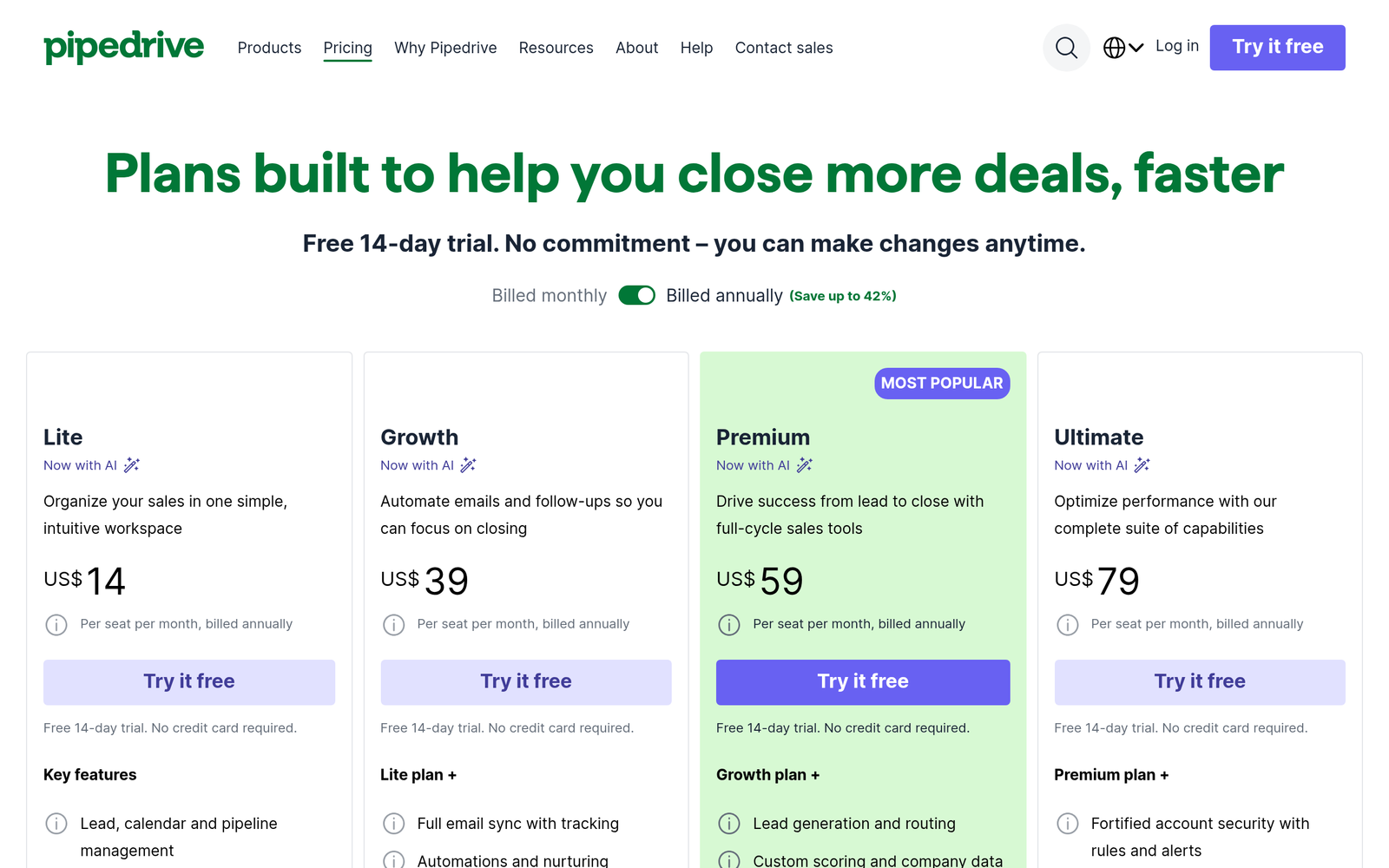
- Lite: £14 per seat/month billed annually (£168 a year), or £24 billed monthly
- Growth: £39 billed annually, £49 monthly. Premium: £59 annually, £79 monthly
- Ultimate: £79 annually, £99 monthly. Add-ons such as Campaigns start from £13.33 a month (checked 15 September 2026)
Where Pipedrive falls short
Pipedrive isn’t a full marketing suite. It has:
- Limited built-in marketing automation
- No deep content management
- Fewer advanced inbound tools
You may need integrations, or a CRM built more around marketing, if your growth relies heavily on:
- Automated email nurturing
- Complex lifecycle tracking
- Multi-channel marketing attribution
Pipedrive vs HubSpot
Pipedrive:
- Simpler
- Sales-focused
- Lower entry cost
- Easier to adopt
HubSpot:
- Stronger marketing automation
- Deeper reporting
- Broader ecosystem
- Higher scaling cost
If you need sales clarity first, Pipedrive is often enough.
If you need marketing-sales integration at scale, HubSpot may win.
Pipedrive vs Zoho
Pipedrive:
- Cleaner user experience
- Faster setup
Zoho:
- More customisation
- Broader tool suite
- Slightly steeper learning curve
Zoho can be more flexible, but Pipedrive is often easier.
Does Pipedrive actually scale?
It scales well for:
- Service-based businesses
- B2B firms
- Recruitment agencies
- Consultants
- Sales-driven organisations
It may struggle if:
- You require enterprise-level customisation
- You need deep marketing automation
- Your reporting needs are highly complex
For most growing UK businesses, it scales far enough.
Beyond that, complexity usually increases across the whole business, not only in the CRM.
The real risk
The main risk with Pipedrive is complacency. If you:
- Do not define pipeline stages
- Do not enforce activity tracking
- Do not monitor close rates
- Do not review forecasts
then even the best CRM is just for show. How disciplined your process is decides how far you can scale.
Who should choose Pipedrive
Choose Pipedrive if:
- You want clarity over complexity
- You have an active sales team
- You need pipeline visibility
- You want quick adoption
- You prefer simplicity over feature overload
Avoid it if:
- Marketing automation is central
- You need deep lifecycle segmentation
- You want a full marketing ecosystem
The Whito view
Our reading: Pipedrive does one job well, moving deals down a pipeline. Its 2025 plan rename means older reviews can mislead: entry is now the Lite plan at £14 a seat a month on annual billing, before VAT. UK data sits in a London data centre, which is one of its most useful features for UK firms.
Related reviews from Whito
Pipedrive: Common questions before you commit
Is Pipedrive good for a UK business?
Yes, especially if you have an active sales process and need clear pipeline visibility. It’s built for teams that sell consistently, not for heavy marketing automation.
Does Pipedrive replace marketing software?
No, it’s sales-first and light on built-in marketing automation. If lifecycle email, attribution, and content marketing are central to your strategy, you’ll likely need integrations.
Is Pipedrive better than HubSpot?
It’s simpler, easier to adopt, and lower cost at entry level. HubSpot offers deeper marketing tools and reporting, but with greater complexity and higher scaling costs.
Will Pipedrive scale as we grow?
For most service and B2B businesses, yes. If you require enterprise-level customisation or advanced marketing ecosystems, you may eventually outgrow it.
See how real UK businesses do this well
Our Stolen With Pride series looks at marketing that worked for real UK businesses, and what a smaller firm could copy from it. See how Surreal Cereal turned LinkedIn into a free marketing channel, how Bloom & Wild’s email opt-out built more loyalty than any campaign, and more.