
By Jacob Whitmore · Published
Read a short summary
General summary
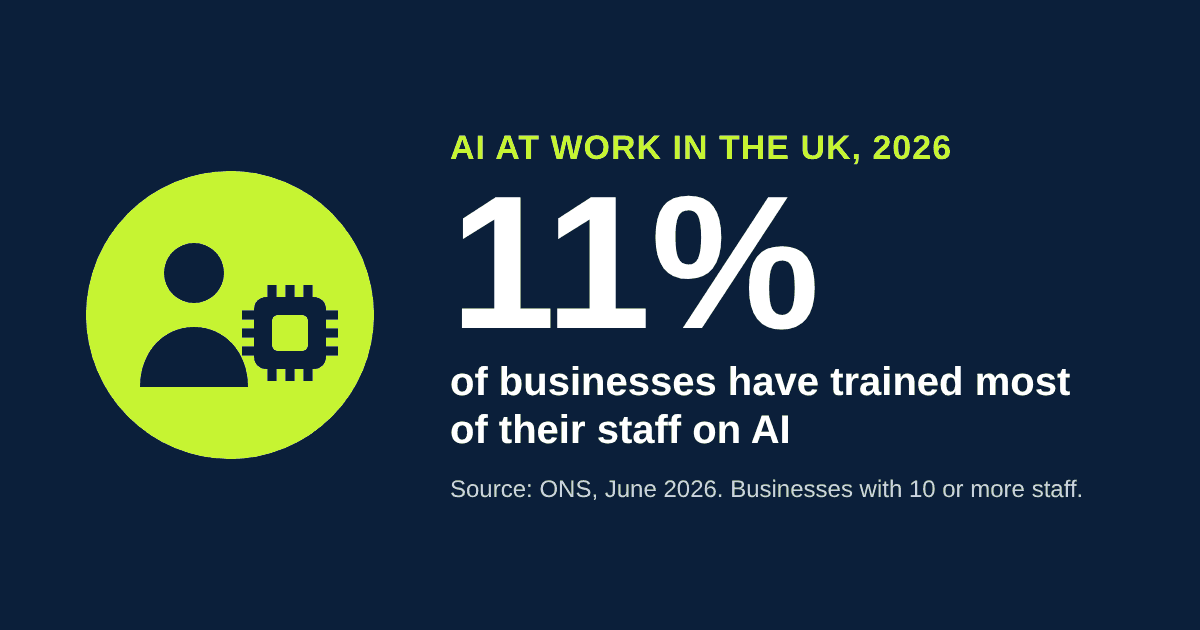
Official figures show AI has not changed headcount at most UK businesses so far. The bigger gap is training: only 11% of businesses with 10 or more staff say more than half their workforce has had AI training, while 55% of employees say they use AI. Skills, not cost, are the main barrier.
Bullet points
- Only 11% of businesses (10 or more staff) have trained more than half their workforce on AI (ONS).
- 55% of employees say they use AI for work or education (ONS).
- Around half of businesses say AI has not changed their headcount (ONS).
- 67% of businesses using AI say limited AI skills affect them (DSIT).
- 81% keep a human checking AI output (DSIT).
Basic explainer
Lots of people already use AI at work, but few businesses have trained most of their staff to use it. So far AI is changing tasks more than it is changing job numbers.
Updated 26 November 2026. Every figure on this page comes from the Office for National Statistics (ONS) or the Department for Science, Innovation and Technology (DSIT), and is linked to the source.
Most talk about AI and jobs is about job losses. The official numbers tell a different story.
AI has not cut many jobs yet. What it has done is move faster than training. More than half of employees say they use AI for work or education. Only around one in nine businesses with 10 or more staff has trained more than half of its workforce.
That is the real gap for 2027. Not robots replacing people. People using tools they have not been trained to use.
The figures to quote
| Figure | Source | Survey period |
|---|---|---|
| Only 11% of businesses (10 or more staff) say more than half their workforce has had AI-related training | ONS, Artificial intelligence in UK businesses: 2023 to 2026 (20 July 2026) | June 2026 |
| 55% of employees report using AI for work or education | ONS, same article (Opinions and Lifestyle Survey, Great Britain) | May to June 2026 |
| About 35% of businesses (10 or more staff) use at least one AI technology, up from about 12% in late 2023 | ONS, same article | June 2026 |
| Around half of businesses say AI has not changed their overall headcount | ONS, same article | June 2026 |
| Just under 7% of medium-sized businesses report AI has reduced headcount, the highest of any size band | ONS, same article | June 2026 |
| Around 10% of businesses report automating or replacing roles with AI | ONS, same article | June 2026 |
| 67% of businesses using AI say limited AI skills, expertise or knowledge affects them | DSIT, AI adoption survey report 2026 (29 October 2026), 3,503 businesses | 7 January to 21 April 2026 |
| 81% of businesses apply some human input or oversight to what AI produces | DSIT, same report | 7 January to 21 April 2026 |
Which to quote: for training, use the ONS 11%. For skills as a barrier, use the DSIT 67%. Do not set the ONS and DSIT figures against each other as a trend. They ask different businesses different questions at different times.
The mistake: treating AI as a headcount story
The headlines say AI is coming for jobs. So far, UK businesses say otherwise.
The ONS asked businesses what AI had done to their overall headcount. Across every size band, around half said it had made no difference. A large share said they were not sure or that it did not apply to them.
Cuts are reported, but by a small minority. Medium-sized businesses report the most, at just under 7%. Smaller firms report slightly less.
Where cuts do show up, they sit with businesses using AI to improve how they run. Of those, 63% reported no change in headcount, 1% an increase and 6% a decrease.
The ONS’s own reading is that the effect on employment “remains limited at this stage”.
The real story: workers are ahead of the training
The bigger shift is inside jobs, not in job numbers.
- Workers use AI more than businesses do. 55% of employees say they use AI for work or education. About 35% of businesses with 10 or more staff say the business uses an AI technology. The ONS says this may partly reflect people using AI tools on their own as part of their daily work.
- Training is the main response, but it is thin. Training or retraining existing staff is the most common way businesses bring in AI skills, at around 40% of medium to large firms. Yet only 11% say more than half their workforce has been trained.
- Hiring for AI skills is rare. Recruiting new staff with AI skills runs from around 2% of the smallest businesses to 10% of those with 250 or more staff.
- Use is wide, not deep. Only 10% of adopting businesses with 10 or more staff say they use AI extensively. 15% say more than half their employees use it in daily work.
Skills are the bottleneck, not cost
Both government surveys point the same way.
- DSIT found limited AI skills, expertise or knowledge affected 67% of businesses already using AI, and 78% of those planning to.
- DSIT found cost was more often about the time and effort to embed AI than the price of the tools.
- The ONS found businesses that cite a lack of AI expertise are far more likely to train staff: around 62%, compared with around 26% of businesses reporting no barriers.
Which roles are changing
The ONS asked which roles AI had affected. The answer depends on the type of AI.
- Over half of businesses using AI to create visual content report effects on creative or design roles.
- 53% of businesses using AI image processing report effects on administrative or clerical roles, and on creative or design roles.
- Businesses using machine learning on data most often report effects on administrative or clerical roles (41%) and data analysis roles (39%).
“Affected” here means the business reported an impact on that role. It does not mean jobs were lost.
What the figures mean for a small business
Structure before scale applies here too.
- Find out who is already using AI. Ask your team which tools they use and for what. The ONS figures suggest many staff will be using AI whether or not the business has decided to.
- Pick one or two jobs to do well. DSIT found administration (81%) and marketing (71%) are the most common uses among businesses using or planning AI. Start where the work is routine and easy to check.
- Show people how, then check the output. 81% of businesses keep a human checking AI output. Keep doing it, especially on anything a customer will see.
- Measure the time saved, not the tools bought. DSIT found 64% of businesses saw no immediate effect on operating costs. If AI is not saving hours you can name, it is not yet paying its way.
How we built this page
- We read the ONS article Artificial intelligence in UK businesses: 2023 to 2026 (released 20 July 2026) and the DSIT AI adoption survey report 2026 (published 29 October 2026) in full on 26 November 2026.
- The ONS business figures come from the Business Insights and Conditions Survey, wave 159 (June 2026, 38,637 responding businesses, 26.7% response rate). Many figures cover businesses with 10 or more employees only; we say so where that applies. The survey excludes some industries, including finance and insurance, and public sector health and education.
- The ONS employee figure (55%) comes from a different survey, the Opinions and Lifestyle Survey, covering Great Britain from May to June 2026. It is not directly comparable with the business figures.
- The DSIT figures come from 3,503 telephone interviews with UK businesses between 7 January and 21 April 2026.
- The ONS describes its newest questions on extent of use and training as early indications. Treat them that way.
- We have not added estimates, adjusted figures or combined surveys. Wording follows the sources.
This page reports official survey figures. It is general information, not employment, legal or HR advice.
Free to cite
You are welcome to use any figure on this page. Please credit the original source (ONS or DSIT) and link to this page.
Suggested credit: Whito, citing ONS, “AI at work in the UK: 2026 statistics”, whito.co.uk/research/uk-ai-workforce-statistics/, updated 26 November 2026.
Related: UK AI adoption statistics 2026.
The takeaway
AI has not emptied UK offices. It has filled them with people using tools most have not been trained on. Fix the training before you buy the next tool.
How to read this study
The figures show what Whito found in the sample and on the dates stated on this page. They describe the businesses, prices or answers we looked at, not every UK business. Prices and AI answers change over time. Every Whito study follows our research methodology standard. Spotted an error? Tell us and we will check it.
If your business is named here and you think we have a fact wrong, email contact@whito.co.uk and we will check it and correct it. If you want to respond, send us a statement and we will publish it alongside. Full detail: Corrections, right of reply and removals.