
By Jacob Whitmore · Published
Read a short summary
General summary
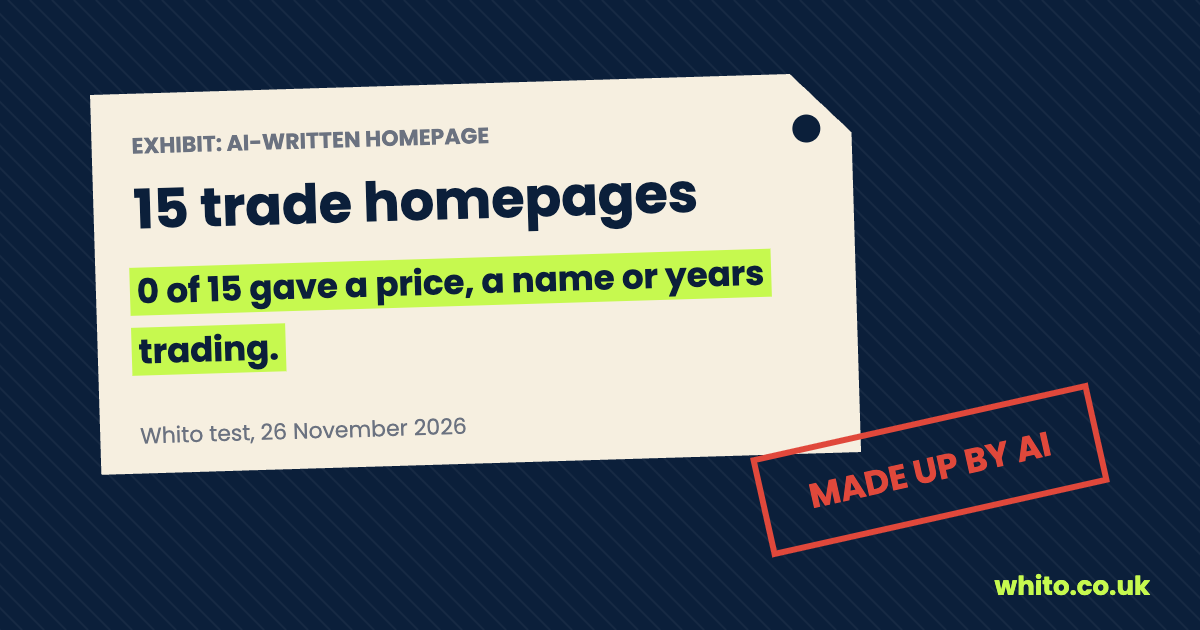
Whito asked an AI tool to write 15 UK trade homepages, three each for plumbers, electricians, locksmiths, heating engineers and dental practices, with no facts supplied. Not one page gave a price, a person’s name or how long the business had traded, while 12 said the business was insured and 11 named a registration or check the tool was never told about. All 15 outputs are published unedited.
Bullet points
- 0 of 15 AI pages gave a price, a name or years trading
- 12 of 15 said the business was insured without being told
- 11 of 15 named a registration, check or standard on their own
- 3 of 15 included a made-up customer review
- Each trade has its own annotated post and rewrite
Basic explainer
We asked AI to write 15 trade websites. It made up claims and left out prices and names.
One plain request, five trades, three cities each. The pages read well. They were also largely made of claims the tool invented, with the facts customers need left out.
A lot of UK trades now get their website copy from ChatGPT or a tool like it. The pages come back fast and sound professional. We wanted to know what is actually in them.
So we asked one AI tool to write 15 homepages: three each for plumbers, electricians, locksmiths, heating engineers and dental practices, in 14 towns and cities. We typed the request most owners type and gave it no facts about the business.
Then we went through every page line by line and asked one question of each claim: did we tell it that?
Key takeaways
- Not one of the 15 pages gave a price, named a person or said how long the business had traded. Those are the facts customers compare on.
- 12 of the 15 said the business was insured and 11 named a registration, check or standard. The tool was told none of it.
- 3 pages, all for electricians, included a customer review the tool wrote itself, signed with a real neighbourhood.
- Within each trade, the three pages were close to interchangeable. Swap the place names and you would struggle to tell them apart.
What 15 AI-written homepages said
Source: Whito AI homepage test, 26 November 2026. 15 pages written by Claude Sonnet from one plain request each, unedited.
Trade by trade
Each trade has its own post with one page shown in full and annotated, all three outputs unedited, and a rewrite you can copy.
- Plumbers: 3 of 3 said Gas Safe. We never told it.
- Electricians: 3 of 3 invented a customer review.
- Locksmiths: 3 of 3 said no hidden fees. 0 showed a price.
- Heating engineers: 3 of 3 left the register number as [XXXXXX].
- Dental practices: 3 of 3: “Welcome to Your [City] Dental Practice”.
Why this matters for your enquiries
A customer comparing three trades online is looking for a reason to pick one. AI copy gives every business the same reasons, so the customer falls back on price, reviews or whoever answers first.
Worse, the tool fills the space where your facts belong with promises: insured, guaranteed, checked, within the hour. They sound safe. Whether they are true is down to you, and the tool never asks.
This is a Start-stage problem, not a tools problem. Before any copy gets written, by you or by AI, write down the facts a rival cannot copy: where you work, what you do and do not do, a real price, who turns up, and your real reviews.
The takeaway
AI writes the parts of your homepage that every rival shares. The parts that win the job are the ones only you know. Give it those, or write them yourself.
How we ran the test
On 26 November 2026 we used Claude Sonnet, Anthropic’s AI assistant, in a fresh session for each trade. We typed “Write the homepage copy for my [trade] business in [city]” (for dentists, “my dental practice in [city]”) three times per trade, changing only the city, and gave no other information. Cities: plumbers in Leeds, Bristol and Norwich; electricians in Manchester, Glasgow and Cardiff; locksmiths in Birmingham, Leeds and Brighton; heating engineers in Sheffield, Belfast and Nottingham; dental practices in York, Edinburgh and Exeter.
We did not edit any output. Counts come from a simple text search, checked by reading each page. “Insured” counts any page that said the business was insured. “Registration, check or standard” counts pages naming Gas Safe registration, DBS checks, OFTEC registration or the BS 7671 wiring regulations. “Response time” counts “within the hour”, “same day” or “within 24 hours”.
This is a small test of one tool on one day. AI tools give different wording each time and other tools may differ. It shows what the default request produces, not what every AI tool always writes. The full text of all 15 pages is published in the five trade posts.
Free to cite. You can quote or chart any figure on this page, as long as you link back to it. Suggested credit: Whito, “We Asked AI to Write 15 UK Trade Homepages. Not One Included a Price”, 26 November 2026, whito.co.uk/research/ai-written-trade-homepages-test/
Journalists and trade bodies: the full, unedited tool output for all 15 pages is in the five trade posts linked above, so you can check every count yourself.
How to read this study
The figures show what Whito found in the sample and on the dates stated on this page. They describe the businesses, prices or answers we looked at, not every UK business. Prices and AI answers change over time. Every Whito study follows our research methodology standard. Spotted an error? Tell us and we will check it.
If your business is named here and you think we have a fact wrong, email contact@whito.co.uk and we will check it and correct it. If you want to respond, send us a statement and we will publish it alongside. Full detail: Corrections, right of reply and removals.